Добрый день, Коллеги. Важное сообщение, просьба принять участие. Музей Ферсмана ищет помощь для реставрационных работ в помещении. Подробности по ссылке
The continually rising standards of petroleum geoscience and oil search require an ever greater knowledge of the fundamental nature of petroleum, its origin, and its behavior in the rocks of the earth’s crust. In the early stages of the petroleum era, most oil men were not much concerned about the how, why, and when of oil and gas; all they cared to know was where. Those years are gone, and it is now more and more recognized that the how, why, and when of petroleum are critical keys to where it should be sought.
Chemistry is familiar enough; fire and fermentation are cornerstones of human civilization, and the beaker and the test tube are readily recognizable icons in most of the world. Flow is even more familiar; everyone has seen a river, felt the wind, taken a pulse. Though they are rarely on the center stage, fluids that undergo chemical reactions as they flow also impact an astonishingly large number of human experiences. Examples of this include air purification, electro-chemical transport within the human brain, blood and air flow through lungs, flow through kidneys, catalytic converters, tooth decay, deterioration of historic objects, and nearly every large-scale manufacturing process, from semiconductors to paper. Besides the sheer number, the diversity of this list is impressive.
Ruby as a natural gemstone has an early history in which its colorful properties [1] were much valued in ornamental and symbolic jewelry by potentates and other persons of power and prestige [2,3]. This appreciation has extended into latter times and more so into the more general populace. It is an important gem for scientific study [4] and for exploration quests to find new ruby deposits [5,6].
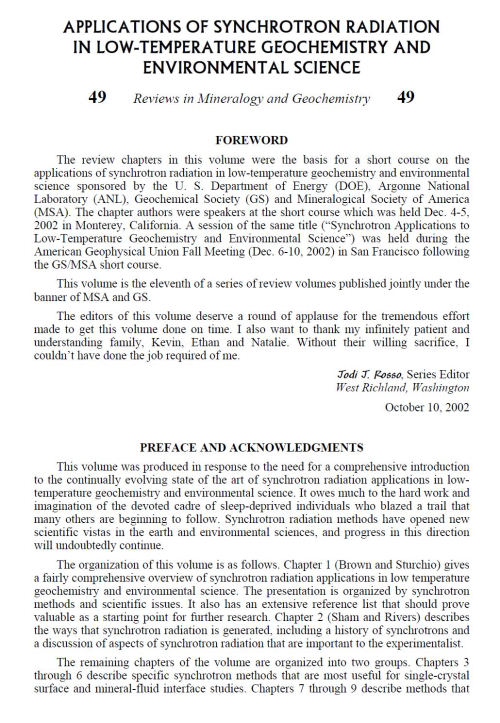
The review chapters in this volume were the basis for a short course on the applications of synchrotron radiation in low-temperature geochemistry and environmental science sponsored by the U. S. Department of Energy (DOE), Argonne National Laboratory (ANL), Geochemical Society (GS) and Mineralogical Society of America (MSA).
All symbols used in the present work are defined at the appropriate place in the text, which can be found by reference to the index at the end of the volume. The units defined below, and the symbols by which they are identified, are confined to a general list of those most commonly used in the present work; other units will be defined where necessary in the text itself. It must be noted that a number of traditional units have been retained as a matter of policy throughout the work because they are still widely used in the current as well as in the past literature; e.g. the litre has been used as a unit volume although IAPSO have recommended that for high-precision measurements of volume it be replaced by the cubic decimetre (dm3). For a detailed treatment of the use of SI units in oceanography see the IAPSO recommendations published by Unesco (1985). <...>
Публикация тезисов Всероссийской научной конференции «Геология, Геохимия и Геофизика на рубеже XX и XXI веков представляется важным для отечественного геологического сообщества. Совещание созвано в связи со знаменательной датой - 10-летия Российского фонда фундаментальных исследований. Десять лет - достаточный период времени, чтобы судить об эффективности новой формы организации и финансирования фундаментальных научных исследований. - в нашем случае - для наук о Земле. Вывод однозначен.
Представление о круговороте химических элементов в земной коре, введенное и разрабатывавшееся в геохимии В.И,Вернадским, А.Е.Ферсманом, В.М.Гольдшмидтом, А.П.Виноградовым, является синтезом закономерностей поведения элементов в процессах образования и преобразования вещества земной коры. Основными целями такого синтеза являются: