Добрый день, Коллеги. Важное сообщение, просьба принять участие. Музей Ферсмана ищет помощь для реставрационных работ в помещении. Подробности по ссылке
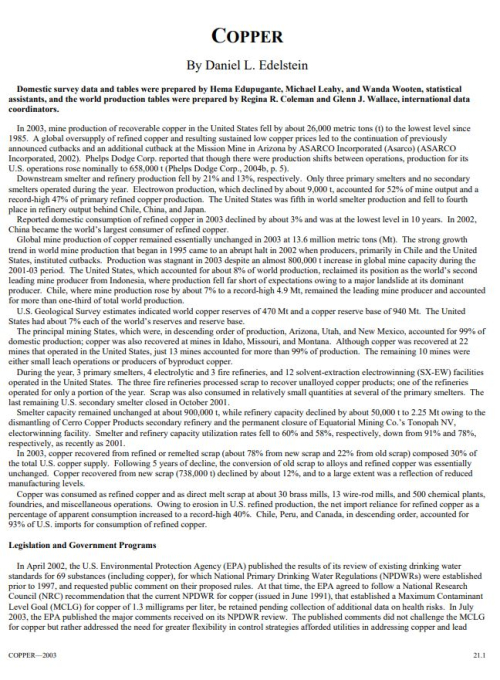
Domestic survey data and tables were prepared by Hema Edupugante, Michael Leahy, and Wanda Wooten, statistical assistants, and the world production tables were prepared by Regina R. Coleman and Glenn J. Wallace, international data coordinators. In 2003, mine production of recoverable copper in the United States fell by about 26,000 metric tons (t) to the lowest level since 1985.
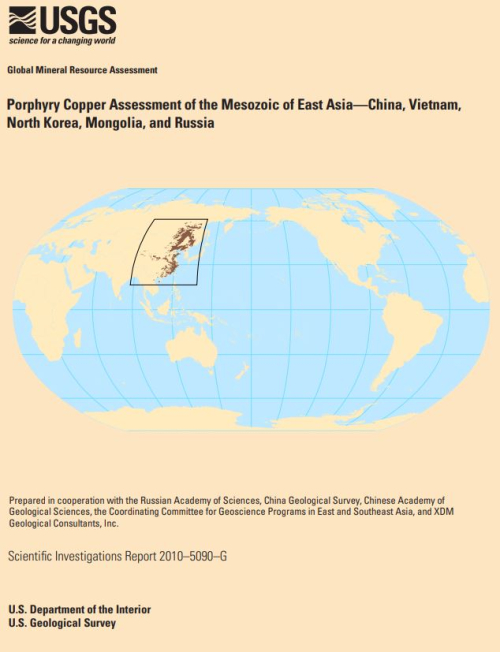
The assessment of porphyry copper deposits in eastern Asia has a long history, and many people have been involved. USGS colleagues Klaus J. Schulz and Joseph A. Briskey initiated the project and participated in the first workshop, in Kunming, Yunnan, in 2002. Stephen G. Peters and Warren Nokleberg coordinated and led the initial assessment activities, prepared preliminary reports, and represented the USGS to our Chinese counterparts at several meetings.
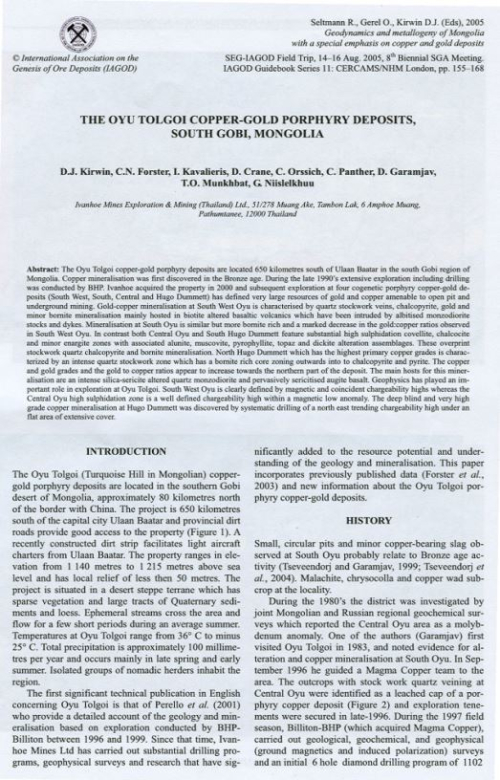
The Oyu Tolgoi copper-gold porphyry deposits arc located 6S0 kilometres south of Ulaan Baa tar in the south Gobi region of Mongolia. Copper mineralisation was first discovered in the Bronze age. During the late 1990’s extensive exploration including drilling was conducted by ВНР.
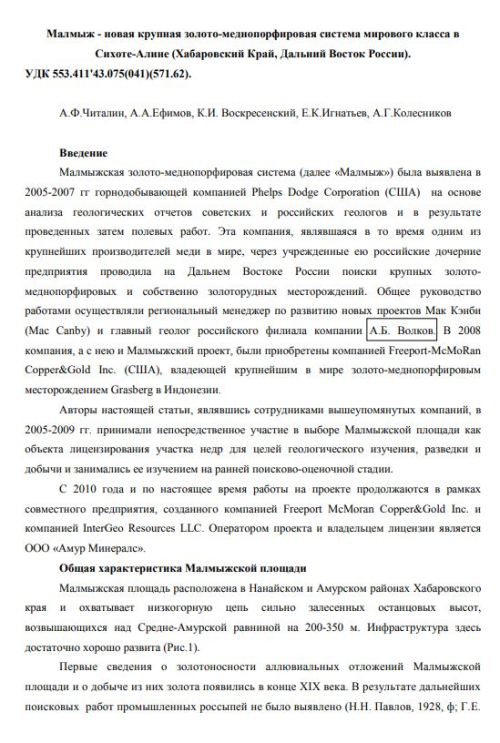
Малмыжская золото-меднопорфировая система (далее «Малмыж») была выявлена в 2005-2007 гг горнодобывающей компанией Phelps Dodge Corporation (США) на основе анализа геологических отчетов советских и российских геологов и в результате проведенных затем полевых работ. Эта компания, являвшаяся в то время одним из крупнейших производителей меди в мире, через учрежденные ею российские дочерние предприятия проводила на Дальнем Востоке России поиски крупных золотомеднопорфировых и собственно золоторудных месторождений. Общее руководство работами осуществляли региональный менеджер по развитию новых проектов Мак Кэнби (Mac Canby) и главный геолог российского филиала компании А.Б. Волков. В 2008 компания, а с нею и Малмыжский проект, были приобретены компанией Freeport-McMoRanCopper&Gold Inc. (США), владеющей крупнейшим в мире золото-меднопорфировым месторождением Grasberg в Индонезии <...>
The Alpine-Balkan-Carpathian-Dinaride (ABCD) belt is one of the world’s oldest mining areas and played a major role in the history of European civilizations, from well before the peak of the Greek and Roman civilizations up untilthe present day. Today, it is Europe’s premier Cu-Au (-Pb-Zn-Ag) province, especially for gold-rich deposits associated with calc-alkaline magmatism, which have become a focus of renewed exploration interest after the political change in the eastern part of CentralEurope. The Alpine–Balkan–Carpathian–Dinaride metallogenic and geodynamic province is part of the AlpineHimalayan orogenic system which extends from western Europe through Iran and the Himalayas to China and Malaysia.
Potassic igneous rocks were originally recognized in the late 19th century by Iddings (1895), who described some orthoclase-bearing basalts from the Yellowstone Park, Wyoming, and coined the term “shoshonite”. In the last century, petrologists generated many names for potassic igneous rocks which were either based on their mineralogy or, more commonly, based on the locality of their occurrence. The practice was to name a new rock after a place where it occurred —the type locality. These different names for essentially similar rocks from different localities led to great confusion (Sørensen 1974; De Wit 1989; Rock 1991; Peccerillo 1992; Soloviev 2014a).
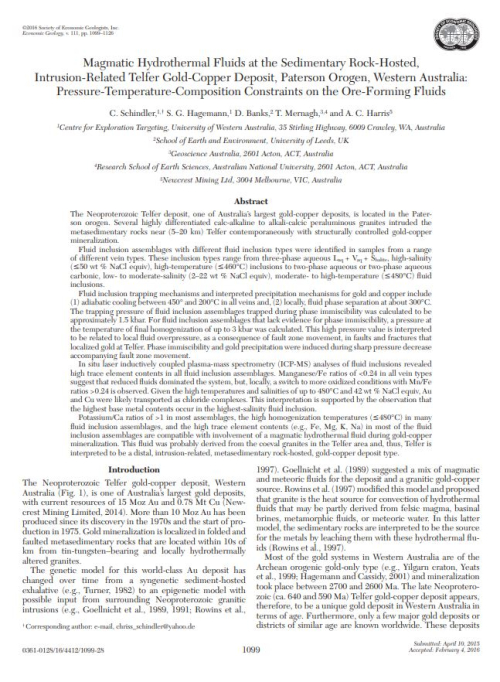
The Triassic Pulang porphyry Cu-Au deposit, located in the South Yidun terrane, is the oldest and one of the largest porphyry deposits in the southeastern Tibetan Plateau. The mineralization occurs mostly in the potassic alteration zone of the Pulang intrusive complex. U-Pb-He triple dating, namely apatite (U-Th)/He, zircon U-Pb, and zircon (U-Th)/He dating, together with inverse thermal modeling, reveals that the Pulang complex was emplaced at a paleodepth of ~5.0 to 6.5 km at 215 ± 2 Ma. The deep-level emplacement of the complex, coupled with the episodic replenishment of the magma chamber, gave rise to the establishment of a prolonged magmatic-hydrothermal system at Pulang.
При процессах выветривания силикатных пород, как известно, происходит значительная потеря ими щелочных металлов, в том числе К и Na, так как последние легко переходят в раствор и выщелачиваются. При этом в зависимости от гипергенной миграционной способности различные щелочные металлы будут в разной степени вынесены из продуктов выветривания.