Добрый день, Коллеги. Важное сообщение, просьба принять участие. Музей Ферсмана ищет помощь для реставрационных работ в помещении. Подробности по ссылке

Поиск по книгам
Автор(ы):Göbbels M., Götze J.
Издание:Springer, 2023 г., 265 стр., ISBN: 978-3-662-64866-7
Язык(и)Английский
Introduction to applied mineralogy / Введение в прикладную минералогию

Mineralogy deals with the predominantly crystalline building blocks of the geologi-cal matter surrounding us, the minerals. Since this geological matter served as a natural environment for humans from the beginning of their existence as a habitat and source of raw materials, the study of minerals as raw materials, building materials, materials and jewelry has always been a vital necessity. Mineralogy from this point of view is one of the oldest sciences. The increasing production and use of technical materials led to the fact that the concept of minerals today has also been extended to synthetic products <...>

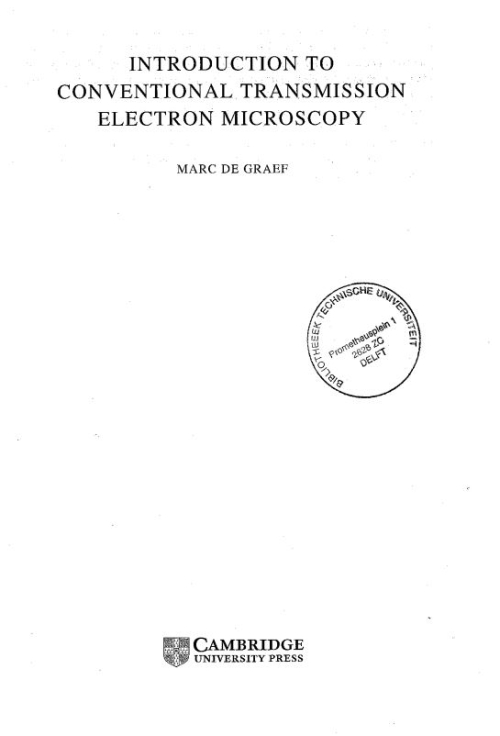
Автор(ы):De Graef M.
Издание:Cambridge University Press, 2003 г., 718 стр., ISBN: 0-521-62006-6
Язык(и)Английский
Introduction to conventional transmission electron microscopy / Введение в традиционную просвечивающую электронную микроскопию

In this chapter, we review the principles and basic tools of crystallography. A thorough understanding of crystallography is a prerequisite for anybody who wishes to learn transmission electron microscopy (ТЕМ) and its applications to solid (mostly inorganic) materials. All diffraction techniques, whether they use x-rays, neutrons, or electrons, make extensive use of the concept of reciprocal space and, as we shall see repeatedly later on in this book, ТЕМ is a unique tool for directly probing this space. Hence, it is important that the ТЕМ user become as familiar with reciprocal space as with direct or crystal space.

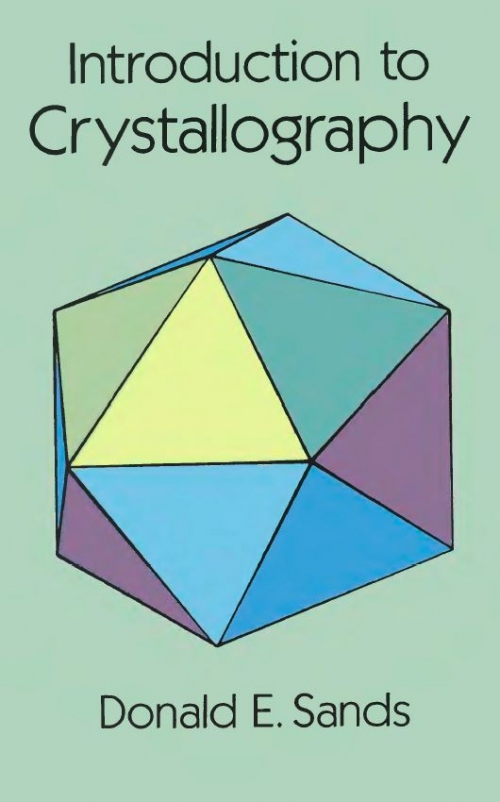
Автор(ы):Sands D.E.
Издание:Dover Publications, New York, 1969 г., 178 стр., ISBN: 0-486-67839-3
Язык(и)Английский
Introduction to crystallography / Введение в кристаллографию

THE proliferation and the importance of the results of crystal structure analysis confront the chemist with the need to learn the language of crystallography. This book is an outgrowth of the opinion that the training of the undergraduate chemistry major can include more of this language than the memorization of a list of lattice types. At the same time, it would be unreasonable and impractical to expect all chemists to become experts in this specialized field. The purpose, therefore, is to treat the subject in a manner that will quickly and painlessly enable the nonspecialist to read and comprehend the crystallographic literature. It is hoped that this introduction may serve as a useful starting point for those students who wish to pursue the subject further.

The principal message is contained in the first four chapters. That is, these chapters supply the vocabulary of crystallography, and descriptions of crystal structures should be rendered intelligible by acquaintance with this language. In order not to discourage the general reader, the use of mathematics has been kept to a minimum. The decision to omit vector and matrix methods was made reluctantly, in order to reduce the prerequisites, but the elegance thus sacrificed is a luxury that some exceptionally competent crystallographers get along without


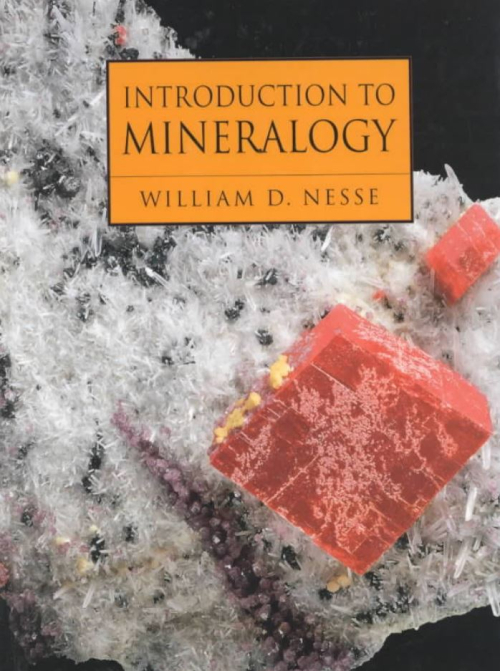
Автор(ы):Nesse W.D.
Издание:Oxford university press, 2000 г., 456 стр., ISBN: 0-19-510691-1
Язык(и)Английский
Introduction to mineralogy / Введение в минералогию

This book was written to provide a comprehensive text for teaching mineralogy to undergraduate students in the geosciences. Mineralogy is an essential because all geoscientists continually deal directly or indirectly with minerals in their professional work.

Издание 3
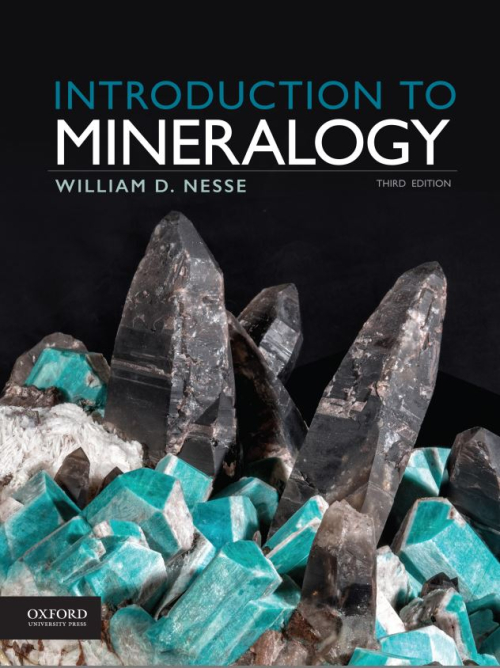
Автор(ы):Nesse W.D.
Издание:Oxford university press, New York - Oxford, 2017 г., 513 стр., ISBN: 9780190618384
Язык(и)Английский
Introduction to mineralogy / Введение в минералогию

Almost every human endeavor is influenced by minerals. Many natural resources used in the manufacture of goods on which civilization and our lives depend begin as minerals in the ground. The crops that we eat are grown in soil composed of minerals. The safety and stability of structures such as buildings, roads, and bridges depend on the mechanical properties of the minerals that make up the rocks and soil on which they are built. In addition, the chemical composition, structure, and texture of the minerals that compose the rocks beneath our feet provide myriad clues that guide geoscientists as they attempt to decipher the history of the earth.

Автор(ы):Haldar S.K., Tisjar J.
Издание:Elsevier, 2014 г., 340 стр., ISBN: 978-0-12-408133-8
Язык(и)Английский
Introduction to mineralogy and petrology / Введение в минералогию и петрологию

The crust of the Earth and underlying relatively rigid mantle make up the lithosphere. The crust is composed of a great variety of minerals and rocks. More than 80% of all raw materials that are used in various sectors of economy, society and the environment are of mineral origin, and demand for them is greater every day. In most countries, the values of raw materials used for the metal industry and building materials exceed the value of the funds allocated for oil and gas, although, we hear more about oil and gas <...>

Издание 2
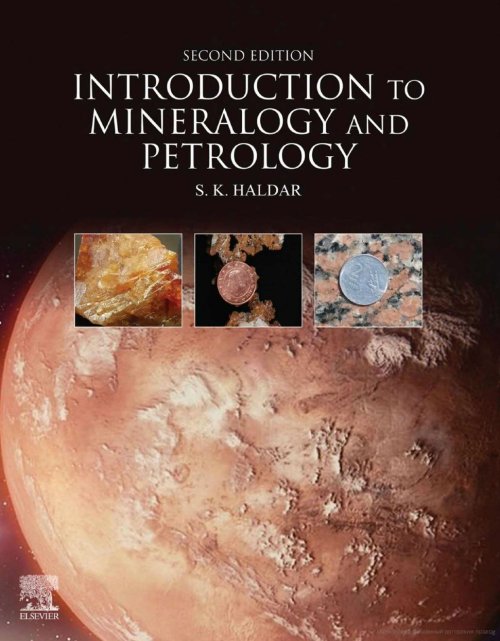
Автор(ы):Haldar S.K.
Издание:Elsevier, 2020 г., 428 стр., ISBN: 978-0-12-820585-3
Язык(и)Английский
Introduction to mineralogy and petrology / Введение в минералогию и петрологию

Since time immemorial the minerals, rocks and soil had been the major attraction for the growth, development, and survival of every living entity including human, animals, birds, plants, and trees. That indeed forced us to know more about the minerals (mineralogy) and the rocks and soils (petrology).

Автор(ы):Correns C.W.
Издание:Springer-Verlag, New York, 1969 г., 497 стр.
Язык(и)Английский
Introduction to mineralogy. Crystallography and petrology / Введение в минералогию. Кристаллография и петрология

We are all familiar with the subdivision of the natural world into the plant, animal, and mineral kingdoms. Of these the realm of minerals is the study and research area of mineralogy. A mineralogist uses the word mineral, however, in a much more restricted sense than prevails with common usage. If we examine a rock rather closely, we notice, for example, that a sandstone is composed of individual quartz grains.

Издание 2
Автор(ы):Nesse W.D.
Издание:Oxford university press, New York - Oxford, 1991 г., 347 стр., ISBN: 0-19-506024-5
Язык(и)Английский
Introduction to optical mineralogy / Введение в оптическую минералогию

This book is intended for use in an introductory optical mineralogy course. The objective in preparing the book was to present in a single volume of reasonable size both a thorough treatment of optical theory as it pertains to mineral identification with the petrographic microscope, and detailed mineral descriptions of the common rock-forming minerais. The first seven chapters <leal with optical theory and provide an introduction to the properties oflight, a description of the petrographic microscope, and a discussion of the optical properties of isotropic and anisotropic materiais. Detailed step-by-step procedures have been included to guide students through the measurement of optical properties in both thin section and grain mount. Selected spindle stage techniques also are included. <...>

Автор(ы):Arehart G.B.
Издание:Department of Geology Science, Reno, 4 стр.
Язык(и)Английский
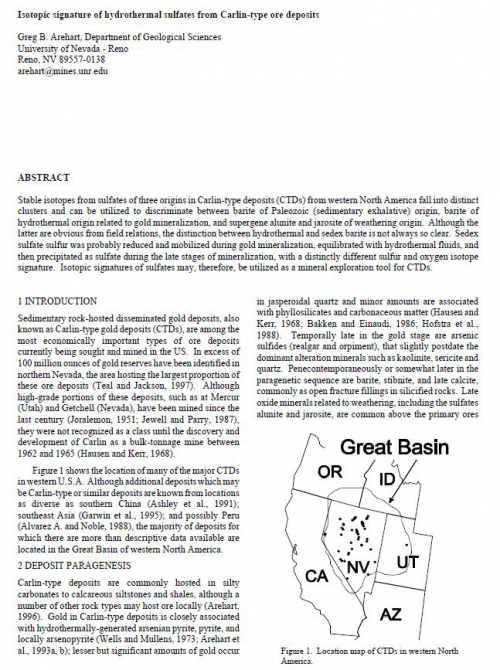
Isotopic signature of hydrothermal sulfares from Carlin-type ore deposit

Stable isotopes from sulfates of three origins in Carlin-type deposits (CTDs) from western North America fall into distinct clusters and can be utilized to discriminate between barite of Paleozoic (sedimentary exhalative) origin, barite of hydrothermal origin related to gold mineralization, and supergene alunite and jarosite of weathering origin. Although the latter are obvious from field relations, the distinction between hydrothermal and sedex barite is not always so clear. Sedex sulfate sulfur was probably reduced and mobilized during gold mineralization, equilibrated with hydrothermal fluids, and then precipitated as sulfate during the late stages of mineralization, with a distinctly different sulfur and oxygen isotope signature. Isotopic signatures of sulfates may, therefore, be utilized as a mineral exploration tool for CTDs.


480.32