Добрый день, Коллеги. Важное сообщение, просьба принять участие. Музей Ферсмана ищет помощь для реставрационных работ в помещении. Подробности по ссылке

Поиск по книгам
Автор(ы):Ahrens T.J.
Издание:American Geophysical Union, Washington, 1995 г., 354 стр., ISBN: 0-87590-852-7
Язык(и)Русский
Mineral physics and crystallography: a handbook of physical constants / Физика минералов и кристаллография: справочник по физическим константам

The purpose of this Handbook is to provide, in highly accessible form, selected critical data for professional and student solid Earth and planetary geophysicists. Coverage of topics and authors were carefully chosen to fulfill these objectives.

These volumes represent the third version of the "Handbook of Physical Constants." Several generations of solid Earth scientists have found these handbooks to be the most frequently used item in their personal library. The first version of this Handbook was edited by F. Birch, J. F. Schairer, and H. Cecil Spicer and published in 1942 by the Geological Society of America (GSA) as Special Paper 36. The second edition, edited by Sydney P. Clark, Jr., was also published by GSA as Memoir 92 in 1966. Since 1966, our scientific knowledge of the Earth and planets has grown enormously, spurred by the discovery and verification of plate tectonics and the systematic exploration of the solar system.

The present revision was initiated, in part, by a 1989 chance remark by Alexandra Navrotsky asking what the Mineral Physics (now Mineral and Rock Physics) Committee of the American Geophysical Union could produce that would be a tangible useful product. At the time I responded, "update the Handbook of Physical Constants." As soon as these words were uttered, I realized that I could edit such a revised Handbook. I thank Raymond Jeanloz for his help with initial suggestions of topics, the AGU's Books Board, especially Ian McGregor, for encouragement and enthusiastic support. Ms. Susan Yamada, my assistant, deserves special thanks for her meticulous stewardship of these volumes. I thank the technical reviewers listed below whose efforts, in all cases, improved the manuscripts.

Издание 22
Автор(ы):Klein C.
Издание:John Wiley & Sons INC, 2002 г., 665 стр.
Язык(и)Английский
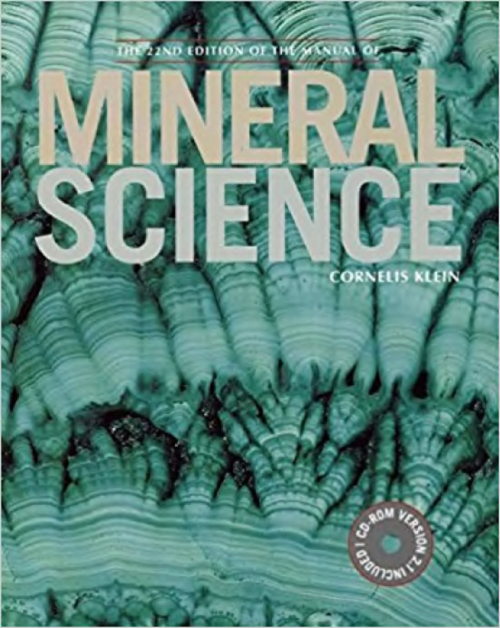
Mineral science / Минералогия

This 22nd edition was prepared during a time of change in many Geology (or Earth Science, or Earth and Planetary Science, or Geoscience) departments, their undergraduate courses, and students. To reflect the extent of the revision, this text for the introductory mineralogy course even has a new title, Manual of Mineral Science, succeeding many earl ier editions with the name Manual of Mineralogy.

Том 15, Выпуск 2
Издание:ООО Британ, Москва, 2010 г., 96 стр., ISBN: 5-900395-29-4
Язык(и)Английский
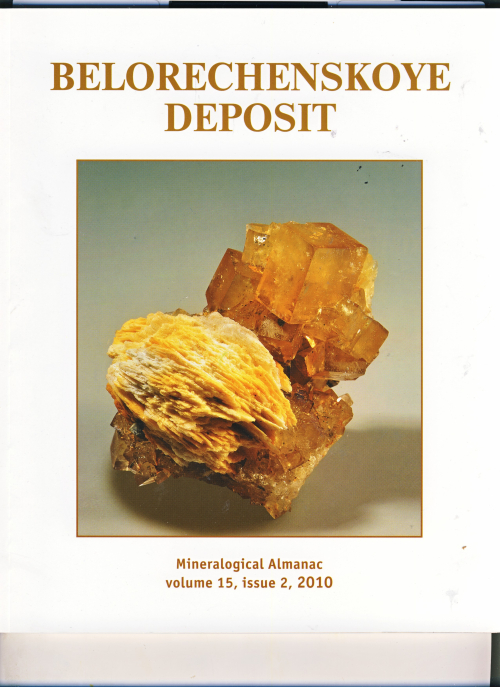
Mineralogical Almanac. Volume 15. Issue 2. Mineralogy of the Belorechenskoye Deposit (Northern Caucasus, Russia) / Минералогический альманах. Том 15. Выпуск 2. Минералогия Белореченского месторождения (Северный Кавказ, Россия).

The Mineralogical Almanac issue is devoted to the mineralogy of ore-bearing hydrothermal veins and oxidation zone of the Belorechenskoye deposit in Adygea Republic, Northern Caucasus, Russia. It is a complex object, with nickel-uraniumand barite ores.
The deposit was prospected in 1960s – 1970s; since that time it has been a steady a source of fine museum-quality mineral specimens.The issue summarizes both original authors’ and earlier published data. The main part of it contains the description of 65 minerals and veins of different types. Another part contains geological data of the deposit and surrounding area.

Издание 2
Автор(ы):Burns R.G.
Издание:Cambridge University Press, 1993 г., 557 стр., ISBN: 978-0-521-43077-7
Язык(и)Английский
Mineralogical applications of crystal field theory / Минералогические приложения теории кристаллического поля

This book arose from a series of lectures given at the Universities of Cambridge and Oxford during the Spring of 1966. The lectures were based on material compiled by the author between 1961 and 1965 and submitted in a Ph.D. dissertation to the University of California at Berkeley. At the time crystal field theory had become well established in chemical literature as a successful model for interpreting certain aspects of transition metal chemistry.

Автор(ы):Meshram T.
Издание:2019 г., 49 стр.
Язык(и)Английский
Mineralogical variation in platinum group element within altered chromitite of the Kondapalli Layered Igneous Complex (Southern India): implication on magmatic evolution and its petrogenetic significance

Минералогические вариации элементов платиновой группы в измененном хромитите расслоенного магматического комплекса Кондапалли (Южная Индия): влияние на эволюцию магматизма и его петрогенетическое значение

Platinum Group Minerals (PGMs) associated with Chromite form in a wide range of geotectonic settings, namely, (1) stratiform or layered magmatic complexes, (2) podiform complexes in ophiolites, (3) the Alaskan zoned complexes and (4) Chromite-rich Archean complexes are also called ‘conduit-type’ (Mondal and Baidya, 1997; Auge et al., 2002; Ahmed and Arai, 2003; Economou-Eliopoulos, 2010; Mukherjee et al., 2012; Mungall, 2014; Peck and Huminicki, 2016; O’Driscoll and González-Jimenez, 2016; Prichard et al., 2017a-b; Mondal et al., 2019).

Редактор(ы):Lichte F.E., Sutley S.J., Taylor C.D.
Издание:USGS, 53 стр.
Язык(и)Английский
Mineralogical, textural and metal residence studies of primary, recrystallized and remobilized ores of the Greens Creek Deposit / Минералогические, текстурные и геохимические исследования образования, рекристаллизации и ремобилизации руд месторождения ГК

The Greens Creek deposit is a 24.2-million-ton polymetallic massive sulfide with a diverse base- and preciousmetal-rich mineralogy, which has been subjected to regional lower greenschist facies metamorphism. Roughly 30 percent of the ores retain primary mineralogy and mineral textures as well as gross original ore stratigraphy. Ore lithologies fall into two groups: massive sulfide ores (greater than 50 percent sulfides) and semimassive or disseminated sulfide gangue-rich “white” ores (less than 50 percent sulfides). There are two types of massive ore: massive pyritic and massive base-metalrich ore.

Автор(ы):Matthes S., Okrusch M.
Издание:Springer, 2010 г., 660 стр., ISBN: 978-3-540-78200-1
Язык(и)Немецкий
Mineralogie. Eine einführung in die spezielle mineralogie, petrologie und lagerstättenkunde / Минералогия Введение в специальную минералогию, петрологию и изучение месторождений

Erfreulicherweise hat die 7. Auflage des Mineralogie-Lehrbuches bei Studenten und Hochschullehrern, aber auch bei interessierten Mineraliensammlern eine positive Aufnahme gefunden und war bereits nach zweieinhalb Jahren vergriffen. Auf Wunsch des Verlages wurde die notwendige Neuauflage nicht nur gründlich überarbeitet, sondern wiederum inhaltlich erweitert und durch zahlreiche neue Abbildungen bereichert. Dabei habe ich mich bemüht, konstruktive Kritik von Rezensenten und Anregungen von Kollegen weitgehend zu berücksichtigen. Äußerst hilfreich waren hierfür Übersichtsartikel, die in den letzten Jahren in Sammelbänden und Zeitschriften zu aktuellen Themen erschienen sind. <...>

Издание 9
Автор(ы):Matthes S., Okrusch M.
Издание:Springer, 2014 г., 725 стр., ISBN: 978-3-642-34659-0
Язык(и)Немецкий
Mineralogie. Eine einführung in die spezielle mineralogie, petrologie und lagerstättenkunde / Минералогия Введение в специальную минералогию, петрологию и изучение месторождений

Kristalle (grch. κρυ´σταλλοσ = Eis, übertragen auf den Bergkristall; Abb. 1.1) sind feste, homogene, anisotrope Körper mit dreidimensional periodischer Anordnung ihrer chemischen Bausteine (Atome, Ionen, Moleküle). Der Kristallbegriff greift weit über die Mineralwelt hinaus; er umfasst ebenso alle kristallinen Substanzen, die im Labor und in technischen Betrieben künstlich gezüchtet oder durch Massenkristallisation hergestellt werden.

Издание 7
Автор(ы):Matthes S., Okrusch M.
Издание:Springer, 2005 г., 527 стр., ISBN: 3-540-23812-3
Язык(и)Немецкий
Mineralogie. Eine einführung in die spezielle mineralogie, petrologie und lagerstättenkunde / Минералогия Введение в специальную минералогию, петрологию и изучение месторождений

Bereits drei Jahre nach ihrem Erscheinen war die 6. Auflage des „Matthes“ vergriffen und der Verlag drängte auf die Vorbereitung einer Neuauflage. Das bot die Gelegenheit, den Inhalt des Lehrbuchs gründlich zu überarbeiten und an den modernen Wissensstand anzupassen. Die bewährte Gliederung in die Hauptteile „Spezielle Mineralogie“, „Petrologie und Lagerstättenkunde“ sowie „Stoffbestand und Bau von Erde und Mond“ blieb dabei erhalten. Allerdings schien es angezeigt, einige sehr umfangreiche Kapitel aufzuteilen, so dass das Buch jetzt aus 30 Kapiteln besteht. Die „Mineralogie“ wurde an vielen Stellen inhaltlich erweitert; zahlreiche neue Abbildungen kamen hinzu; dem stehen Streichungen veralteter Passagen und Straffungen des Textes gegenüber. <...>

6718.87