Добрый день, Коллеги. Важное сообщение, просьба принять участие. Музей Ферсмана ищет помощь для реставрационных работ в помещении. Подробности по ссылке
The authors embarked on the preparation of this book some years ago without realising the magnitude of the task they had set themselves. The original idea stemmed from the realisation that although petrography is now widely acknowledged as a tool for the investigation of hardened concrete, there are no modern texts on the subject. Older books covering the general areas of cements, clinkers, concretes and related materials may have become outdated and most are long out of print. The authors, therefore, have had to gather information from a wide range of published and unpublished sources as well as drawing on their own research material and experience.
Petrography (from the Greek petra meaning rock and graphus meaning writing or a record) originated over 150 years ago as a technique employed primarily by geologists, who used microscopes to examine rock samples to identify their mineralogical and chemical characteristics. Petrographic techniques have since been applied to a wide range of materials used in construction including building stone, aggregate, soil, cement, concrete, mortar, brick, and bituminous mixtures. The polarising microscope has been used for the examination of cementitious materials since 1887. Almost one hundred years ago a series of six articles'1' in Concrete and Concrete Construction, the forerunner of today's CONCRETE, described the possibilities of using a microscope for examining concrete. In the last 40 years, petrography has become widely used for both research and commercial investigation of concrete structures. Petrographic examination is a laboratory procedure that is unique in that it relies highly on visual inspection of the samples. It requires specialist sample preparation and microscopical equipment and operators with appropriate qualifications and experience. Using the microscope the petrographer can determine the composition of concrete, assess its quality, and investigate the causes and extent of any deterioration. Photographs taken through the microscope (photomicrographs) record petrographic features of concrete samples. <...>
There is an increasing awareness of the sensitivities in conditional simulation to sample and assay quality, geological interpretations and structural controls, and variogram parameters such as the nugget effect. A wide range of algorithms and applications has been proposed, presented and discussed (ISGSM 1999, held in Perth, Australia, is the most recent international meeting to focus solely on conditional simulation and its applications for the mining industry). <...>
Resource evaluation drilling is usually on a regular pattern; the pattern spacing should be optimised to maximise profit from mining, accounting for the cost of drilling and the value of additional information from increased density of drilling, and also to reduce risk in mined ore tonnes and grades to an acceptable level. Conditional simulation methods for determining optimum drilling spacing are more powerful than traditional methods, and simulation methods can take into account local variability in grade. Mining profit functions can consider profit and density of evaluation drilling so that profit can be maximised.
Detailed spatial models generated by conditional simulation provide a powerful tool for case-specific optimization of sampling designs. The entire process of sampling, estimation, and decision can be simulated on such a model by a Monte-Carlo approach. Optimization can be based on economic functions or on decision quality constraints rather than simple minimization of estimation variance.
The papers in this volume consider the general themes of flow confinement and topographic control on processes and sedimentary architecture in deep water clastic systems. This publication grew out of an international workshop on Confined Turbidite Systems, held in Nice (France) in September 2001. Many of the papers presented at that meeting related to case studies of the Ores d'Annot turbidites, which are so spectacularly exposed in the region north of Nice. Hence we have also produced a companion volume in the same series (Geological Society Special Publication 221) specifically focusing on the Ores d'Annot.
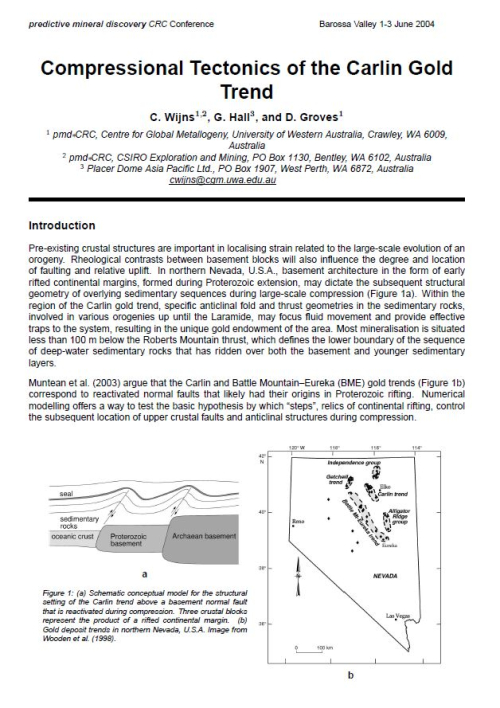
The Roberts Mountains of north-central Nevada are comprised of Paleozoic sedimentary rocks that host several gold deposits and subeconomic gold resources (Fig. 1). These gold occurrences are within a regional alignment of precious and base metal deposits in north-central Nevada termed the Battle Mountain-Eureka mineral belt (Roberts, 1966). Field relations and radiometric ages in three areas of the Roberts Mountains (Maher et al., 1990) allow assignment of minimum and probable maximum ages for gold mineralization. New radiometric age data from the Roberts Mountains and other precious and base metal deposits within the Battle Mountain-Eureka mineral belt are combined in this report with previously published geologic data to construct a metallo-genic framework for gold and other metallic deposits in north-central Nevada.
The Cleo gold deposit, 55 km south of Laverton in the Eastern Goldfields Province of Western Australia, is characterised by banded iron-formation (BIF)-hosted ore zones in the gently dipping Sunrise Shear Zone and high-grade vein-hosted ore in the Western Lodes. There is evidence that gold mineralisation in the Western Lodes (which occurred at ca 2655 Ma) post-dates the majority of displacement along the Sunrise Shear Zone, but it remains uncertain if the ore in both structures formed simultaneously or separately.
In the preface to the first edition of Construction Dewatering—New Methods and Applications, the stated intent of the book was to be a source of practical information for engineers and contractors who must contend with groundwater on construction projects. However, current ractice includes many methods besides straightforward dewatering. The content and new title, Construction Dewatering and Groundwater Control, of this third edition reflect this.