Добрый день, Коллеги. Важное сообщение, просьба принять участие. Музей Ферсмана ищет помощь для реставрационных работ в помещении. Подробности по ссылке
Groundwater geochemistry is the science that explores the processes controlling the chemical composition of groundwater, the groundwater quality. The groundwater quality influences the use of this resource. Groundwater may contain hazardous substances that affect health when consumed or which deteriorate the environment when the water is thoughtlessly spilled at the surface. The groundwater quality may change during the exploitation or it may be affected by human activities of which the impact is not always immediately evident.
We believe this is the first collection of papers to be devoted entirely to reservoir geochemistry, which is an area of growing scientific and economic importance. The main aim of reservoir geochemistry is to understand the distributions and origin(s) of the petroleums, waters and minerals in the reservoir and account for their possible spatial and compositional variation. This is ideally related to basin history and location of source-rock kitchens and migration pathways.
Plant and soil form an integrated system. Technogenic contamination of soils with potentially toxic trace elements (PTE) are reflected in the functioning of plants and soil biota. Soil contamination by PTE has several implications for human health, as well as for the biosphere. Trace element “biogeogenic cycling” in the environment is an integral function of the ecosystem (aquatic, terrestrial, and atmospheric). Therefore, the aim of this collective work is to deal with the trace elements in the holistic environment, considering advancements in the state-of the-art analytical techniques, molecular biology, and contemporary biotechnology that enhance our knowledge of the behavior of trace elements in the biogeosphere and organismal levels, i.e., at the cellular and molecular levels. Various chapters of this book provide the background with appropriate examples to understanding the trace elements in the biogeosphere on bioavailability, biogeochemistry, biotechnology, bioremediation, and risk assessment. <...>
Stable isotope investigations in the earth sciences continue to grow, maybe faster than ever before. After publication of the 5th edition, tremendous progress has been achieved in many subfields of stable isotope geochemistry. To name a few:
– Applications of Multicollector - ICP-MS has grown rapidly and now enable investigations on natural isotope variations of a wide range of transition and heavy elements that could not previously be measured with adequate precision.
Nucleosynthesis is the study of the nuclear processes responsible for the formation of the elements which constitute the baryonic matter of the Universe. The elements of which the Universe is composed indeed have a quite complicated nucleosynthesis history, which extends from the first three minutes of the Big Bang through to the present. Contemporary nucleosynthesis theory associates the production of certain elements/isotopes or groups of elements with a number of specific astrophysical settings, the most significant of which are: (i) the cosmological Big Bang, (ii) stars, and (iii) supernovae.
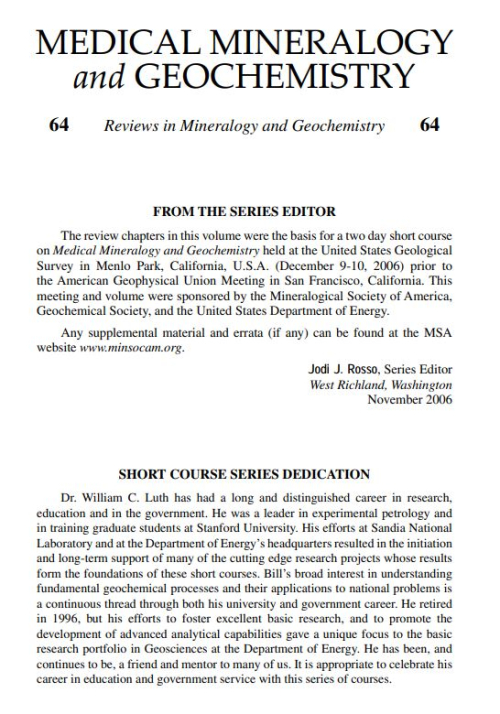
The review chapters in this volume were the basis for a two day short course on Medical Mineralogy and Geochemistry held at the United States Geological Survey in Menlo Park, California, U.S.A. (December 9-10, 2006) prior to the American Geophysical Union Meeting in San Francisco, California. This meeting and volume were sponsored by the Mineralogical Society of America, Geochemical Society, and the United States Department of Energy <...>
In the late 20 th century, biogeochemistry emerged as a new discipline in which the biological, physical, and human sciences collaborate (CGCR, 1999; Schlesinger, 1997). Biological, because the chemical cycles of the planet are mediated by life (Table 1). Physical, because of the strong coupling between climate and atmospheric composition so evident in the glacial-interglacial record of the ice cores (Fig. 1). And, human, because of the massive human disruption of the planet's carbon and nitrogen cycles by fossil fuel burning (which produces CO2 and a range of volatile nitrogen compounds) (Fig. 2).
It is now common parlance to refer to the Earth as a physical–chemical–biological system; but this is a relatively recent innovation. Until about 1950, geologists generally used the word ‘system’ to define geologic periods, or the several crystal classes, or the physical chemistry of multicomponent mixtures. Long before then, the word ‘system’ in its current usage had been a part of the vocabulary of a number of fields, including communication and control engineering.
Applications of concepts and methods of physics and chemistry to geology resulted in the field of Isotope Geochemistry which has revolutionized our understanding of our Earth system and our environment. When isotope techniques applied to understanding environmental changes that have taken place in the anthropocene, the resultant field can be defined as Environmental Isotope Geochemistry.
To begin with,a brief statement of what constitutes organic geochemistry is probably called for.It is the study of the transformation undergone by organic matter of all types, whether of biological or manmade origin, in the Earth System. The transformations involved vary from those mediated by biological processes involved in the production of living tissue and the operation of food-chains, to those controlled by temperature and pressure at depth in the crust. Photochemical processes in the atmosphere and hydrosphere can also be important in controlling the environmental behaviour of some organic compounds.