Добрый день, Коллеги. Важное сообщение, просьба принять участие. Музей Ферсмана ищет помощь для реставрационных работ в помещении. Подробности по ссылке
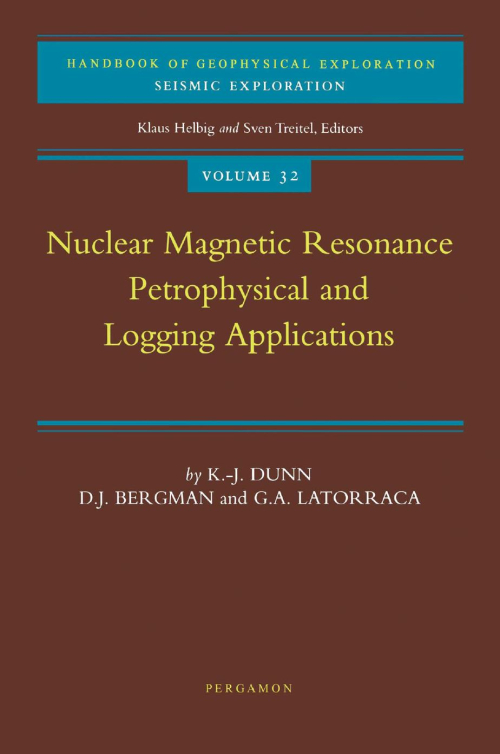
The applications of nuclear magnetic resonance (NMR) to petroleum expb ration and production have become more and more important in recent years. The development of the NMR logging technology and the NMR applications to core analysis and formation evaluation have been very rapid and extensive. Part of this book was a collection of many lecture notes written over the years for Chevron in-house training purposes. As we started writing, the scope of the book gradually broadened.
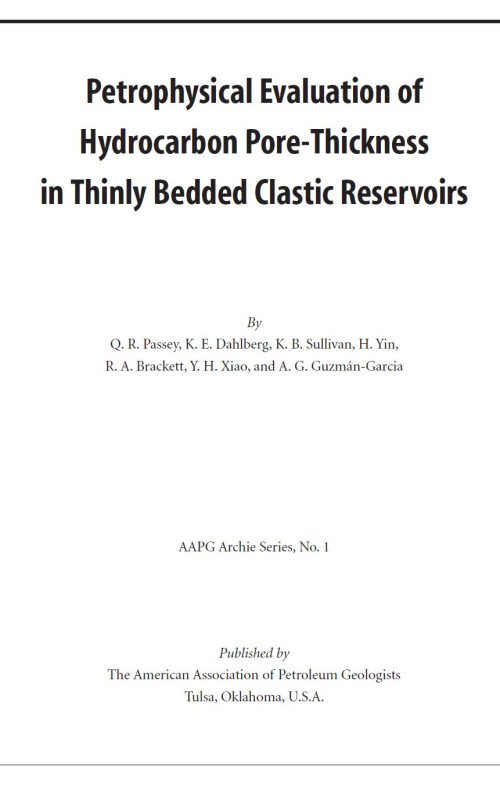
This chapter describes the difficulties associated with formation evaluation in thinly bedded sandstone reservoirs and outlines the existing technology that has been applied to these difficulties. Chapter 2 introduces our integrated approach to evaluating hydrocarbon pore-thickness in thinly bedded clastic reservoirs.
Many terms are introduced in these two chapters through examples and informal definitions: for example, earth models, bed types, logging tool forward models, convolution, inversion, statistical earth models, and Monte Carlo inversion. These topics are discussed more thoroughly in Chapters 6 through 10, and the integrated approach is described in detail in Chapters 11 through 13. <...>
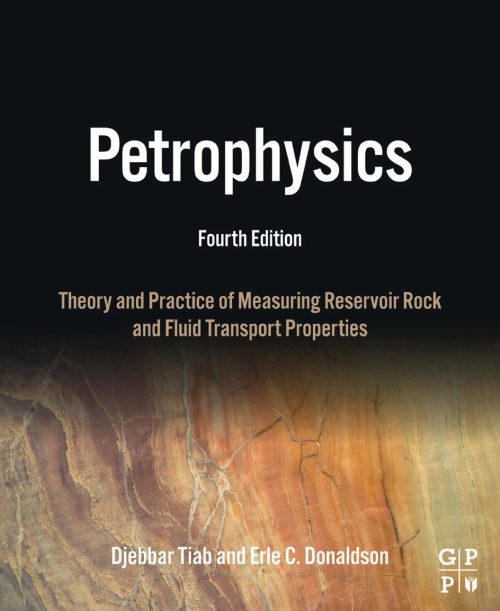
This book has been written for those studying petroleum geology or engineering, for whom the role of the petrophysicist can become a lucrative and satisfying career. The handbook will be equally useful to students and practioners of environmental science and hydrogeology, where the understanding of groundwater flow is an important part of their technical remit.
Petrophysics is the study of rock properties and their interactions with fluids (gases, liquid hydrocarbons, and aqueous solutions). The geologic material forming a reservoir for the accumulation of hydrocarbons in the subsurface must contain a three-dimensional network of interconnected pores in order to store the fluids and allow for their movement within the reservoir.
Mathematical astrophysics and mathematical geophysics have their own journals and conferences, where practitioners discuss mathematical formulations that come to grips with the physical processes of the cosmos and planet Earth. Mathematical petrophysics is by no means new. It started in 1942 with the publication of an equation: the Archie equation.
The solution to this problem depends on your background in geology, chemistry, physics, and your familiarity with various laboratory instruments. Here are some possibilities Cut a fresh piece of each sample. Drop cold HCL on the freshly cut surface and observe. The limestone (Core A) will react vigorously with the cold HCL, releasing CO2 in the process. The sandstone (Core B) and dolomite (Core C) will not react with the cold acid. This simple test identifies the limestone conclusively.
Next, heat the HCL almost to its boiling point and repeat the test with the hot HCL on the two remaining samples (Cores B and C). The dolomite will react with the hot acid but the sandstone will not. This test distinguishes the dolomite from the sandstone. <...>
The SP is a passive measurement of very small electrical voltages resulting from electrical currents in the borehole caused by the differences in the salinities (resistivities) of the formation connate water (Rw) and the drilling mud filtrate (Rmf), and by the presence of ion selective shale beds. The voltage changes are measured by a downhole electrode relative to a surface ground. Unlike other logging tools which are displayed on a specific scale with a specified reference value, the SP has no specified origin and values used for computation are referenced to deflection from the nearby shale baseline established by the interpreter. <...>
Petrophysics, beginning with Archie’s historical yet evergreen equations, has a key function in all applications of geosciences, petroleum engineering and related technologies. It helps us to understand the processes and controlling properties and creates relationships between parameters we can measure as output of the dramatic progress in exploration techniques and properties we need for reservoir characterization (hydrocarbons, water, minerals, geothermal energy), exploration of natural resources, geotechnical constructions and environmental protection.
Объектом исследования является прискважинная зона пласта нефтяного коллектора юрского возраста (ЮС2), представленного мелко- и среднезернистым песчаником с невысокими фильтрационно-ёмкостными свойствами (пористость до 11-18%, проницаемость до 1-20 мД) и высокой нефтенасыщенностью (70-98%), включающая в себя внешнюю и внутреннюю (зона кольматации) глинистую корку и зону проникновения (включающей в себя промытую зону с наиболее высокой концентрацией проникшего в пласт фильтрата бурового раствора и окаймляющую зону, связанную с различной вязкостью пластовой воды и нефти).
В книге изложены теоретические основы и методы изучения свойств горных пород и движения однофазных, многофазных и смешивающихся флюидов в пористых геологических средах.