Добрый день, Коллеги. Важное сообщение, просьба принять участие. Музей Ферсмана ищет помощь для реставрационных работ в помещении. Подробности по ссылке
Carbonate cementation in sandstones: distribution patterns and geochemical evolution S. Morad Origin and spatial distribution of early vadose and phreatic calcite cements in the Zia Formation, Albuquerque Basin, New Mexico, USA J. R. Beckner and P.S. Mozley Carbonate diagenesis and porosity evolution in sheet-flood sandstones: evidence from the Middle and Lower Lunde Members (Triassic) in the Snorre Field, Norwegian North Sea S. Morad, L.F. de Ros, J.P. Nystuen and M. Bergan Carbonate diagenesis in non-marine foreland sandstones at the western edge of the Alleghanian overthrust belt, southern Appalachians K. L. Milliken Palaeogeographical, palaeoclimatic and burial history controls on the diagenetic evolution of reservoir sandstones: evidence from the Lower Cretaceous Serraria sandstones in the Sergipe-Alagoas Basin, NE Brazil A.J. V Garcia, S. Morad, L.F. de Ros and I.S. Al-Aasm
Аутигенная минералогия песчаников, перемежающихся с богатыми органикой аргиллитами, объединяющими диагенез и историю захоронений группы Месаверде в бассейне реки Пичеанс на северо-западе штата Колорадо
Twenty nine sets of sandstone and stratigraphically adjacent fine grained organic rich samples representing diverse de positional environments fluvial coastal paludal and marine have been obtained from cores of the Mesaverde Group within the Piceance Basin Colorado These units have been buried to a sufficient depth that organic maturation has progressed to an advanced state vitrinite reflectance values range from 1 0 to 2 2 in the study area
For more than 10 years, I have given special short courses on fossil fuel exploration for industry and government personnel at the Colorado School of Mines. Portions of these courses have been adapted as a basis for lecture series for the American Association of Petroleum Geologists in the Continuing Education Program. The material in this notebook relates only to lectures discussing stratigraphic principles and petroleum occurrences in deltaic and shallow marine sandstones. The lectures are designed to acquaint the participant with concepts and methods in stratigraphy and to acquaint him primarily with the U.S. literature relating to the subjects. <...>
Diagenesis comprises abroad spectrum of physical, chemical and biological post-depositional processes by which original sedimentary assemblages and their interstitial pore waters react in an attempt to reach textural and geochemical equilibrium with their environment (Curtis, 1977; Burley et al., 1985). These processes are continually active as the mbient environment evolves in terms of temperature, pressure and chemistry during the deposition, burial and uplift cycle of basin history.
Campanian M1 Sandstone is one of the major prospective sandstone units in the Tarapoa field in Oriente Basin, Ecuador. The M1 Sandstone is always markedly sharp based, averages 25 m in thickness, shows upward increasing marine bioturbation and generally fines upward from coarse to very fine grained sandstone. In cores, the sandstones at base are amalgamated coarse to fine grained with prominent cross stratification (dm thick), sometimes clearly bi-directional and contains mud drapes.
Deltaic depositional facies result from interacting dynamic physical processes (wave energy, tidal action, climate, etc.) which modify and disperse riverborne elastics. Since ancient times, river deltas have been of fundamental importance to civilization. Owing to their early significance as agricultural lands, deltas received considerable attention from scholars such as Homer, Herodotus, Plato, and Aristotle. More recently, subsurface deltaic facies have played a paramount role in accommodating the world's energy needs; ancient deltaic sediments have provided source beds and reservoirs for a large percentage of the known petroleum reserves. The facies relationships and mechanisms responsible for development and distribution of deltaic sand bodies must be understood before they can be explored efficiently. <...>
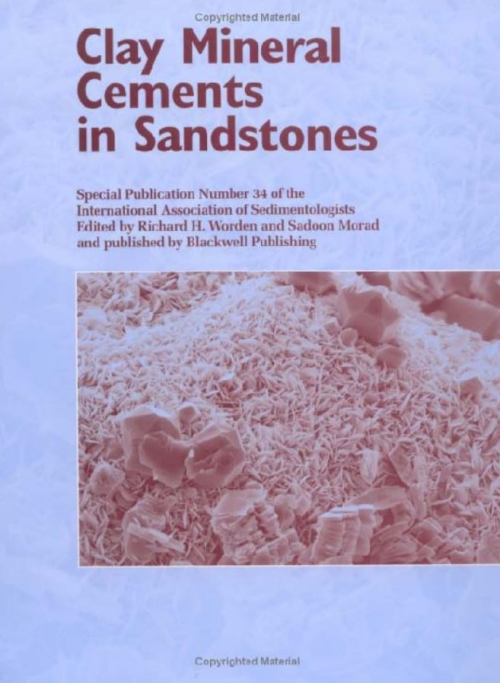
Clays are one of the most important groups of minerals that destroy permeability in sandstones, but they also react with drilling and completion fluids and induce fine-particle migrationduring hydrocarbon production. They are a very complex family of minerals that commonly are mutually intergrown and contain a wide range of solid solutions and form by a wide range of processes. They form under a wide diversity of pressure and temperature conditions, as well as rock and fluid compositional conditions.
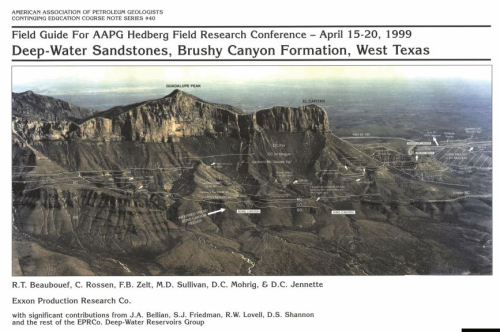
Exceptional oblique-dip exposures of submarine fan complexes of the Brushy Canyon Fm. allow reconstruction of channel geometries and reservoir architecture from the slope to the basin floor. The Brushy Canyon conslsts of 1,500 ft. of basinally restricted sandstones and siltstones that onlap older carbonate slope deposits at the NW margin of the Delaware Basin.
This volume is a follow-up to my earlier book “Deep-Water Processes and Facies Models: Implications for Sandstone Petroleum Reservoirs,” published under Elsevier’s “Handbook of Petroleum Exploration and Production” series (Volume 5). In that book and in my other publications,