Добрый день, Коллеги. Важное сообщение, просьба принять участие. Музей Ферсмана ищет помощь для реставрационных работ в помещении. Подробности по ссылке
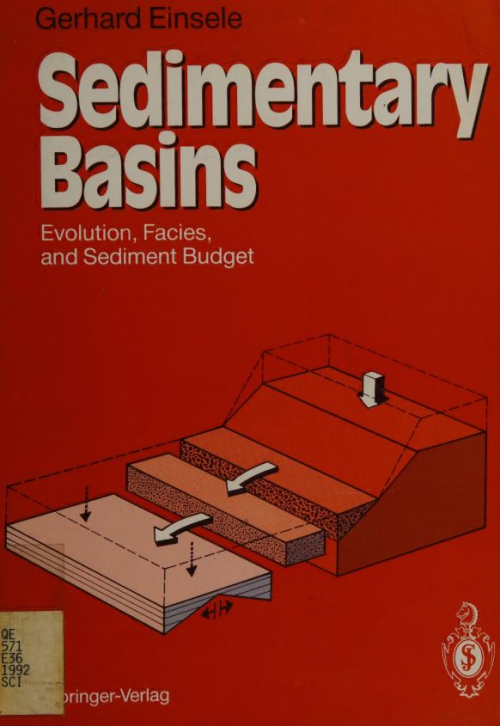
Sedimentary basins are, in a very broad sense, all those areas in which sediments can accumulate to considerable thickness and be preserved for long geological time periods. In addition, there also exist areas of long-persisting denudation, as well as regions where ero-sional and depositional processes more or less neutralize each other (creating what is known as non-deposition or omission).
From May 3-5, 1999, more than 200 geologists assembled in Grieghallen, Bergen to discuss the sedimentary development of the Norwegian offshore areas and their analogues. The conference was organised by the Norwegian Petroleum Society. The participants came from universities, government agencies and oil and consulting companies in Norway, Denmark, Great Britain, Holland, France, Spain, Canada and USA. The presentations included 25 talks, 10 core examples and 37 posters. Particular emphasis was on the posters and the core examples, recognising that it was within these presentations that most of the data were presented. Three keynote addresses were given: by Robert Dalrymple on non- and marginalmarine environments, by H. Edward Clifton on shallow-marine environments, and by Arnold Bouma on deep-water environments. For various reasons, papers from these keynote addresses were not included in the volume, but their abstracts are included in the abstracts volume (Martinsen and Dreyer, 1999). <...>
The modern geological sciences are characterized by extraordinarily rapid progress, as well as by the development and application of numerous new and refined methods, most of them handling an enormous amount of data available from all the continents and oceans. Given this state of affairs, it seams inevitable that many students and professionals tend to become experts in relatively narrow fields and thereby are in danger of losing a broad view of current knowledge.
The study of carbon ate- si lie tclastic mixed sequences has seen an increase in the number of investigations that focus on mixed settings as pan of the continuum between the carbonate and clastic end members. The level of interest in such mixed sequences has been reflected in recent years by sessions at national meetings that dealt specifically with the topic, and also by recent publications
VAN RENSBERGEN, P., HILLIS, R.R., MALTMAN, AJ. & MORLEY, C.K. Subsurface sediment mobilization: introduction MALTMAN, AJ. & BOLTON, A. How sediments become mobilized Shallow subsurface sediment mobilization
OWEN, G. Load structures: gravity-driven sediment mobilization in the shallow subsurface HARRISON, P. & MALTMAN, A. J. Numerical modelling of reverse-density structures in soft non-Newtonian sediments PARIZE, O. & FRIES, G. The Vocontian clastic dykes and skills: a geometric model BANKWITZ, P., BANKWITZ, E., BRAUER, K., KAMPF, H. & STORR, M. Deformation structures in Plioand Pleistocene sediments (NW Bohemia, Central Europe)
LISP-UK studies BLACK, K. S. & PATERSON, D. M. LISP-UK Littoral Investigation of Sediment Properties: an introduction DYER, K. R. The typology of intertidal mudflats AMOS, C. L., BRYLINSKY, M., SUTHERLAND, T. F., O'BRIEN, D., LEE, S. & CRAMP, A. The stability of a mudflat in the Humber estuary, South Yorkshire, UK CHRISTIE, M. C. & DYER, K. R. Measurements of the turbid tidal edge over the Skeffling mudflats
LAW, D. J. & BALE, A. J. In situ characterization of suspended particles using focused-beam, laser reflectance particle sizing BROWN, S. L. Sedimentation on a Humber saltmarsh WIDDOWS, J., BRINSLEY, M. & ELLIOTT, M. Use of in situ flume to quantify particle flux (biodeposition rates and sediment erosion) for an intertidal mudflat in relation to changes in current velocity and benthic macrofauna
Как известно, совокупность данных о строении, вещественном составе осадочных толщ и возрастных спектрах детритовых цирконов отражает процессы, протекающие как собственно в бассейнах седиментации, так и на прилегающих к ним территориях, выступающих в качестве источников сноса обломочного материала.