Добрый день, Коллеги. Важное сообщение, просьба принять участие. Музей Ферсмана ищет помощь для реставрационных работ в помещении. Подробности по ссылке
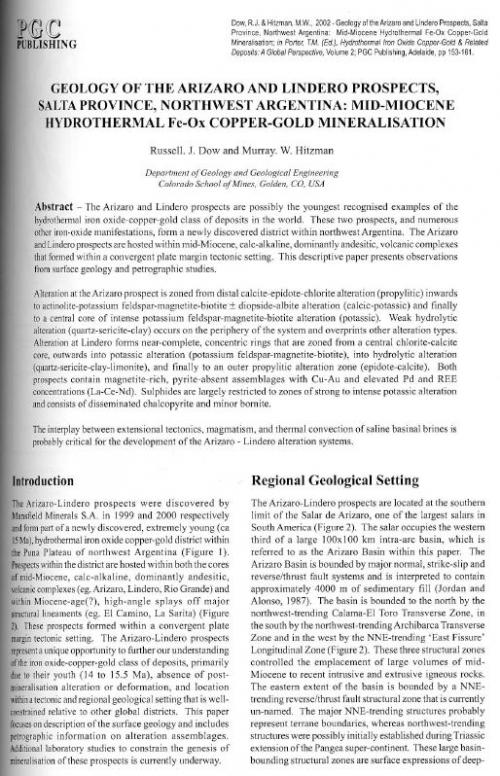
Геология перспективных месторождений Арисаро и Линдеро, провинция Сальта, Северо-запад Аргентины: гидротермальная железисто-медно-золотая минерализация среднего миоцена
The Arizaro and Lindero prospects are possibly the youngest recognised examples of the hydrothermal iron oxide-copper-gold class of deposits in the world. These two prospects, and numerous other iron-oxide manifestations, form a newly discovered district within northwest Argentina. The Arizaro and Lindero prospects are hosted within mid-Miocene, calc-alkaline, dominantly andesitic, volcanic complexes that formed within a convergent plate margin tectonic setting. This descriptive paper presents observations from surface geology and petrographic studies.
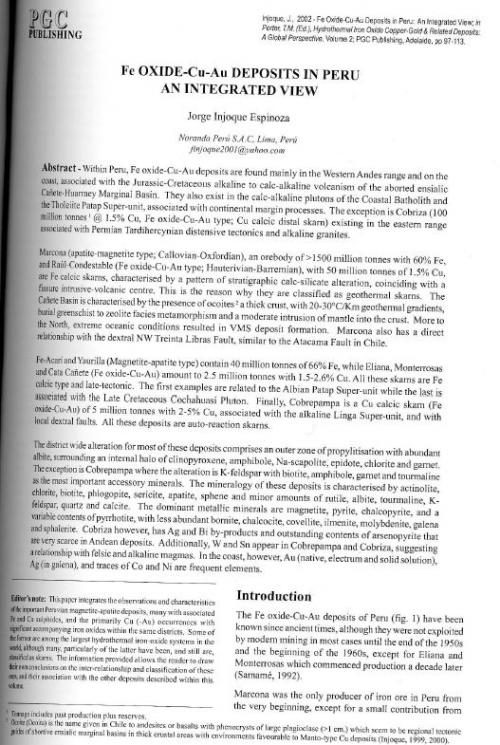
Within Peru, Fe oxide-Cu-Au deposits are found mainly in the Western Andes range and on the coast, associated with the Jurassic-Cretaceous alkaline to calc-alkaline volcanism of the aborted ensialic Canete-Huarmey Marginal Basin. They also exist in the calc-alkaline plutons of the Coastal Batholith and theTholeiite Patap Super-unit, associated with continental margin processes. The exception is Cobriza (100 million tonnes' @ 1.5% Cu, Fe oxide-Cu-Au type; Cu calcic distal skarn) existing in the eastern range associated with Permian Tardihercynian distensive tectonics and alkaline granites.
Phalaborwa is the second largest copper mine in the world and the largest in Africa. The orebody is hosted by the Loolekop pipe within the Phalaborwa Complex, and is also mined for magnetite, apatite, vermiculite with a large array of by-products including gold, silver, phosphate, rare earth elements and uranium. The Phalaborwa Complex intruded Archaean basement at the edge of the Kaapvaal Craton in early Proterozoic times (2060±lMa) and consists of concentrically zoned, multiple intrusions which decrease in age from the margin to the core. The outer parts are predominantly clinopyroxenites, which have been variably metasomatised.
Геология протерозойских месторождений оксидов железа, Нико-кобальт-золото-висмутовых и Сью-Дайанн-медно-серебряных, южная магматическая зона Грейт-Беар, северо-западные территории, Канада.
The NICO cobalt-gold-bismuth and Sue-Dianne copper-silver deposits of the Mazenod Lake area, Northwest Territories, are currently being drill-delineated by Fortune Minerals Limited. They are the only known significant Canadian examples of the Proterozoic iron oxide-hosted polymetallic class, more commonly referred to as hydrothermal iron oxide copper-gold deposits. NICO and Sue-Dianne are located in the southern part of the Great Bear magmatic zone, the central tectonic subdivision of the Bear Structural Province. It is a post-collisional plutonic terrane with related continental volcanic rocks dating from 1867 Ma and culminating with the emplacement of A-type rapikivi granite plutons at approximately 1856 Ma. Iron oxide occurrences are widely distributed within the Great Bear magmatic zone, ranging from Salobo-type magnetite-rich schists and ironstones in receptive basement rocks to Kiruna-type magnetite-apatite-rich veins and Olympic Dam-type sulphidized magnetite-hematite breccias in overlying volcanic rocks. NICO is hosted in iron- and potassium-altered, brecciated basement sedimentary rocks at and beneath the volcanic unconformity, showing similarities to the Salobo-type. The host "black rock" amphibole-magnetite-biotite schists and ironstones are capped by potassium feldspar-magnetite "red rock" felsite. In contrast, Sue-Dianne shows the essential characteristics of Olympic Dam-type ores, with mineralization hosted within a well-zoned diatreme breccia complex crosscutting a rotated ash flow tuff succession above the unconformity. At both NICO and Sue-Dianne, ongoing detailed paragenetic studies demonstrate that early, reduced, high-temperature mineral assemblages are overprinted by late, oxidative, low-temperature assemblages. These together with stratigraphic relationships, indicate fluid mixing at shallow crustal levels was important in deposit formation. Proximity of the NICO and Sue-Dianne deposits to subvolcanic porphyries, rapakivi granite and various other phases of the Marian River Batholith, together with geochronology and mineralogy studies, suggest they are all genetically related. The occurrence of diverse iron oxide deposit types within the Great Bear magmatic zone, makes this region favourable for exploration and for the study of the Proterozoic iron oxide class as a whole.
Porphyry-style Cu-Au/Mo deposits are among the most sought after targets for both base and precious metal exploration in the world today. Of particular interest are the "super porphyry" copper and or gold deposits, because of their size, grade and ability to support large scale, long life, profitable operations.
The term "super porphyry" is interpreted loosely in this publication, relating in general to the largest deposits in any established porphyry province. For a discussion of the accepted terminology and size classification of large porphyry-style deposits, see the introduction section of Richards, (2005) in this publication.
Porphyry-style Cu-Au/Mo deposits are among the most sought after targets for both base and precious metal exploration in the world today. Of particular interest are the "super porphyry" copper and/or gold deposits, because of their size, grade and ability to support large scale, long life, profitable operations.
The term "super porphyry" is interpreted loosely in this publication, relating in general to the largest deposits in any established porphyry province. For a discussion of the accepted terminology and size classification of large porphyry-style deposits, see the introduction section of Richards, (2005) in this publication.
This preface presents the background to this book, the second volume of the "Hydrothermal Iron Oxide Copper-Gold & Related Deposits - A Global Perspective" series, and briefly discusses the rationale for inviting the papers it contains, their format and what it is hoped the volume will achieve. It also offers some observations on the unifying characteristics of the iron oxide copper-gold family of deposits and what they may represent in a broader context.
The "hydrothermal iron-oxide copper-gold" (IOCG) family and related deposits continue to attract keen interest, both as the subject of academic research and as arguably the most sought after mineral exploration target in the world today.
Following the discovery of the giant Olympic Dam ore deposit in 1975, a realisation developed that there was an important class of mineral deposits not previously appreciated. It became apparent that this class, the Iron Oxide Copper-Gold deposits, included not only Olympic Dam, but also a number of other known deposits. It also became apparent that this was a class that could produce large, high grade prizes, of the order of 0.25 to 1 billion tonnes of around +1% Cu and 0.5 g/t Au. As a consequence this class has been one of the major targets of the exploration industry over the last decade, resulting in the discovery of further giant orebodies in Australia such as Ernest Henry, and Candelaria, Salobo, Sossego and others in South America.
Abstract - Hydrothermal copper & gold deposits associated with felsic intrusives, particularly porphyry related and epithermal ores, are found in a series of extensive, narrow, linear metallogenic provinces throughout the world. These are predominantly associated with the great Mesozoic to Cainozoic orogenic belts. Major deposits however, are also found within Palaeozoic orogens, while a few are known from the Precambrian. The style and setting of these deposits is variable and diverse, although many common features emerge from a global comparison.
Рудное поле Оловского месторождения урана локализовано в северной прибортоной части одноименной впадины, расположенной в пределах Олово-Могочинской структурно-металлогенической зоны золотомолибденового пояса (Смирнов, 1944) Восточного Забайкалья (рис.1). С развитием этой зоны связывается мезозойский интрузивный и эффузивный магматизм, формирование мезо-кайнозойских приразломных впадин и разнообразного гидротермального оруденения урана (рудные поля Могочинское, Маяк, Сигирлинскос), золота, молибдена, мышьяка, флюорита, киновари и других полезных ископаемых.
В геологическом строении рудного поля по возрасту образования, условиям залегания и составу выделяется два структурных этажа: нижний-доверхнемезозойский кристаллический фундамент и обрамление впадины и верхний - выполняющие последнюю континентальные неметаморфизованные вулканогенноосадочные отложения верхней юры - нижнего мела. В составе слоистых пород верхнемезозойского структурного этажа выделяется (Пельменсв, 1968) четыре макроритма, каждый из которых начинается относительно грубообломочными терригенными осадками со сменой их к концу ритмов тонкообломочными.