Добрый день, Коллеги. Важное сообщение, просьба принять участие. Музей Ферсмана ищет помощь для реставрационных работ в помещении. Подробности по ссылке
В книге публикуются статьи доктора геолого-минералогических наук СВ. Мейена (1935—1987) — известного специалиста в области палеофлористики и стратиграфии палеозоя. В нее вошла значительная часть научного наследия автора, посвященная систематике и филогении голосеменных, проблеме их происхождения и месте в истории растительного мира. В отдельных статьях рассмотрены вопросы морфологии, систематики, филогении и экологии проптеридофитов. Две статьи посвящены проблемам палеофлористики: соотношениям между палеозойскими флорами Ангариды и Гондваны, а также между палеофитом и мезофитом.
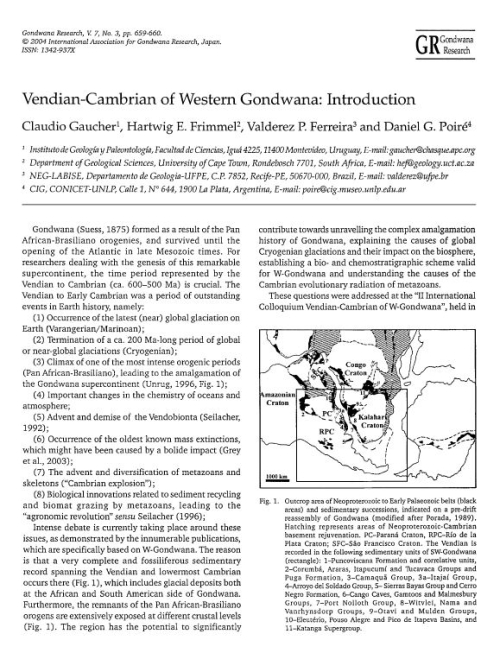
Gondwana (Suess, 1875) formed as a result of the Pan African-Brasiliano orogenies, and survived until the opening of the Atlantic in late Mesozoic times. For researchers dealing with the genesis of this remarkable supercontinent, the time period represented by the Vendian to Cambrian (ca. 600-500 Ma) is crucial. The Vendian to Early Cambrian was a period of outstanding events in Earth history, namely:
(1) Occurrence of the latest (near) global glaciation on Earth (Varangerian/Marinoan);
(2) Termination of a ca. 200 Ma-long period of global or near-global glaciations (Cryogenian);
(3) Climax of one of the most intense orogenic periods (Pan African-Brasiliano), leading to the amalgamation of the Gondwana supercontinent (Unrug, 1996, Fig. 1);
(4) Important changes in the chemistry of oceans and atmosphere;
(5) Advent and demise of the Vendobionta (Seilacher, 1992);
(6) Occurrence of the oldest known mass extinctions, which might have been caused by a bolide impact (Grey etal., 2003);
(7) The advent and diversification of metazoans and skeletons ("Cambrian explosion");
(8) Biological innovations related to sediment recycling and biomat grazing by metazoans, leading to the "agronomic revolution" sertsu Seilacher (1996); <...>
In the Late Cambrian-Ordovician, Gondwana-derived microcontinents such as Kokchetav, Altai-Mongolian, Tuva-Mongolian, and Barguzin, as well as the Kazakhstan-Tuva-Mongolian island arc or a system of island arcs were involved in intense accretion-collision processes in similar geodynamic settings on a vast territory of Central Asia — from West Kazakhstan to Lake Baikal. The processes were likely to be the result of a large rebuilding of the Earth’s crust possibly related to the increased mantle impact on the lithosphere as they were simultaneous to the opening of the Uralian and Mongolian-Okhotsk (Turkestan) Oceans. The 970–850 Ma breakup of Rodinia and the 760–700 Ma important tectonic events were followed by the Late Cambrian-Early Ordovician plume magmatism impulse at 500–480 Ma, which led to the opening of new oceans and accelerated the accretion of the Gondwana-derived blocks to the island arc and subsequent formation of an extended — more than 6000 km long — Kazakhstan-Baikal orogenic belt.
Neotethyan suprasubduction zone ophiolites represent anomalous oceanic crust developed in older host basins during trench rollback cycles and later entrapped in orogenic belts as a result first of trench-passive margin and then continent–continent collisions. The Middle Jurassic Mirdita zone ophiolites in northern Albania constitute a critical transition between the dominantly mid-ocean ridge basalt (MORB)-related Early Jurassic Alpine–Apennine ophiolites in the west and supra-subduction zone (SSZ)-generated Cretaceous Eastern Mediterranean ophiolites in the east. The previously recognized Western- and Eastern-type ophiolites in the Mirdita zone display significant differences in their internal structure and pseudostratigraphy, but their geochemical affinities are more gradational in contrast to the earlier claims that these ophiolites may have formed in different tectonic settings at different times. Crosscutting relations of dike intrusions in the Eastern-type ophiolites indicate changes in the chemistry of magmatic plumbing systems from basaltic to andesitic, dacitic, rhyodacitic, and boninitic compositions through time and from west to east.