Добрый день, Коллеги. Важное сообщение, просьба принять участие. Музей Ферсмана ищет помощь для реставрационных работ в помещении. Подробности по ссылке
The accepted practice for the estimation of thin (2D) vein deposits recommends the use of the grade x thickness service variable (i.e., the accumulation). Grade estimates are obtained indirectly by the estimated accumulation/estimated thickness ratio. This practice stems from the varying support (thickness) problem and the resulting non-additive nature of the grade variable. We compare the actual performance of the direct grade estimation approach used by some practitioners to that of the indirect approach using accumulation. Our simulated and real data indicate that the direct approach is more accurate for point grade estimation where the grade-thickness correlation coefficient is positive (and vice-versa). Moreover, the relative gain of the direct method increases with the (positive) correlation coefficient. This finding contradicts common thinking that the indirect approach should be the preferred method where grade-thickness correlation is strongly positive. Also, for a given positive grade-thickness correlation, the relative gain of the direct method increases with the coefficient of variation of the grade and thickness.
In their paper, Marcotte and Boucher (2001) cast some new light on the old problem of 2D estimation of vein-type deposits with thickness and grade of intercepts. Using a theoretical approach, some extensive simulation experiments and the Walker Lake data, they show that the direct approach (interpolation of grade at points on a regular grid) gives better estimates of the true grade at those points than the indirect approach (interpolation of grade x thickness or accumulation and interpolation of thickness) when there is some positive correlation between grade and thickness and that this better performance increases with the correlation of grade and thickness as well as the variability of both variables. We would like to bring some reservations to that conclusion by showing that even if direct point grade estimates are better than indirect ones, it is not necessarily true for block estimates and in particular for the estimated grade of the whole orebody itself. <...>
В книге рассматриваются системы разработки различных типов жильных месторождений полезных ископаемых, применяемые как в Советском Союзе, так и за рубежом. Приводится горногеологическая характеристика жильных месторождений, дается их классификация, рассматриваются особенности разработки жильных месторождений.
The great surge of interest and activity in exploration for uranium deposits over the last decade has added significantly to our knowledge of uranium geology and the nature of uranium deposits. Much of the information that has been developed by government and industry programmes has not been widely available and in many cases has not had the benefit of systematic gathering, organization and publication.
There are two main issues stemming from Vallée’s (2002) comments on Dominy et al. (2001b). First, he raises the importance of quality assurance/quality control (QA/QC) during resource estimation programs, and second, he indicates that the resolution and understanding of continuity (grade and geological) issues are paramount in the classification of resources. In particular, continuity is critical at the boundary between the Inferred and Indicated Mineral Resource categories.
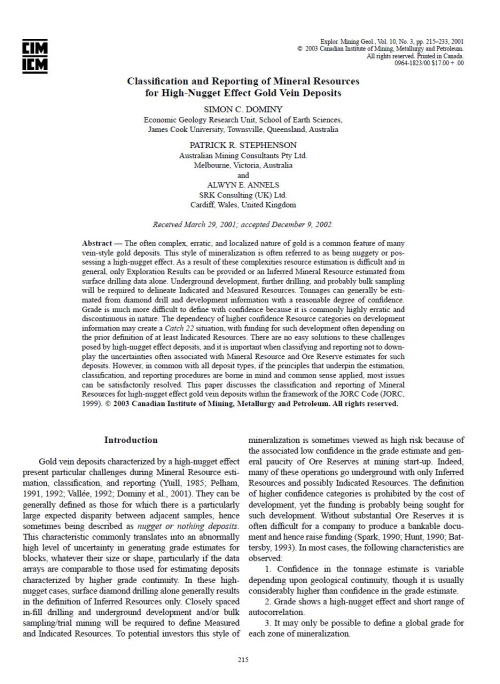
The often complex, erratic, and localized nature of gold is a common feature of many vein-style gold deposits. This style of mineralization is often referred to as being nuggety or possessing a high-nugget effect. As a result of these complexities resource estimation is difficult and in general, only Exploration Results can be provided or an Inferred Mineral Resource estimated from surface drilling data alone. Underground development, further drilling, and probably bulk sampling will be required to delineate Indicated and Measured Resources.
В брошюре доктора технических наук А.Ф. Назарчика (Институт физики Земли имени О. Ю. Шмидта АН СССР) и кандидата технических наук Н.И. Попова (ВНИИ-1) обобщен опыт работы передовых рудников Северо-Востока СССР, рассматриваются возможности более эффективного использования техники при эксплуатации жильных месторождений в зоне вечной мерзлоты.
Книга рассчитана на инженерно-технических работников горнорудной промышленности, экономистов, работников проектных и научно-исследовательских организаций, а также может быть полезна учащимся горных вузов и техникумов
Книга представляет попытку систематического рассмотрения условии формирования и принципиальных особенностей зональности рудных тел и сопутствующих ореолов на низко- п среднетемпературных жильных гидротермальных месторождениях с позиций термодинамического моделирования процессов рудообразования. В исследовании используется равновесно-динамический подход, в котором процесс описывается последовательными равновесными состояниями с включением некоторых элементов динамики. Построены обобщенные модели рудообразующих гидротермальных систем жильных полиметаллических н урановых месторождений, включающие область формирования первичных рудоносных растворов н области рудо- н ореолообразования. Книга рассчитана на геологов, изучающих рудные месторождения, специалнстов-геохнмиков, может служить пособием по моделированию процессов рудообразования для студентов и аспирантов.
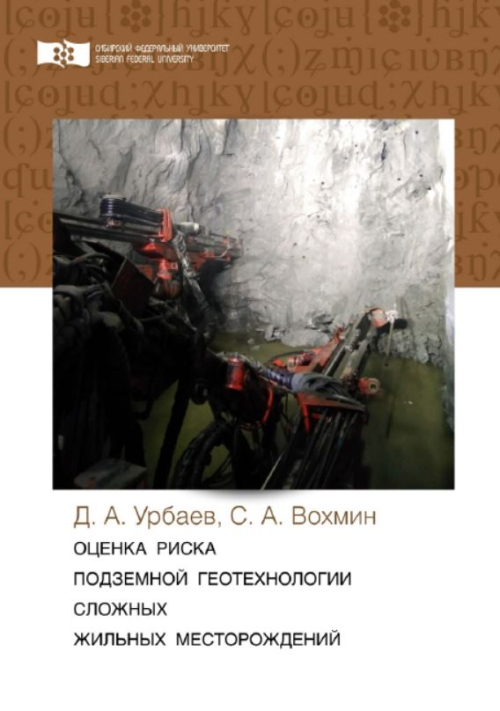
Разработана методика оценки сложности природно-геологических условий и соответствия им технологических параметров добычи для сравнения и обоснования очередности освоения золоторудных месторождений.
Предназначена для горных инженеров, ученых в области горного дела и золотодобычи, студентов горных вузов, а также интересующихся использованием математики для решения прикладных задач.