Добрый день, Коллеги. Важное сообщение, просьба принять участие. Музей Ферсмана ищет помощь для реставрационных работ в помещении. Подробности по ссылке
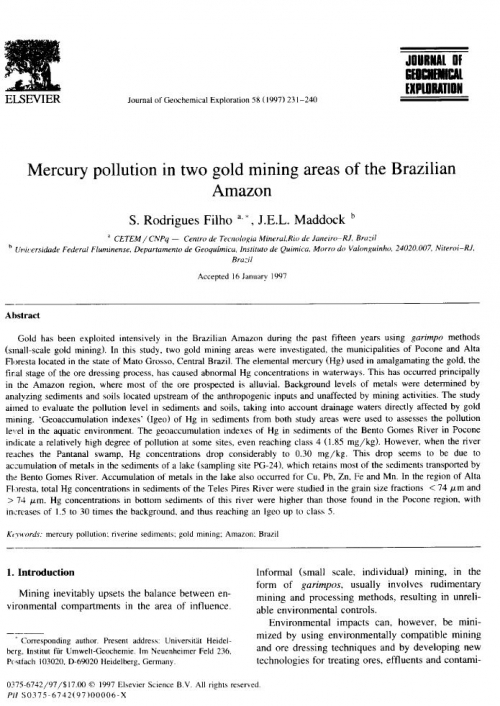
Gold has been exploited intensively in the Brazilian Amazon during the past fifteen years using garimpo methods (small-scale gold mining). In this study, two gold mining areas were investigated, the municipalities of Pocone and Alta Floresta located in the state of Mato Grosso, Central Brazil. The elemental mercury (Hg) used in amalgamating the gold, the fir.al stage of the ore dressing process, has caused abnormal Hg concentrations in waterways. This has occurred principally in the Amazon region, where most of the ore prospected is alluvial. Background levels of metals were determined by analyzing sediments and soils located upstream of the anthropogenic inputs and unaffected by mining activities. The study aimed to evaluate the pollution level in sediments and soils, taking into account drainage waters directly affected by gold mining. 'Geoaccumulation indexes' (Igeo) of Hg in sediments from both study areas were used to assesses the pollution level in the aquatic environment. The geoaccumulation indexes of Hg in sediments of the Bento Gomes River in Pocone indicate a relatively high degree of pollution at some sites, even reaching class 4 (1.85 mg/kg). However, when the river reaches the Pantanal swamp, Hg concentrations drop considerably to 0.30 mg/kg. This drop seems to be due to accumulation of metals in the sediments of a lake (sampling site PG-24), which retains most of the sediments transported by the Bento Gomes River. Accumulation of metals in the lake also occurred for Cu, Pb, Zn, Fe and Mn. In the region of Alta Floresta, total Hg concentrations in sediments of the Teles Pires River were studied in the grain size fractions < 74 /urn and > 74 /xm. Hg concentrations in bottom sediments of this river were higher than those found in the Pocone region, with increases of 1.5 to 30 times the background, and thus reaching an Igeo up to class 5.
Эпигенетическое месторождение Серра Пелада Au-PGE, залегающее в отложениях, и его потенциальная генетическая связь с железооксидно-медно-золотой минерализацией в минеральной провинции Карахас, Амазонский кратон, Бразилия
The Serra Pelada Au-PGE deposit is located within the Carajas Mineral Province of the southeastern Amazon Craton, Brazil. Gold-PGE ores are epigenetic and display a strong structural control, being hosted in sub-greenschist facies carbonaceous and calcareous meta-siltstone, within the hinge zone of a reclined, tight, regional-scale F2 synform. Although the entire orebody has undergone deep tropical weathering, some evidence of the original hydrothermal alteration is preserved. Gold-PGE mineralisation is associated with the formation of magnetite- and hematite-rich hydrothermal breccias, massive zones of hematite metasomatism, intense sericite (white mica)-kaolin metasomatism, siderite veining and a jasperoid envelope of amorphous silica alteration hosting rare disseminated pyrite. All other Au-PGE ore-related mineral assemblages have undergone intense weathering to hydrated Fe-oxides and secondary clay minerals, preventing further description of primary ore and alteration features. The geochemistry of the primary Au-PGE ores at Serra Pelada displays many similarities to that of Fe-oxide Cu-Au deposits within the Carajas Mineral Province, and indeed world-wide, in terms of metal association (eg. Co, Ni, Cu, U), LREE enrichment and accompanying Fe-metasomatism. The Au-Pd-Pt association also suggests ore metal transport in acid, oxidising, chloride-rich fluids, similar to those for Fe-oxide Cu-Au deposits. In combination with these similarities, and the location of the Serra Pelada Au-Pd-Pt deposit, it is suggested that the latter represents a distal equivalent to the Fe-oxide Cu-Au deposits and, as such, a target that may have been overlooked during exploration programs around such terrains globally.