Добрый день, Коллеги. Важное сообщение, просьба принять участие. Музей Ферсмана ищет помощь для реставрационных работ в помещении. Подробности по ссылке
There is a vast literature on the topic of sediment transport, and, generally, the contributions to it fall into three categories: descriptive marine geological, process-oriented oceanographic, and empirical engineering. I admit this is a rather sweeping generalization but so often the engineering literature starts with dimensional reasoning and then obtains results from experiments to produce empirical relationships with little apparent attempt to relate the results to the natural environment. Conversely, the geological literature establishes some very good physical concepts but fails to quantify them sufficiently to turn them into valid theories. The oceanographic approach is to consider the driving fluid processes in the absence of a satisfactory view of the sedimentary response. Of course there are very notable exceptions to the above statements.
The COASTAL SEDIMENTS '07 conference was organized as a technical specialty conference devoted to the physical aspects of sediment processes and morphology change in the coastal and inlet environment. Following previous conferences in the Coastal Sediments series that were held in 1977, 1987, 1991, 1999, and 2003, COASTAL SEDIMENTS'07 celebrated 30 years of the Coastal Sediments series and promoted exchange of information and views among specialists in the fields of coastal engineering, geology, oceanography, and related disciplines. The theme of COASTAL SEDIMENTS
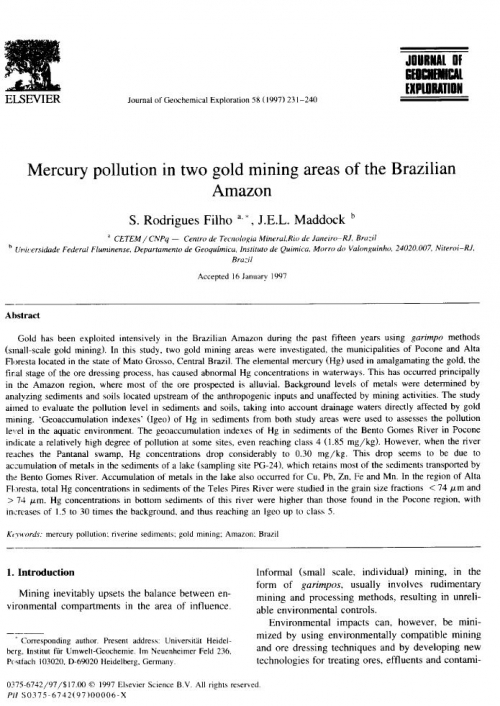
Gold has been exploited intensively in the Brazilian Amazon during the past fifteen years using garimpo methods (small-scale gold mining). In this study, two gold mining areas were investigated, the municipalities of Pocone and Alta Floresta located in the state of Mato Grosso, Central Brazil. The elemental mercury (Hg) used in amalgamating the gold, the fir.al stage of the ore dressing process, has caused abnormal Hg concentrations in waterways. This has occurred principally in the Amazon region, where most of the ore prospected is alluvial. Background levels of metals were determined by analyzing sediments and soils located upstream of the anthropogenic inputs and unaffected by mining activities. The study aimed to evaluate the pollution level in sediments and soils, taking into account drainage waters directly affected by gold mining. 'Geoaccumulation indexes' (Igeo) of Hg in sediments from both study areas were used to assesses the pollution level in the aquatic environment. The geoaccumulation indexes of Hg in sediments of the Bento Gomes River in Pocone indicate a relatively high degree of pollution at some sites, even reaching class 4 (1.85 mg/kg). However, when the river reaches the Pantanal swamp, Hg concentrations drop considerably to 0.30 mg/kg. This drop seems to be due to accumulation of metals in the sediments of a lake (sampling site PG-24), which retains most of the sediments transported by the Bento Gomes River. Accumulation of metals in the lake also occurred for Cu, Pb, Zn, Fe and Mn. In the region of Alta Floresta, total Hg concentrations in sediments of the Teles Pires River were studied in the grain size fractions < 74 /urn and > 74 /xm. Hg concentrations in bottom sediments of this river were higher than those found in the Pocone region, with increases of 1.5 to 30 times the background, and thus reaching an Igeo up to class 5.
У нас есть: 33719 книг, 8273 карты, 47 инбоксов. Итого: 42039 материалов