Добрый день, Коллеги. Важное сообщение, просьба принять участие. Музей Ферсмана ищет помощь для реставрационных работ в помещении. Подробности по ссылке
The Kupol epithermal Au-Ag vein district is located in the northern part of the Okhotsk-Chukotka volcanic belt, a Late Cretaceous subduction-related continental volcanic arc exposed for >3,000 km along the eastern coast of Russia. High-grade veins are hosted in the Kupol andesite sequence, a 300- to 1,000-m-thick, subhorizontal, layered sequence of andesite flows, sills, and ash tuffs, dated at 97 to 96 Ma (Cenomanian). The Kupol andesite sequence is underlain by mixed mafic-felsic volcanic units plus sedimentary rocks (“older volcanics”) and overlain by a >1-km-thick “upper felsic” sequence of dacitic-rhyolitic tuffs and associated dikes and flow domes, dated at 95 to 85 Ma, with local sequences of fluvio-lacustrine sedimentary rocks.
The Elatsite porphyry copper deposit is one of the two operating large Bulgarian copper and gold deposits. It is located in the Elatsite-Chelopech ore field, the northernmost part of the Panagyurishte ore district of the Apuseni-Banat-Timok-Srednogorie magmatic and metallogenic belt. The ore mineralization is associated with the Late Cretaceous magmatic activity manifested in the area. It is of vein-disseminated type and builds up a large ore stockwork.
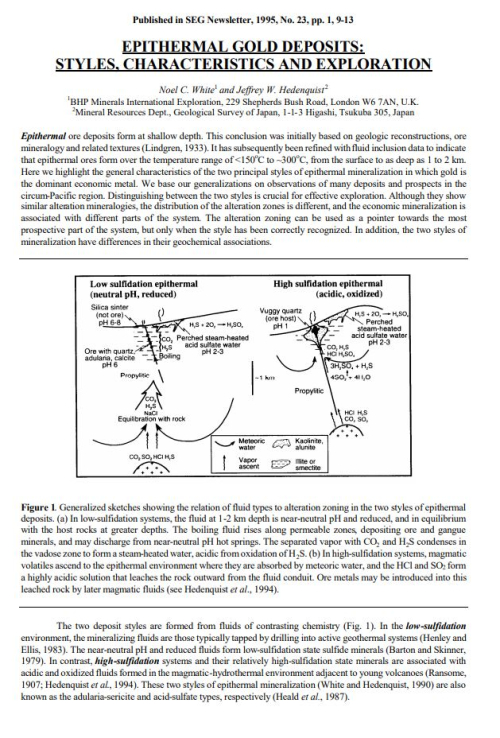
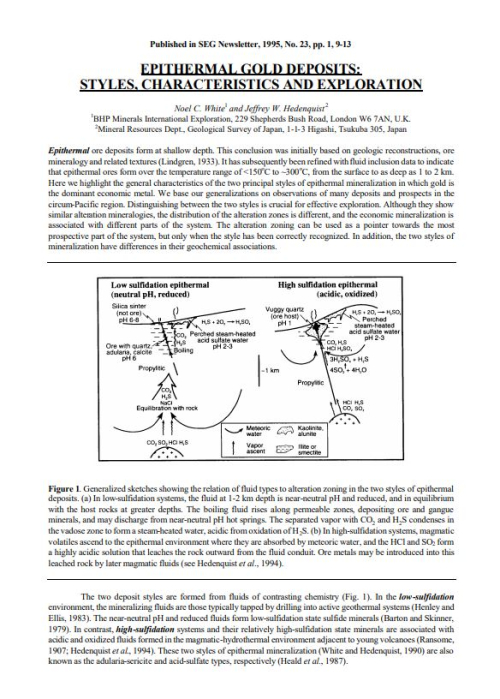
Epithermal ore deposits form at shallow depth. This conclusion was initially based on geologic reconstructions, ore mineralogy and related textures (Lindgren, 1933). It has subsequently been refined withfluid inclusion data to indicate that epithermal ores form over the temperature range of <150o C to ~300o C, from the surface to as deep as 1 to 2 km. Here we highlight the general characteristics of the two principal styles of epithermal mineralization in which gold is the dominant economic metal. We base our generalizations on observations of many deposits and prospects in the circum-Pacific region. Distinguishing between the two styles is crucial for effective exploration. Although they show similar alteration mineralogies, the distribution of the alteration zones is different, and the economic mineralization is associated with different parts of the system. The alteration zoning can be used as a pointer towards the most prospective part of the system, but only when the style has been correctly recognized. In addition, the two styles of mineralization have differences in their geochemical associations. <...>
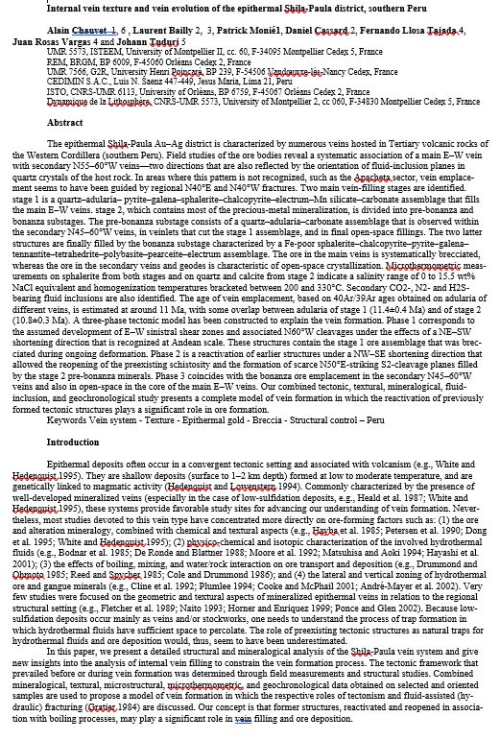
The epithermal Shila-Paula Au–Ag district is characterized by numerous veins hosted in Tertiary volcanic rocks of the Western Cordillera (southern Peru). Field studies of the ore bodies reveal a systematic association of a main E–W vein with secondary N55–60°W veins—two directions that are also reflected by the orientation of fluid-inclusion planes in quartz crystals of the host rock. In areas where this pattern is not recognized, such as the Apacheta sector, vein emplacement seems to have been guided by regional N40°E and N40°W fractures. Two main vein-filling stages are identified. stage 1 is a quartz–adularia– pyrite–galena–sphalerite–chalcopyrite–electrum–Mn silicate–carbonate assemblage that fills the main E–W veins. stage 2, which contains most of the precious-metal mineralization, is divided into pre-bonanza and bonanza substages. The pre-bonanza substage consists of a quartz–adularia–carbonate assemblage that is observed within the secondary N45–60°W veins, in veinlets that cut the stage 1 assemblage, and in final open-space fillings.
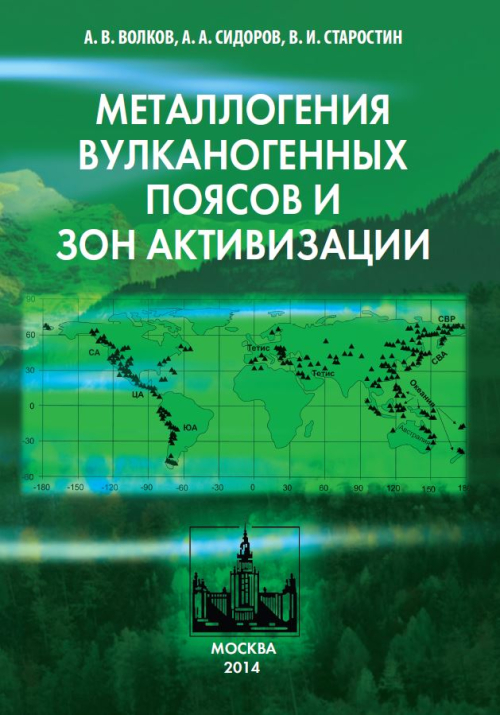
В монографии рассмотрены многочисленные закономерности и особенности металлоносности вулканогенных поясов различного типа при особом внимании к месторождениям благородных металлов. В частности, в отдельной главе охарактеризованы эпитермальные месторождения золота и серебра в существенно обновленной интерпретации их генезиса и рудноформационных связей. Основной оригинальный материал получен при исследовании регионов окраинноморской литосферы Северо-востока Азии.
Для специалистов в области металлогении, геологии и генезиса рудных месторождений, преподавателей и студентов геологических специальностей вузов.
Актуальность условий формирования золоторудных месторождений определяется двумя глобальными факторами. При сохранении традиционной инвестиционной привлекательности золота отмечается снижение динамики мирового производства этого драгоценного металла по фактическому объему добычи в период с 2019-2021 гг. По экспертным оценкам мировое производство золота может сократится на 15-20% уже к 2030 году по причине снижения качества и количества мировых запасов. Российский сектор будет подчиняться глобальным тенденциям, что создает возможность прохождения пиковых объемов добычи золота в нашей стране в ближайшей перспективе. Истощение сырьевой базы лидирующих золотодобывающих регионов России делает актуальным проведение геологоразведочных работ на выявление перспективных золоторудных объектов, не являющихся привычными по геологической и/или технологической характеристикам, в том числе находящихся в труднодоступных районах.
Epithermal ore deposits form at shallow depth. This conclusion was initially based on geologic reconstructions, ore mineralogy and related textures (Lindgren, 1933). It has subsequently been refined withfluid inclusion data to indicate that epithermal ores form over the temperature range of <150o C to ~300o C, from the surface to as deep as 1 to 2 km. Here we highlight the general characteristics of the two principal styles of epithermal mineralization in which gold is the dominant economic metal. We base our generalizations on observations of many deposits and prospects in the circum-Pacific region. Distinguishing between the two styles is crucial for effective exploration. Although they show similar alteration mineralogies, the distribution of the alteration zones is different, and the economic mineralization is associated with different parts of the system. The alteration zoning can be used as a pointer towards the most prospective part of the system, but only when the style has been correctly recognized. In addition, the two styles of mineralization have differences in their geochemical associations. <...>
About the Special Issue Editor Preface to ”Experimental and Thermodynamical Modeling of Ore-Forming Processes in Magmatic and Hydrothermal Systems” Galina Palyanova Editorial for the Special Issue: Experimental and Thermodynamic Modeling of Ore-Forming Processes in Magmatic and Hydrothermal Systems Reprinted from Alexander V. Zotov, Nikolai N. Kuzmin, Vladimir L. Reukov and Boris R. Tagirov Stability of AuCl2 − from 25 to 1000 ◦C at Pressures to 5000 bar and Consequences for Hydrothermal Gold Mobilization Vladimir L. Tauson, Sergey V. Lipko, Nikolay V. Smagunov and Raisa G. Kravtsova Trace Element Partitioning Dualism under Mineral–Fluid Interaction: Origin and Geochemical Significance