Добрый день, Коллеги. Важное сообщение, просьба принять участие. Музей Ферсмана ищет помощь для реставрационных работ в помещении. Подробности по ссылке
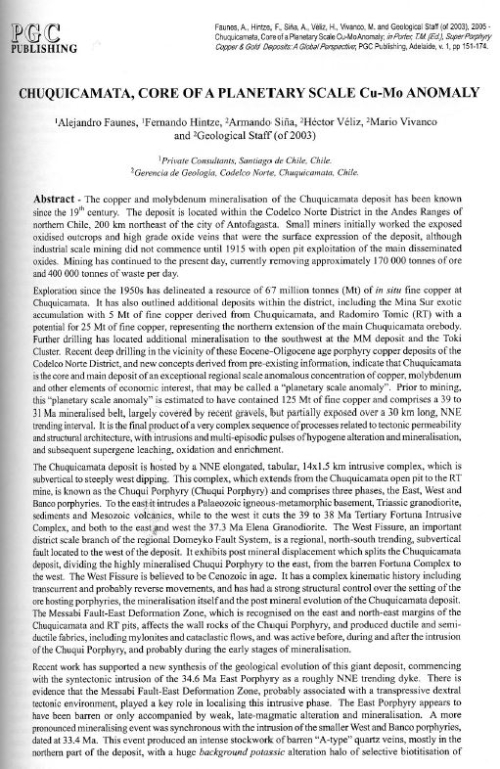
The copper and molybdenum mineralisation of the Chuquicamata deposit has been known since the 19' century. The deposit is located within the Codelco Norte District in the Andes Ranges of northern Chile, 200 km northeast of the city of Antofagasta. Small miners initially worked the exposed oxidised outcrops and high grade oxide veins that were the surface expression of the deposit, although industrial scale mining did not commence until 1915 with open pit exploitation of the main disseminated oxides. Mining has continued to the present day, currently removing approximately 170 000 tonnes of ore and 400 000 tonnes of waste per day.
Медно-порфировое месторождение Эскондида, Север Чили: Открытие, расположение, геология, гипогенная минерализация и гипергенная руда - Обзор
The Escondida porphyry copper deposit and its satellites are the source of ore for the world's current largest copper mine, with an installed capacity of 1.2 Mt of fine copper per annum. The published ore reserve + mineral resource at Escondida and the satellite Escondida Norte deposits at the end of 2004 totalled 2.88 Gt @ 1.13% Cu, or 10.11 Gt @ 0.70% Cu when lower grade leach and oxide ores are included. Escondida was discovered in 1981 as the culmination of an exploration program initiated in 1978. This program, the Atacama Project, was specifically targeted at locating supergene enriched porphyry copper ore within the 500 km interval between Chuquicamata and El Salvador, in the established porphyry copper belt of northern Chile.
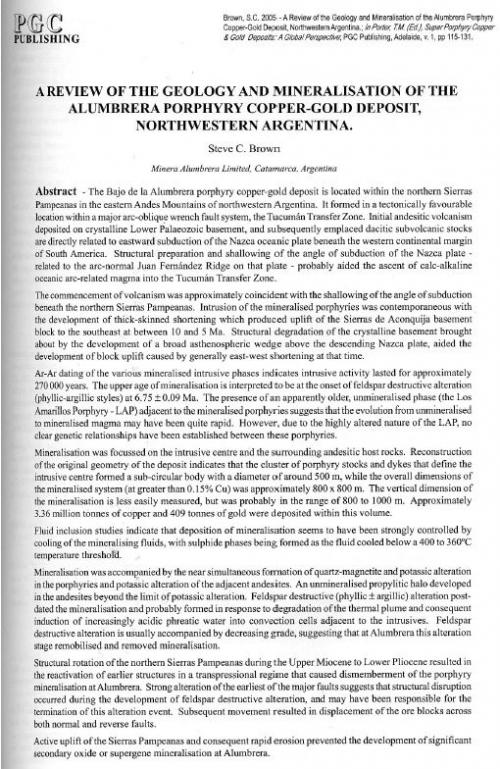
The Bajo de la Alumbrera porphyry copper-gold deposit is located within the northern Sierras Pampeanas in the eastern Andes Mountains of northwestern Argentina. It formed in a tectonically favourable location within a major arc-oblique wrench fault system, the Tucuman Transfer Zone. Initial andesitic volcanism deposited on crystalline Lower Palaeozoic basement, and subsequently emplaced dacitic subvolcanic stocks are directly related to eastward subduction of the Nazca oceanic plate beneath the western continental margin of South America. Structural preparation and shallowing of the angle of subduction of the Nazca plate -related to the arc-normal Juan Fernandez Ridge on that plate - probably aided the ascent of calc-alkaline oceanic arc-related magma into the Tucuman Transfer Zone.
The formation of porphyry Cu deposits in calc-alkaline magmatic arcs is considered to be the cumulative product of a wide range of processes beginning with dehydration of the subducting oceanic slab. No single process is key to the formation of large deposits, but the absence or inefficient operation of any contributory process, or the action of a deleterious process, can stunt or prevent deposit formation.
The Wernecke and Southern Ogilvie Mountains in Yukon are part of an almost east-west trending range in the northern Canadian Cordillera in which several areas of the Palaeo-Mesoproterozoic basement are exposed, enveloped by a Phanerozoic miogeoclinal sequence. The oldest division, the -1.8-1.4 Ga Wernecke Supergroup, is interpreted as a "clastic rift'". It is an up to 15 km thick pile, the bulk of which is a monotonous, well-bedded siltite-quartz rich litharenite-argillite, topped by carbonate-pelite units. Less than 1% of the area consists of small gabbro to diorite intrusions of several, mostly Palaeoproterozoic and Mesoproterozoic, generations. The predominantly brittle deformation regime produced extensive tracts of disrupted and dismembered units grading to tectonic (not subduction !) melange. These have been overprinted by large scale Na, Ca, Mg, Fe, C02 and lesser Si, K metasomatism to produce widespread albitisation, chloritisation, carbonatisation, hematitisation and less extensive sericitisation (with local biotite) of the fractured sedimentary » magmatic rocks as well as tectonic fragmentites. The "Wernecke Breccia" is a metasomatised disaggregated breccia series and it is associated with hundreds of small scattered showings of specular hematite, magnetite and chalcopyrite, several occurrences of U and Co minerals, and anomalous gold. Not even a marginally economic orebody has so far been discovered despite intermittent exploration going back to the 1960s. It appears that we are dealing with a moderately deep (closely above the ductile-brittle interface) level of regional release and displacement of metals from source rocks (Fe, Cu and Co from gabbros; U perhaps from carbonaceous argillites) by metasomatic destruction of the carrier minerals. However, the system lacked sufficient plumbing and the channelling required to produce better metal accumulations at higher levels.
Геология перспективных месторождений Арисаро и Линдеро, провинция Сальта, Северо-запад Аргентины: гидротермальная железисто-медно-золотая минерализация среднего миоцена
The Arizaro and Lindero prospects are possibly the youngest recognised examples of the hydrothermal iron oxide-copper-gold class of deposits in the world. These two prospects, and numerous other iron-oxide manifestations, form a newly discovered district within northwest Argentina. The Arizaro and Lindero prospects are hosted within mid-Miocene, calc-alkaline, dominantly andesitic, volcanic complexes that formed within a convergent plate margin tectonic setting. This descriptive paper presents observations from surface geology and petrographic studies.
Within Peru, Fe oxide-Cu-Au deposits are found mainly in the Western Andes range and on the coast, associated with the Jurassic-Cretaceous alkaline to calc-alkaline volcanism of the aborted ensialic Canete-Huarmey Marginal Basin. They also exist in the calc-alkaline plutons of the Coastal Batholith and theTholeiite Patap Super-unit, associated with continental margin processes. The exception is Cobriza (100 million tonnes' @ 1.5% Cu, Fe oxide-Cu-Au type; Cu calcic distal skarn) existing in the eastern range associated with Permian Tardihercynian distensive tectonics and alkaline granites.
Phalaborwa is the second largest copper mine in the world and the largest in Africa. The orebody is hosted by the Loolekop pipe within the Phalaborwa Complex, and is also mined for magnetite, apatite, vermiculite with a large array of by-products including gold, silver, phosphate, rare earth elements and uranium. The Phalaborwa Complex intruded Archaean basement at the edge of the Kaapvaal Craton in early Proterozoic times (2060±lMa) and consists of concentrically zoned, multiple intrusions which decrease in age from the margin to the core. The outer parts are predominantly clinopyroxenites, which have been variably metasomatised.
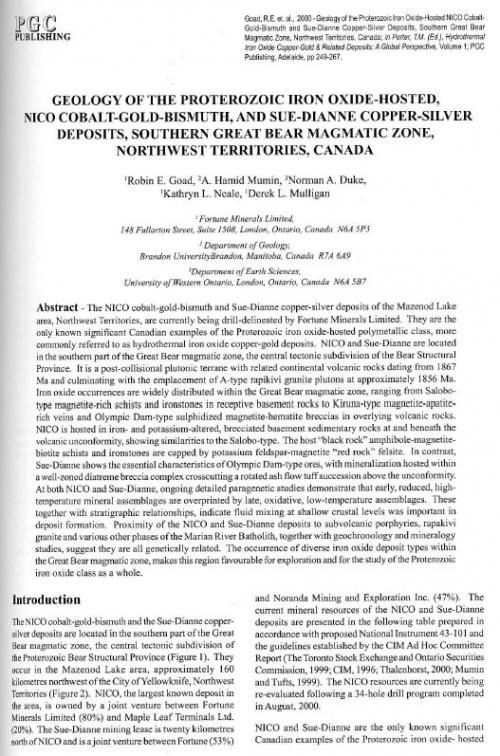
Геология протерозойских месторождений оксидов железа, Нико-кобальт-золото-висмутовых и Сью-Дайанн-медно-серебряных, южная магматическая зона Грейт-Беар, северо-западные территории, Канада.
The NICO cobalt-gold-bismuth and Sue-Dianne copper-silver deposits of the Mazenod Lake area, Northwest Territories, are currently being drill-delineated by Fortune Minerals Limited. They are the only known significant Canadian examples of the Proterozoic iron oxide-hosted polymetallic class, more commonly referred to as hydrothermal iron oxide copper-gold deposits. NICO and Sue-Dianne are located in the southern part of the Great Bear magmatic zone, the central tectonic subdivision of the Bear Structural Province. It is a post-collisional plutonic terrane with related continental volcanic rocks dating from 1867 Ma and culminating with the emplacement of A-type rapikivi granite plutons at approximately 1856 Ma. Iron oxide occurrences are widely distributed within the Great Bear magmatic zone, ranging from Salobo-type magnetite-rich schists and ironstones in receptive basement rocks to Kiruna-type magnetite-apatite-rich veins and Olympic Dam-type sulphidized magnetite-hematite breccias in overlying volcanic rocks. NICO is hosted in iron- and potassium-altered, brecciated basement sedimentary rocks at and beneath the volcanic unconformity, showing similarities to the Salobo-type. The host "black rock" amphibole-magnetite-biotite schists and ironstones are capped by potassium feldspar-magnetite "red rock" felsite. In contrast, Sue-Dianne shows the essential characteristics of Olympic Dam-type ores, with mineralization hosted within a well-zoned diatreme breccia complex crosscutting a rotated ash flow tuff succession above the unconformity. At both NICO and Sue-Dianne, ongoing detailed paragenetic studies demonstrate that early, reduced, high-temperature mineral assemblages are overprinted by late, oxidative, low-temperature assemblages. These together with stratigraphic relationships, indicate fluid mixing at shallow crustal levels was important in deposit formation. Proximity of the NICO and Sue-Dianne deposits to subvolcanic porphyries, rapakivi granite and various other phases of the Marian River Batholith, together with geochronology and mineralogy studies, suggest they are all genetically related. The occurrence of diverse iron oxide deposit types within the Great Bear magmatic zone, makes this region favourable for exploration and for the study of the Proterozoic iron oxide class as a whole.
Porphyry-style Cu-Au/Mo deposits are among the most sought after targets for both base and precious metal exploration in the world today. Of particular interest are the "super porphyry" copper and or gold deposits, because of their size, grade and ability to support large scale, long life, profitable operations.
The term "super porphyry" is interpreted loosely in this publication, relating in general to the largest deposits in any established porphyry province. For a discussion of the accepted terminology and size classification of large porphyry-style deposits, see the introduction section of Richards, (2005) in this publication.