Добрый день, Коллеги. Важное сообщение, просьба принять участие. Музей Ферсмана ищет помощь для реставрационных работ в помещении. Подробности по ссылке
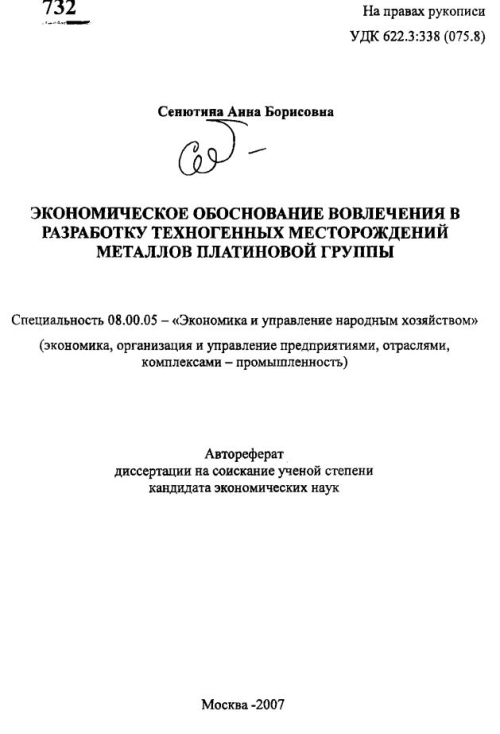
Особую значимость в системе минеральносырьевого комплекса имеют драгоценные металлы Pt, Au, Pd, Rh, Ru, lr, Os, g, которые, благодаря своим уникальным физико-химическим и механическим свойствам, пользуются спросом во многих отраслях промышленности и у населения. Вместе с тем, значительная их часть может выступать в роли всеобщего эквивалента стоимости денежных металлов (металлических денег).
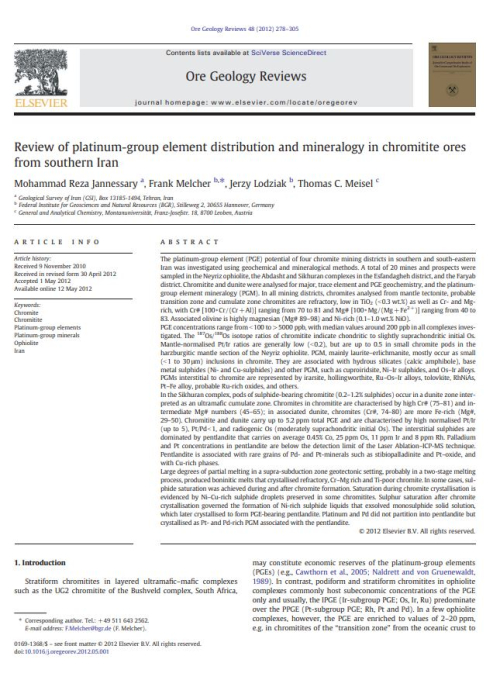
The platinum-group element (PGE) potential of four chromite mining districts in southern and south-eastern Iran was investigated using geochemical and mineralogical methods. A total of 20 mines and prospects were sampled in the Neyriz ophiolite, the Abdasht and Sikhuran complexes in the Esfandagheh district, and the Faryab district. Chromitite and dunite were analysed for major, trace element and PGE geochemistry, and the platinumgroup element mineralogy (PGM). In all mining districts, chromites analysed from mantle tectonite, probable transition zone and cumulate zone chromitites are refractory, low in TiO2 (b0.3 wt.%) as well as Cr- and Mgrich, with Cr# [100*Cr /(Cr+Al)] ranging from 70 to 81 and Mg# [100*Mg /(Mg+ Fe2+)] ranging from 40 to 83.
Минералогические вариации элементов платиновой группы в измененном хромитите расслоенного магматического комплекса Кондапалли (Южная Индия): влияние на эволюцию магматизма и его петрогенетическое значение
Platinum Group Minerals (PGMs) associated with Chromite form in a wide range of geotectonic settings, namely, (1) stratiform or layered magmatic complexes, (2) podiform complexes in ophiolites, (3) the Alaskan zoned complexes and (4) Chromite-rich Archean complexes are also called ‘conduit-type’ (Mondal and Baidya, 1997; Auge et al., 2002; Ahmed and Arai, 2003; Economou-Eliopoulos, 2010; Mukherjee et al., 2012; Mungall, 2014; Peck and Huminicki, 2016; O’Driscoll and González-Jimenez, 2016; Prichard et al., 2017a-b; Mondal et al., 2019).
Объектом исследования является офиолитовый комплекс Кала Эн Нахаль-Умм Сагата, расположенный в районе Гедареф Судана. Офиолитовые комплексы установлены во многих местах Судана, например, Красноморские холмы, холмы Ингессана в северных провинциях, а также в южной части центрального Судана.
ГеологическаяслужбаФинляндии.Геологияипетрологияруд основных расслоенных интрузий Аканваара иКойтелайнени расслоенного комплекса Кейвица-Сатоваара,севернаяФинляндия
The Akanvaara and Koitelainen intrusions, ca 2440 Ma old, represent a group of cratonic mafic layered intrusions (aged from 2500 to 2440 Ma) of the Fennoscandian (Baltic) Shield. These intrusions, which show all the standard types of igneous layering, host deposits of chromite, vanadium, titanium, platinum-group elements (PGE) and gold. The cumulate stratigraphy in Akanvaara and Koitelainen reflects both normal tholeiitic fractionation and superimposed intermittent selective and wholesale contamination by anatectic salic melt (now granophyre) from the floor and the roof, and by refractory residual phases after anatexis of the roof rocks.
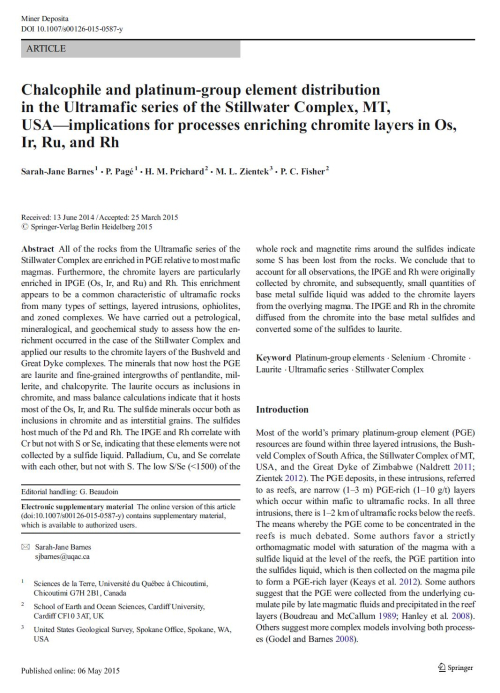
Распределение халькофильных элементов и элементов платиновой группы в ультраосновных породах комплекса Стиллуотер, Массачусетс, США - влияние на процессы обогащения слоев хромита Os, Ir, Ru и Rh
All of the rocks from the Ultramafic series of the Stillwater Complex are enriched in PGE relative to most mafic magmas. Furthermore, the chromite layers are particularly enriched in IPGE (Os, Ir, and Ru) and Rh. This enrichment appears to be a common characteristic of ultramafic rocks from many types of settings, layered intrusions, ophiolites, and zoned complexes.
Databases of mineral deposits and occurrences are essential to conducting assessments of undiscovered mineral resources (Singer, 1993). In the USGS’s (U.S. Geological Survey) global assessment of undiscovered resources of copper, potash, and the platinum-group elements (PGE), only a few mineral deposit types will be evaluated. For example, only porphyry-copper and sediment-hosted copper deposits will be considered for the copper assessment.
Andrei Y. Barkov and Federica Zaccarini Editorial for the Special Issue “Platinum-Group Minerals: New Results and Advances in PGE Mineralogy in Various Ni-Cu-Cr-PGE Ore Systems” Federica Zaccarini, Giorgio Garuti, Evgeny Pushkarev and Oskar Thalhammer Origin of Platinum Group Minerals (PGM) Inclusions in Chromite Deposits of the Urals Sai-Hong Yang, Ben-Xun Su, Xiao-Wen Huang, Dong-Mei Tang, Ke-Zhang Qin, Yang Bai, Patrick Asamoah Sakyi and Melesse Alemayehu Platinum-Group Mineral Occurrences and Platinum-Group Elemental Geochemistry of the Xiadong Alaskan-Type Complex in the Southern Central Asian Orogenic Belt
This book describes extraction of nickel, cobalt and platinum-group metals. The starting point is ore-in-place and the finishing point is high-purity metals and chemicals. We have combined the description of these metals in one book because they very often occur together, are extracted together and have similar properties. The objectives of the book are to:
(a) describe how these metals occur and are extracted; (b) explain why these extraction processes have been chosen; (c) indicate how the processes can be operated most efficiently, with minimal impact on the environment; and, (d) suggest future improvements.