Добрый день, Коллеги. Важное сообщение, просьба принять участие. Музей Ферсмана ищет помощь для реставрационных работ в помещении. Подробности по ссылке
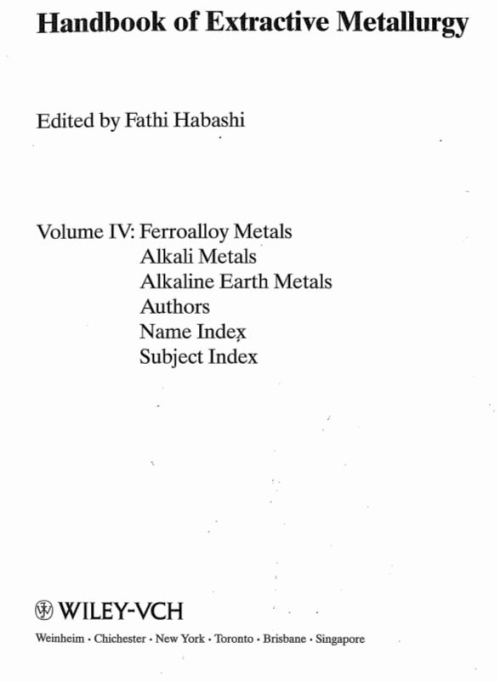
Extractive metallurgy is that branch of metallurgy that deals with ores as raw material and metals as finished products. It is an ancient art that has been transformed into a modem science as a result of developments in chemistry and chemical engineering. The present volume is a collective work of a number of authors in which metals, their history, properties, extraction technology, and most important inorganic compounds and toxicology are systematically described.
Extractive metallurgy is that branch of metallurgy that deals with ores as raw material and metals as finished products. It is an ancient art that has been transformed into a modem science as a result of developments in chemistry and chemical engineering. The present volume is a collective work of a number of authors in which metals, their history', properties, extraction technology, and most important inorganic compounds and toxicology are systematically described.
Extractive metallurgy is that branch of metallurgy that deals with ores as raw material and metals as finished products. It is an ancient art that has been transformed into a modem science as a result of developments in chemistry and chemical engineering. The present volume is a collective work of a number of authors in which metals, their history, properties, extraction technology, and most important inorganic compounds and toxicology are systematically described.
The aim of this book is to summarize the current state of knowledge on the environmental geochemistry and resource potential of metallurgical slags. Hundreds of millions of tonnes of slag, a by-product of pyrometallurgical processing of ferrous and non-ferrous ores or recyclable materials, are generated annually worldwide. These slags are either landfilled, reprocessed, or repurposed.
The term rare earths denotes the group of 17 chemically similar metallic elements that includes scandium, yttrium, and the lanthanides (Spedding 1978; Connelly et al. 2005). The lanthanides are the series of elements with atomic numbers 57 to 71, all of which, except promethium, occur in nature. The rare-earth elements, being chemically similar to one another, invariably occur together in minerals and behave as a single chemical entity. Thus, the discovery of the rare earths themselves occurred over a period of nearly 160 years, from 1787 to 1941 (Szabadvary 1988; Weeks 1956).
Reports of economic crises, investor anxiety and the impact of climate change al help paint a gloomy picture of the future. More optimistic predictions may be met with scorn and accused of lack of ‘reality.’ Nonetheless, one of the many lessons of history is that accurate factual data provides by far the best basis for discussion of future alternative paths of development, optimistic or otherwise (Raw Materials Database 2012). The objectives of this paper are to show: (1) that positive future trends related to mining and metals are evident (Ericsson and Hodge 2012); and (2) that a number of gloom-laden myths should be refuted
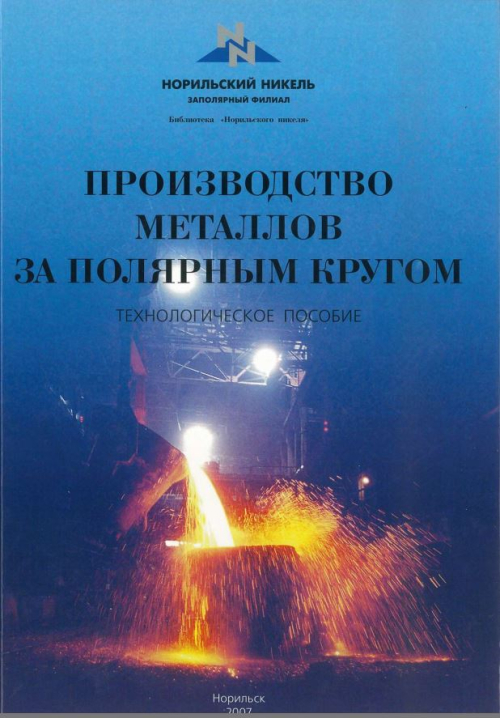
На предприятиях Группы компаний «Норильский никель» работают десятки тысяч специалистов - металлурги и геологи, горняки и транспортники, обогатители и финансисты. Но кем бы ни был по профессии работающий в Группе - он, в первую очередь, работник «Норильского никеля».
Основные производственные мощности горно-металлургической компании «Норильский никель» расположены на полуострове Таймыр. Здесь же находится головное предприятие компании — ее Заполярный филиал. Таймырский полуостров - самый северный в мире. На северных территориях Таймыра — арктические пустыни, выходящие к Карскому морю и морю Лаптевых, и горы Бырранга (высота до ] 146 м над уровнем моря). В средней части — Северо-Сибирская низменность и тундра. На юге — горы Путорана (до 1500 м над уровнем моря), горная тундра и лесотундра.