Добрый день, Коллеги. Важное сообщение, просьба принять участие. Музей Ферсмана ищет помощь для реставрационных работ в помещении. Подробности по ссылке
The Hattu schist belt is an emerging gold-producing ore district in the western part of the Archean Karelian Province of the Fennoscandian Shield. The belt consists of 2.76 to 2.70 Ga tonalite, granodiorite, and leucogranite intruded into a mafic-felsic epiclastic-volcanic sequence of an only slightly older age. Complex and successive folding, shearing, and hydrothermal processes affected these rocks prior to the lower amphibolites facies peak metamorphism (550° ± 50°C; 3–5 kbar) at ca. 2.70 Ga. Orogenic gold deposits are hosted by the highly strained zones that developed during the Archean deformation of the belt. However, previous K-Ar and Rb-Sr geochronological studies indicated that a second tectonothermal overprint affected the Hattu schist belt between 1.7 and 1.8 Ga during the Svecofennian orogeny.
Accretionary orogens are the sites of long-lived convergent margin tectonics, both compressional and extensional. They are also the hosts to the majority of the world’s important gold deposits. A very diverse range of deposit types occurs within accretionary orogens, commonly in close proximity in space and time to each other. These include porphyry and associated high-sulphidation Au–Cu–Ag deposits, classic low-sulphidation Au–Ag deposits, low-sulphidation Au deposits centred on alkalic intrusive complexes, Carlin-type Au deposits, Au-rich volcanichosted massive sulphide deposits, orogenic Au deposits, intrusion-related Au deposits and iron oxide Cu–Au deposits. Empirical patterns of spatial distribution of these deposits suggest there must be fundamental generic controls on gold metallogeny.
The so-called ‘mesothermal’ gold deposits are associated with regionally metamorphosed terranes of all ages. Ores were formed during compressional to transpressional deformation processes at convergent plate margins in accretionary and collisional orogens. In both types of orogen, hydrated marine sedimentary and volcanic rocks have been added to continental margins during tens to some 100 million years of collision.
In the last 15 years the concept of mineral systems approach to understanding orogenic gold systems has been developed. The orogenic gold model, as defined by Groves et al. (1998) argues for gold to be deposited during compressional deformation in accretionary orogens, from hydrothermal fluids derived from the metamorphism of greenstones. These deposits are typically found in late Archaean or in Palaeoproterozoic greenstone belts (Groves et al., 2007) and include the world class gold provinces of Yilgarn Craton, Superior Province, the Birimian of West Africa and the Tanzania Craton.
Orogenic gold deposits have formed over more than 3 billion years of Earth’s history, episodically during the Middle Archean to younger Precambrian, and continuously throughout the Phanerozoic. This class of gold deposit is characteristically associated with deformed and metamorphosed mid-crustal blocks, particularly in spatial association with major rustal structures. A consistent spatial and temporal association with granitoids of a variety of compositions indicates that melts and fluids were both inherent products of thermal events during orogenesis.
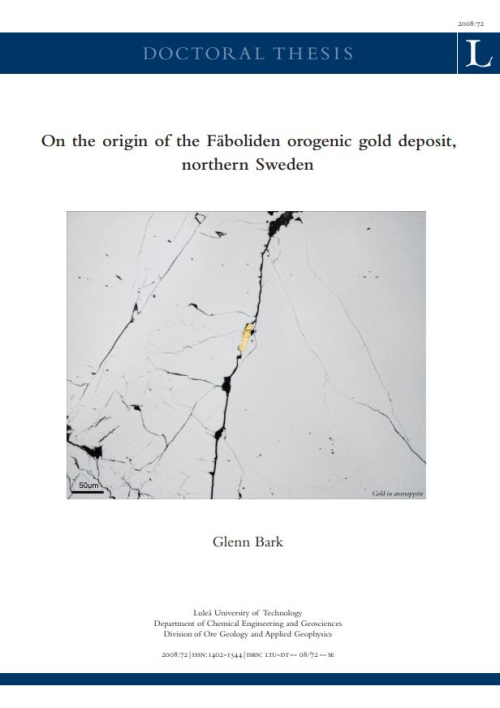
A new promising ore province, the Gold Line, southwest of the well-known Skellefte District, northern Sweden, is currently under exploration. This province hosts, so far, one operating mine, the Svartliden Au mine, and the recently closed Blaiken Zn-Pb-Au-Ag mine. The largest known gold deposit, the hypozonal Fäboliden orogenic gold deposit, in the area was recently granted mining permits. The deposit holds c. 54 Mt at 1.2 g/t Au, with a planned production of 4.6 Mt of ore/year.
Reduced intrusion-related gold deposits have become a new, low-grade, large-tonnage exploration target during the last decade. The best recognized examples of such deposits are recognized throughout the Tintina Gold Province of the northern North American Cordillera. Because such examples may have many features in common with orogenic gold deposits, such as anomalous Bi, W, and Te,
Внимание, которое в современной геологии уделяется изучению широкого класса мезотермальных месторождений золота связано, с одной стороны, с высокой экономической значимостью этих месторождений, как источника коренного золота, а с другой, – с недостаточной ясностью их происхождения (Буряк, 1982; Kerrich, Cassidy, 1994; Kempe et al., 2001; Hu et al., 2002; Graupner et al., 2006; Morelli et al., 2007; Бортников и др., 1994, 1998; Бортников, 2006; Hart, 2007; Sillitoe, 2010, 2020; Su et al., 2018; Vikentyev et al., 2019; Wilson et al., 2020a,b и цитируемые в них работы). В рамках этой проблемы наиболее острую дискуссию среди исследователей вызывает происхождение месторождений (по терминологии (Groves et al., 1998)) орогенноного типа (Groves et al., 1998; 2020a,b; Goldfarb et al., 2001, 2014; de Boorder, 2012; Hronsky et al., 2012; Groves, Santosh, 2016; Gaboury, 2019; Meyer, 2023 и цитируемые в них работы).
In a recent review article, Groves et al. (1998) suggested that lode-gold deposits worldwide, which have been variously termed mesothermal, turbidite-hosted, slate-belt hosted, greenstone-hosted, Mother lode-type or gold-only deposits, are a coherent group of gold deposits with a common origin.