Добрый день, Коллеги. Важное сообщение, просьба принять участие. Музей Ферсмана ищет помощь для реставрационных работ в помещении. Подробности по ссылке
A knowledge of clay is important in many spheres of scientific endeavour, particularly in natural sciences such as geology, mineralogy and soil science, but also in more applied areas like environmental and materials science. Over the last two decades research into clay mineralogy has been strongly influenced by the development and application of a number of spectroscopic techniques which are now able to yield information about clay materials at a level of detail that previously would have seemed inconceivable.
The terms interlayering, mixed-layering, and interstratification describe phyllosilicate structures in which two or more kinds of layers occur in a vertical stacking sequence, that is, along c* or a line normal to (001). Phyllosilicate layers are strongly bonded internally but rather weakly bonded to each other. Thus, each layer approximates a one-dimensional “molecule” in the e* direction, and a two-dimensional crystal in the a and b directions. The basal surfaces of different kinds of layers are geometrically very similar and consist of sheets of oxygen or hydroxyl ions in quasi-hexagonal array. Consequently, layers with different internal arrangements can stack together and still articulate well at their interfaces. These structural factors are almost unique to the clays and phyllosilicates generally, and doubtless are responsible for the common occurrence of interstratified species. <...>
The monograph series published by the Mineralogical Society has until now been concerned mainly with the application of techniques like X-ray diffraction, thermal analysis, infrared spectroscopy and electron optical methods to the identification and study of clay minerals. Inevitably much information about the chemical constitution was contained within these volumes and was essential to them. However, it seemed that there was also a need for a monograph that contained all this information in one volume and also covered some wider aspects of clay chemistry such as their colloid behaviour and surface chemistry, their reactions with organic substances and to heating, and the chemical conditions necessary for their formation.
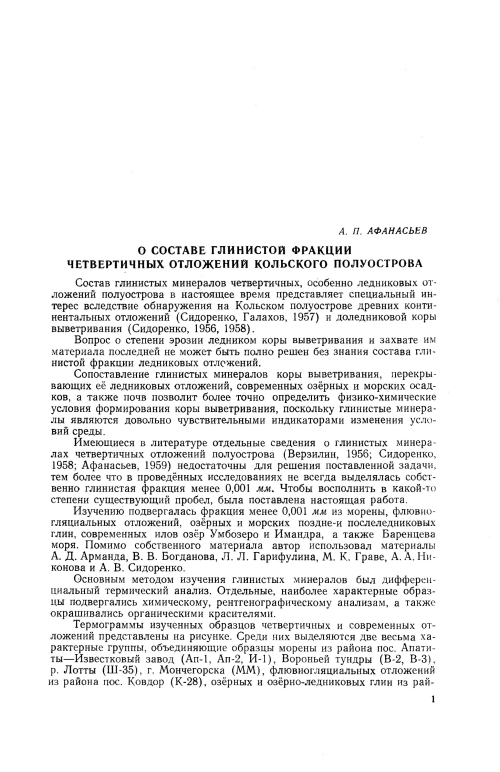
Состав глинистых минералов четвертичных, особенно ледниковых отложений полуострова в настоящее время представляет специальный интерес вследствие обнаружения на Кольском полуострове древних континентальных отложений (Сидоренко, Галахов, 1957) и доледниковой коры выветривания (Сидоренко, 1956, 1958). Вопрос о степени эрозии ледником коры выветривания и захвате им материала последней не может быть полно решен без знания состава глинистой фракции ледниковых отложений.
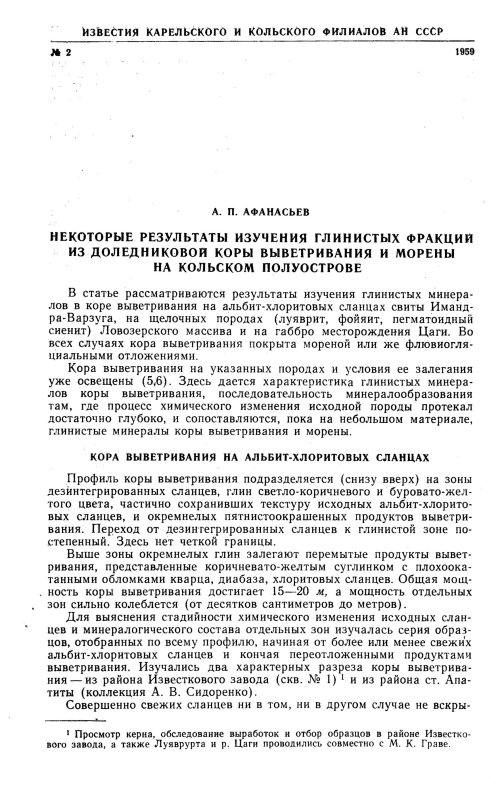
В статье рассматриваются результаты изучения глинистых минералов в коре выветривания на альбит-хлоритовых сланцах свиты Иманд-ра-Варзуга, на щелочных породах (луяврит, фойяит, пегматоидный сиенит) Ловозерского массива и на габбро месторождения Цаги. Во всех случаях кора выветривания покрыта мореной или же флювиогля-циальными отложениями.
Introduction R. F. Giese Precision Scanning Calorimetry of Clay Minerals and their Intercalates R. F. Giese High-Pressure Differential Thermal Analysis: Applications to Clay Minerals A. F. Koster van Groos and Stephen Guggenheim Thermogravimetric Analysis of Minerals D. L. Bish and C. J. Duffy Vacuum Thermogravimetric Analysis and Evolved Gas Analysis by Mass Spectrometry F. J. Wicks and R. A. Ramik Mineral Index J. W. Stucki
Описываются глины как минеральные образования, широко распространенные в верхней части Земной коры и использующиеся в различных областях жизнедеятельности человека. Рассматриваются кристаллохимические особенности глинистых минералов, физико-химические процессы на поверхности раздела минерал-вода, структура и контактные взаимодействия в глинистых системах с позиции современной структурной минералогии, физики поверхностных явлений и физико-химической механики дисперсных систем.
The clay minerals are small hydrous layer silicates and are part of the phyllosilicate family. As discussed in Chapter 11, many of the hydrous layer silicates in clays, muds, soils, shales, slates, etc. are coarser than clay (< 2 or < 4 pm). Primarily for this reason I have suggested (Weaver, 1980) using the term physil, which has no size connotation, to refer to the low-temperature ( 5 400°C) hydrous layer silicates.
Clays are one of the most important groups of minerals that destroy permeability in sandstones, but they also react with drilling and completion fluids and induce fine-particle migrationduring hydrocarbon production. They are a very complex family of minerals that commonly are mutually intergrown and contain a wide range of solid solutions and form by a wide range of processes. They form under a wide diversity of pressure and temperature conditions, as well as rock and fluid compositional conditions.
The word “clays” was assigned early to fine grained material in geological formations (Agricola 1546) or soils (de Serres 1600). Clays have been identified as mineral species in the begining of the 19th century in the production of ceramic materials (Brongniart 1844). Then Ebelmen (1847) carefully analyzed the decomposition of rocks under chemical attack and the way that porcelain can be commonly made. Since this pionner works, the definition of clays has varied.