Добрый день, Коллеги. Важное сообщение, просьба принять участие. Музей Ферсмана ищет помощь для реставрационных работ в помещении. Подробности по ссылке
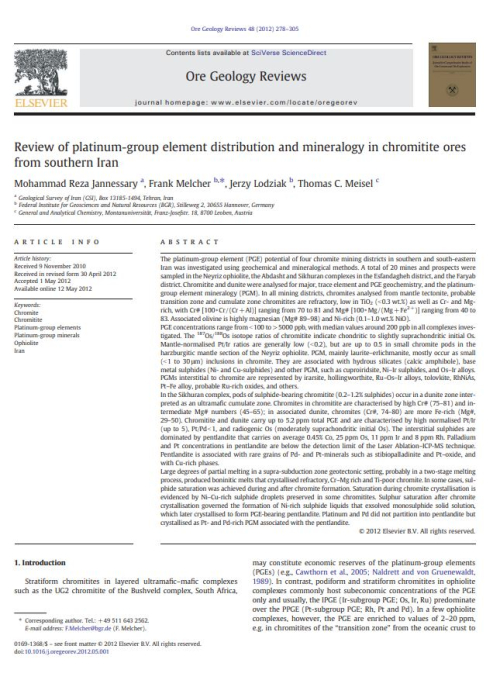
The platinum-group element (PGE) potential of four chromite mining districts in southern and south-eastern Iran was investigated using geochemical and mineralogical methods. A total of 20 mines and prospects were sampled in the Neyriz ophiolite, the Abdasht and Sikhuran complexes in the Esfandagheh district, and the Faryab district. Chromitite and dunite were analysed for major, trace element and PGE geochemistry, and the platinumgroup element mineralogy (PGM). In all mining districts, chromites analysed from mantle tectonite, probable transition zone and cumulate zone chromitites are refractory, low in TiO2 (b0.3 wt.%) as well as Cr- and Mgrich, with Cr# [100*Cr /(Cr+Al)] ranging from 70 to 81 and Mg# [100*Mg /(Mg+ Fe2+)] ranging from 40 to 83.
Минералогические вариации элементов платиновой группы в измененном хромитите расслоенного магматического комплекса Кондапалли (Южная Индия): влияние на эволюцию магматизма и его петрогенетическое значение
Platinum Group Minerals (PGMs) associated with Chromite form in a wide range of geotectonic settings, namely, (1) stratiform or layered magmatic complexes, (2) podiform complexes in ophiolites, (3) the Alaskan zoned complexes and (4) Chromite-rich Archean complexes are also called ‘conduit-type’ (Mondal and Baidya, 1997; Auge et al., 2002; Ahmed and Arai, 2003; Economou-Eliopoulos, 2010; Mukherjee et al., 2012; Mungall, 2014; Peck and Huminicki, 2016; O’Driscoll and González-Jimenez, 2016; Prichard et al., 2017a-b; Mondal et al., 2019).
Показатели продуктивности порфировых месторождений Cu-Au+Pd±Pt: данные из Скуриса, полуостров Халкидики, Греция, и сравнение с мировыми минерализациями
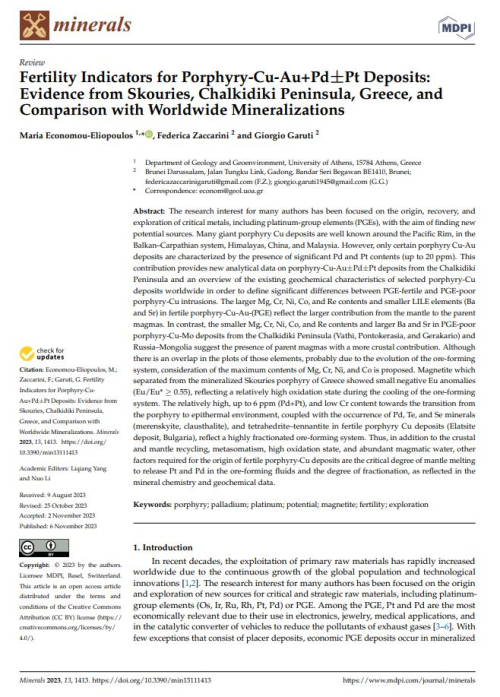
: The research interest for many authors has been focused on the origin, recovery, and exploration of critical metals, including platinum-group elements (PGEs), with the aim of finding new potential sources. Many giant porphyry Cu deposits are well known around the Pacific Rim, in the Balkan–Carpathian system, Himalayas, China, and Malaysia. However, only certain porphyry Cu-Au deposits are characterized by the presence of significant Pd and Pt contents (up to 20 ppm).
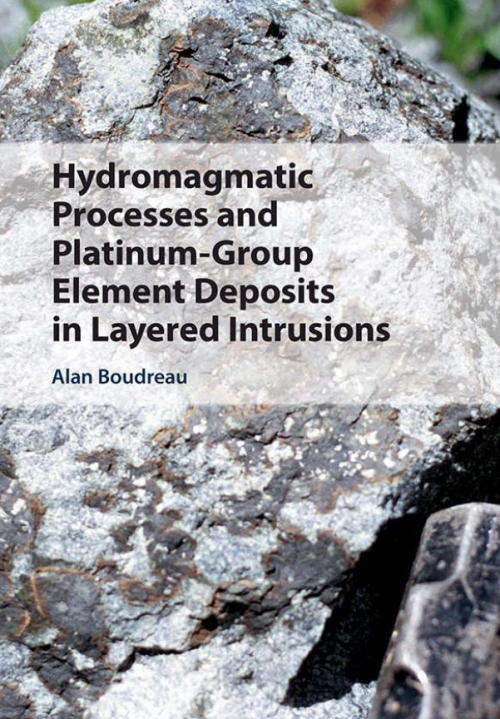
The idea for this book originally began as a description of the hydrothermal model for the concentration of platinum-group elements (PGE) in layered intrusions. This is a model that is contrary to the majority opinion of those who work in layered intrusions, and acceptance requires overcoming a certain amount of cognitive dissonance with longstanding interpretations. However, much of the supporting evidence has grown stronger over time and the need to present a full and detailed description of the model is long overdue.
The paper discusses the results of studying the contents of platinum group elements (PGE) and platinum group minerals (PGM) in ores of the Kingash deposit. The bulk of PGE has been established as concentrated in disseminated sulfide chalcopyrite–pyrrhotite–pentlandite ore and is represented by palladium bismuth–tellurides. During melt differentiation, the content and relationship of PGE are changed; the Pd/Pt value increases (up to 1.9 and 4.2 in dunite and wehrlite, respectively) with decreasing Mg number.
Количественная оценка минеральных ресурсов платины, палладия, золота, никеля и меди в неоткрытых месторождениях PGE в основных и ультраосновных расслоенных интрузиях в Финляндии
Most of the known platinum group element (PGE) resources in Finland are in contact- and reef-type deposits in 2.45 Ga mafic-ultramafic layered intrusions. These intrusions also have the potential to contain the majority of possibly existing, yet undiscovered, PGE resources in Finland. The undiscovered Pt, Pd, Au, Ni, and Cu resources in contact- and reef-type deposits were estimated down to one kilometre depth using the three-part quantitative assessment method.
The results of mineralogical–technological studies of PGM mineralization in zonal mafic–ultra mafic complexes of the Ural–Alaskan type are given. All studied massifs in the Urals and Kamchatka are characterized by similar evolution of mineral assemblages. The chromite (platinum–chromitite–dunite) and dunite (platinum–pegmatoid dunite) geological–economic types of small platinum deposits and occur rences are separate enriched sites (ore shoots) of largevolume platinum ore deposits. These are rather thick and extended zones of recrystallized dunites with attributes of hightemperature structural deformations and intense fluid reworking.
В брошюре в популярной форме рассказывается о месторождениях платиновых металлов и их размещении, о свойствах платины, о важнейших областях применения этого драгоценного металла в народном хозяйстве нашей страны. Авторы кандидаты геолого-минералогических наук В.И. Соболевский и А.Д. Генкин приводят много интересных фактов, связанных с разработкой платиновых месторождений в России, мало знакомых широкому кругу наших читателей.