Добрый день, Коллеги. Важное сообщение, просьба принять участие. Музей Ферсмана ищет помощь для реставрационных работ в помещении. Подробности по ссылке
This book grew from a course taught with Dan McKenzie to final year physicists in Cambridge. Our task was to provide undergraduates who already possessed a good grounding in physics and mathematical methods with a broad exposure to geophysics in just 24 lectures. Fortunately it is possible to bring a student in geophysics to the forefront of the subject quite quickly: within 24 lectures it is possible to explain research techniques that are in current use and were used to make discoveries that _ are now less than 20 years old, which is impossible in most other branches of physics. In order to provide the course with structure, and to introduce an essential quantitative element that would allow us to examine it with numerical problems as well as purely descriptive accounts, we decided to concentrate on the development of seismology since the introduction of the World Wide Standardised Seismic Network in about 1960 and its role in the development of plate tectonic theory, the major advance in earth science this century. <...>
In geologic terms, a plate is a large, rigid slab of solid rock. The word tectonics comes from the Greek root "to build." Putting these two words together, we get the term plate tectonics, which refers to how the Earth's surface is built of plates. The theory of plate tectonics states that the Earth's outermost layer is fragmented into a dozen or more large and small plates that are moving relative to one another as they ride atop hotter, more mobile material. The diagrams below show the break-up of the supercontinent Pangaea (meaning "all lands" in Greek), which figured prominently in the theory of continental drift -- the forerunner to the theory of plate tectonics. <...>
The debate regarding whether or not melting anomalies are fuelled by hot diapirs from the deep mantle – the Plume hypothesis – or whether they arise from shallow processes ltimately related to plate tectonics – the Plate hypothesis – is an extraordinarily rich cross - disciplinary subject with seemingly endless ramifi cations. Relevant material is scattered far and wide, and because of this, over the last decade, scientists have come together and tried to address this problem using the website www.mantleplumes.org.
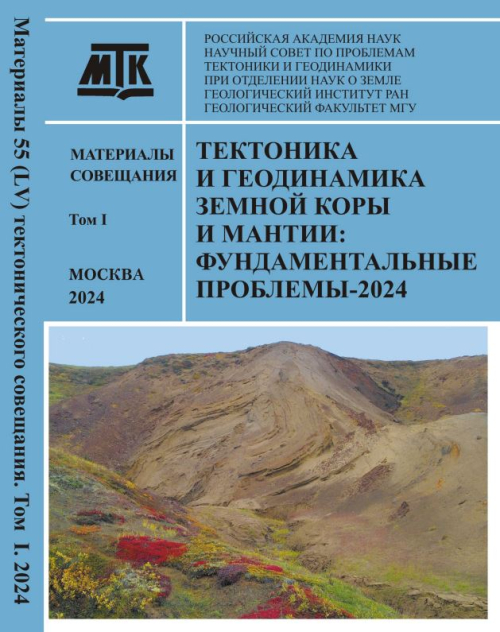
Агатова А.Р., Непоп Р.К. Сейсмотектоническая активность как триггер солифлюкционно-оползневых процессов в высокогорной части Алтая в позднем плейстоцене – голоцене Алексеев Н.Л., Богомолов Е.С., Сергеев С.А., Каменев И.А., Егоров М.С. Тектоно-термальная эволюция метаморфического комплекса островов Реуер (Восточная Антарктида) в позднем докембрии – раннем палеозое Андреев Г.П. Вскрываемая «физика геологии». Резонансная природа цикличности седиментогенеза Артамонов А.В. Влияние разломообразования на формирование внутриплитных тектоно-магматических структур Артюшков Е.В., Чехович П.А. Ретроградный метаморфизм в докембрийской коре и его роль в плиоцен-четвертичных поднятиях Архипова Е.В., Жигалин А.Д., Гусева И.С., Гусева А.С. Системное сейсмотектоническое взаимодействие горизонтов литосферы Восточной Сибири и Дальнего Востока
Маринин А.В., Тверитинова Т.Ю. Строение и тектонические напряжения Туапсинской сдвиговой зоны Мелик-Адамян Г.У. Начальные стадии позднеорогенного тектогенеза Армении в свете современных биостратиграфических представлений Мельниченко Ю.И., Съедин В.Т., Обжиров А.И., Шакиров Р.Б., Лепешко В.В. Вулканотектоника и особенности геодинамики Японского и Охотского морей Минц М.В. Неоархей-протерозойский суперконтинент (2.75-0.9 млрд лет): альтернатива модели суперконтинентальных циклов 17 Михеев Е.И., Владимиров А.Г. Корреляция и геодинамическая интерпретация метаморфизма и гранитоидных комплексов Ольхонского региона (Прибайкалье) и п-ова Святой Нос (Забайкалье) Монастырев Б.В. Сейсморазведочная модель севера ЗападноСибирской геосинеклизы в аспекте теории рифтогенеза
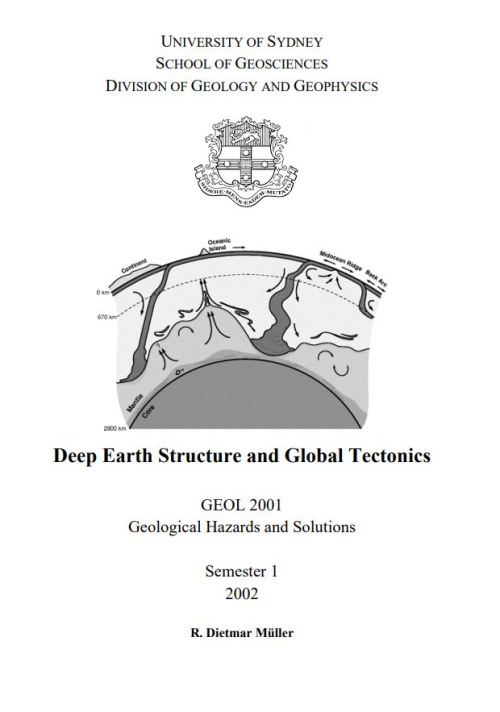
The study of seismic wave propagation, especially of the P (longitudinal) waves, has enabled us to distinguish two components in the shallower part of the earth:
- The crust (thickness varying from 10 to 70 km, average 30 Ian);
- The underlying mantle, separated from the crust by a surface of discontinuity at which the seismic-wave velocities change suddenly (the Mohorovicic discontinuity, generally shortened to Moho).