

Добрый день, Коллеги. Важное сообщение, просьба принять участие. Музей Ферсмана ищет помощь для реставрационных работ в помещении. Подробности по ссылке
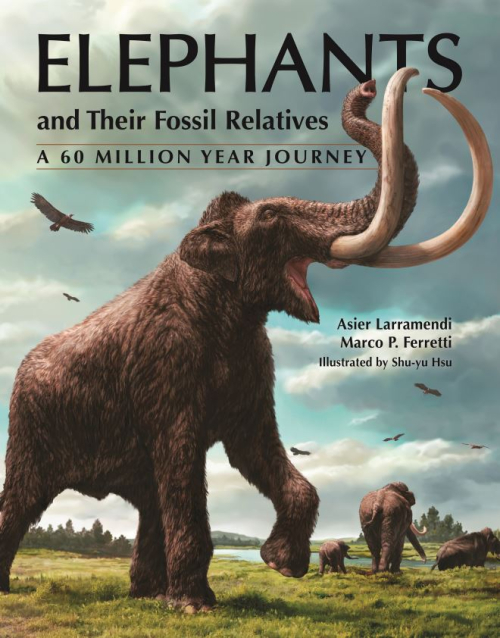
Elephants are among the animal species to which humans feel a particular affinity, despite being separated by at least 80 million years of evolution. Their intelligence and complex social lives, as well as their size as the largest land animals, captivate us. Elephants belong within a larger group of animals called Proboscidea, named for their proboscis, or trunk, but only three proboscidean species survive today – the Asian and African elephants, the latter recently divided into forest and savanna species. All the rest are extinct – an astonishing array of forms known only from their fossils, ranging in size from early species no bigger than a domestic cat, to the largest up to three times the body mass of the living species, according to the authors’ calculations.
All known proboscidean species are described in these pages, providing a fascinating parade of “variations on a theme” – two tusks, four tusks, straight tusks, spiral tusks, shovel tusks; trunks of varying length; and teeth adapted to different kinds of food. They span some 60 million years and five continents – a story of gradual expansion from their apparently North African origins. Fossil proboscideans played a significant role in early understanding of evolution – Scottish palaeontologist Hugh Falconer wrote enthusiastically about mammoths to Charles Darwin, and as more fossils accumulated the evolutionary trend to elephantine size and a richly branched evolutionary tree came into focus; until nowadays, the origin and adaptation of individual species can be plotted through well-dated fossil sequences.
The enormous amount of information in this beautifully produced and well-organized book is accessible to readers of all levels of knowledge, taking us stepwise through the major phases of proboscidean evolution. Every known species is described, and their habits, distribution, and relationships explained to the limits of current knowledge. The text is wonderfully complemented by new, full-color illustrations by Shu-yu Hsu, bringing dozens of proboscidean species stunningly to life. The illustrations are based on the latest research, and the authors explain the process from measuring old bones to reconstructing the living animal.Nor are the modern species forgotten in this comprehensive tome. How thick is an elephant’s skin? Do they drink through their trunk? How do the tusks grow? How big is their brain? The answers to these and many other questions are here. <...>

