
Добрый день, Коллеги. Важное сообщение, просьба принять участие. Музей Ферсмана ищет помощь для реставрационных работ в помещении. Подробности по ссылке
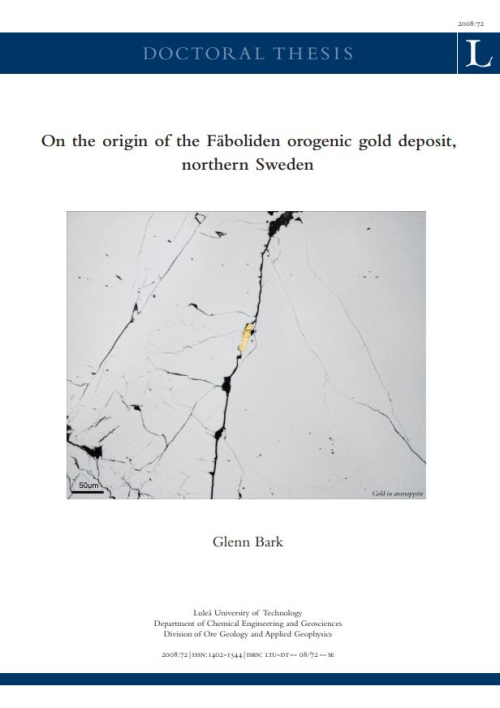
A new promising ore province, the Gold Line, southwest of the well-known Skellefte District, northern Sweden, is currently under exploration. This province hosts, so far, one operating mine, the Svartliden Au mine, and the recently closed Blaiken Zn-Pb-Au-Ag mine. The largest known gold deposit, the hypozonal Fäboliden orogenic gold deposit, in the area was recently granted mining permits. The deposit holds c. 54 Mt at 1.2 g/t Au, with a planned production of 4.6 Mt of ore/year. The mineralization at Fäboliden is commonly hosted in arsenopyrite-bearing quartz-veins, within a roughly N-S striking, steeply dipping shear zone in amphibolite facies volcanosedimentary host rocks. The narrow belt of supracrustal rocks is surrounded by late- to postorogenic Revsund granite. The gold is fine-grained (2–40 m) and closely associated with arsenopyrite-löllingite and stibnite. Gold is found in fractures and as inclusions in the arsenopyrite-löllingite. Gold is also seen as free grains in the silicate matrix of the host rock. The hydrothermal mineral assemblage in the proximal alteration zone is diopside, calcic amphibole, biotite, and minor andalusite and tourmaline. This type of assemblage is commonly recognized in hypozonal orogenic gold deposits worldwide. The lateral extent of the proximal alteration zone is estimated to 30–50 meters, and there is a good agreement between diopsideamphibole-biotite alteration, quartz veining, and gold mineralization. The mineral assemblage in the distal alteration zone is characterised by the presence of Ca- and Fe-Mg amphiboles, hedenbergite, biotite, and quartz. The transition from the distal alteration into the regional metamorphic assemblage is diffuse, and the only discernable feature appears to be a gradual decrease of amphibole away from the mineralization. <...>