

Добрый день, Коллеги. Важное сообщение, просьба принять участие. Музей Ферсмана ищет помощь для реставрационных работ в помещении. Подробности по ссылке
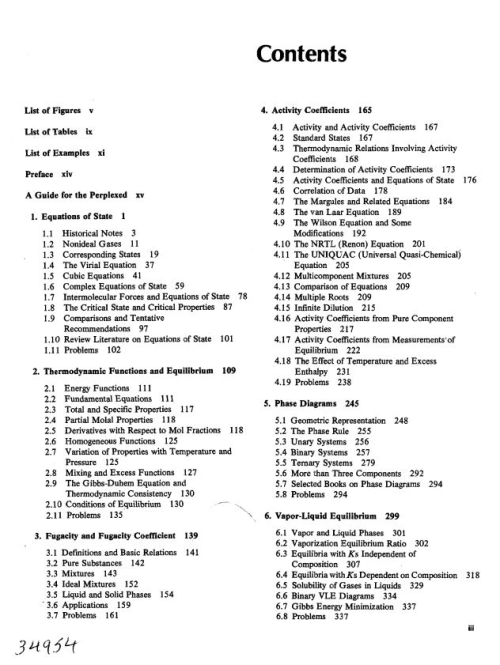
Phase equilibria exist or are being strived for all around us. Most industrial processes are designed for and operate near equilibrium conditions; even when this is not so, it is important to know what would happen at equilibrium. Chemical engineering processes of primary importance are those of mixing, conversion, and separation involving gases, liquids, and solids. This book is devoted to the thermodynamic basis and practical aspects of the calculation of equilibrium conditions of multiple phases that are pertinent to such processes.
At the present time, the theory and practice of process design based on phase equilibria are changing and growing significantly. Rigorous or unique solutions of phase equilibrium problems are not often attainable, and rarely is any particular method overwhelmingly superior. Accordingly, efforts have been made throughout the book to provide guidance to adequate theory and practice-although not always unambiguously because of the present state of the art. A brief summary guide immediately follows this preface. Since much of the author's interest and experience has been in process design work, where the next step leads to construction of equipment, the book is slanted toward users rather than developers of phase equilibrium theory and correlations. To a certain extent the case method is used, whereby key theoretical results or algorithms are illustrated with numerical examples or problems for solution by the reader that are integrated with the text. These problems are within the capability of a programmable calculator or portable computer, but from an instructor's point of view many of them can be extended so as to make demands on 32K or more powerful computers. It is beyond the scope of this book to apply the material to the design of multistage equilibrium processes, a topic that is well covered elsewhere.
Although many results from classical and statistical thermodynamics are needed, particularly concerning mixtures, no detailed development of those subjects is attempted. Instead, a users' manual has been assembled with enough explanation to make the material plausible or to recall the background if it has been experienced by the reader. Ample references are made to standard works on the subject where the background material can be studied in any detail required. Care has been taken, however, to point out the local significance and limitations of the quoted results. <...>