
Добрый день, Коллеги. Важное сообщение, просьба принять участие. Музей Ферсмана ищет помощь для реставрационных работ в помещении. Подробности по ссылке
In 1803, when Alexander von Humboldt arrived in Mexico, the colonial site of Guanajuato represented the third largest town in “Spanish” America, just overwhelmed in population by Mexico City and Havana. During the 18th century, the Guanajuato Mining District was reportedly producing one-third of the world´s silver. Estimates of historic production range from 700 million to 1.5 billion ounces of silver, as well as 4 to 7 million ounces of gold. Remarkably, some areas are still today under exploitation. Geomorphological and environmental consequences from hundreds of years of mining activity can still be observed in the surroundings of this charming UNESCO World Heritage community.
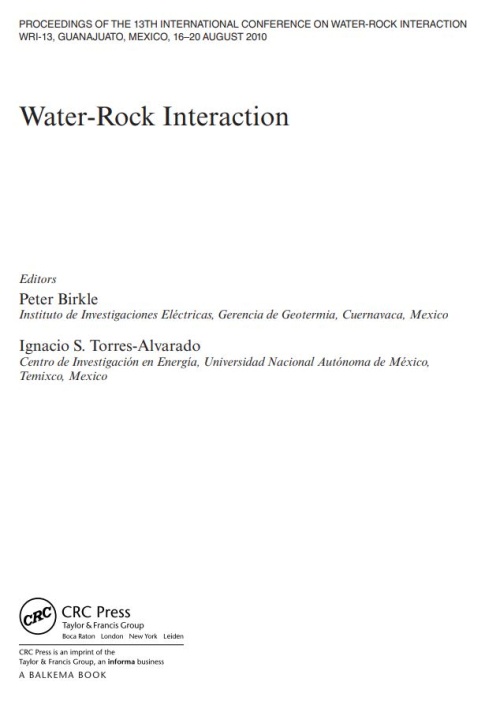
The 13th International Symposium on Water-Rock Interaction (WRI-13) was held in Guanajuato, Mexico, from August 16 to 20, 2010. The symposium addressed main aspects of Water-Rock Interaction, including recent advances in understanding of principal geochemical processes in isotopic studies (Hotoshi Sakai memorial session), from high-temperature reservoirs to low-temperature systems (vadose zones, watersheds, karst systems), water-rock interaction through magmatic and ore forming processes, reconnaissance and concerns about groundwater quality and environmental aspects, recent advances in numerical modeling, specific interaction between fluids and minerals, sequestration of CO2, geological hazards and organic processes. Special emerging topics of the present WRI-13 proceedings were environmental impacts by mining activities, the geochemical response through the injection of CO2 into the subsoil, natural and anthropogenic sources for arsenic anomalies in groundwater and surface systems, the application of novel isotope and tracer methods (CFC, SF6, 11B/10B, 44Ca/40Ca, 53Cr/52Cr, 56Fe/54Fe, 207,208Pb/ 206Pb, 226Ra, 228Ra), and advanced geochemical methods for geothermal exploration.
The symposium was organized by participants from the Centro de Investigación Científica y de Educación Superior de Ensenada (CICESE, Ensenada, Baja California), Centro de Investigación en Matemáticas, A.C. (CIMAT, Guanajuato), Universidad de Guanajuato (UG, Guanajuato), Centro de Enseñanza Técnica y Superior (CETYS, Guanajuato), Instituto de Investigaciones Eléctricas (IIE, Cuernavaca, Morelos), Centro de Investigación en Energía (CIE, UNAM, Temixco, Morelos), Instituto Mexicano de Tecnología del Agua (IMTA, Jiutepec, Morelos), Centro de Geociencias (CGeo, UNAM, Juriquilla, Queretaro), Instituto de Geofísica (IGeof, UNAM, Mexico City), Centro de Investigación Científica de Yucatán (CICY, Mérida, Yucatán), and the Universidad Autónoma de Baja California Sur (UABCS, La Paz, Baja California Sur). <...>