
Добрый день, Коллеги. Важное сообщение, просьба принять участие. Музей Ферсмана ищет помощь для реставрационных работ в помещении. Подробности по ссылке
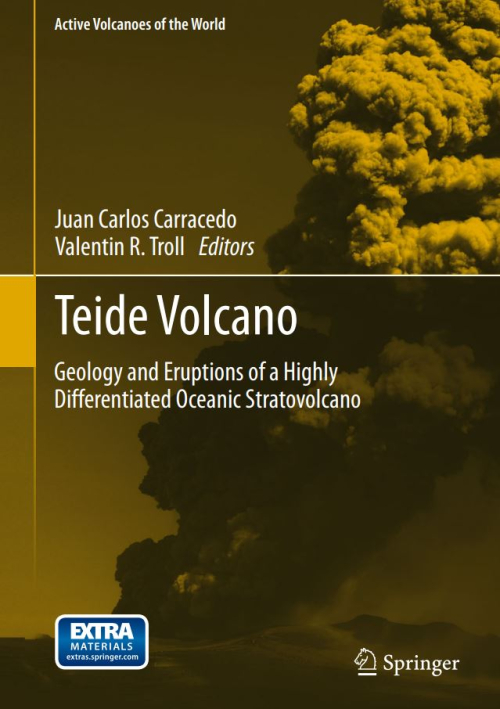
The Canary Islands Archipelago, offshore of the northwestern coast of Africa, originated from ocean-island volcanism over a span of 20 million ears. This 600-km-long chain of islands (total population *2 million), with their beautiful volcanic landscapes, beaches, and year-round mild climate, receives more than 12 million visitors each year. The prime tourist destination is Teide Volcano on the Island of Tenerife, the centerpiece of Teide National Park and the focus of this scientific volume. In 2010, Teide National Park was the most heavily visited national park of any European country and the second most visited worldwide. Teide is a huge volcano that towers 3,718 m (a.s.l.) above the central part of Tenerife, reaching the highest elevation in the Canaries and Spain. Moreover, if its height is measured relative to the seafloor, Teide is the third tallest (*7,718 m) volcanic edifice on Earth after the Hawaiian shield volcanoes Mauna Kea and Mauna Loa. In 2007, the United Nations Educational, Scientific, and Cultural Organization (UNESCO) inscribed Teide National Park as a World Heritage Site, in recognition of its diverse, abundant evidence of the geological processes that underpin the evolution of volcanic islands, complementing other volcanic properties such as Hawaii Volcanoes National Park (USA) and Gala´pagos National Park (Ecuador).
Because of its imposing physical visage, Teide naturally has long attracted scientific attention following the colonization of the Canaries, but especially during the eighteenth and nineteenth centuries when the emerging ‘‘science’’ of geology began to develop. Beginning in the latter part of the twentieth century, many geoscience and related studies— including the systematic geologic mapping and dating of volcano-related deposits—have been conducted at Teide as well as other Canarian volcanoes, resulting in a substantial scientific literature. For example, during the past 6 years, one of the editors (Carracedo) has published and edited three major books (in Spanish) summarizing the volcanic geology and associated hazards of Canarian volcanoes in general, and of Teide in particular. Unfortunately, to date no comparably comprehensive works in English about Canarian volcanism exist. Thus, this volume marks a milestone in remedying this long-standing deficiency. It provides a wideranging summary of the geologic evolution of Teide—the emblematic volcano of the Canaries. <...>