

Добрый день, Коллеги. Важное сообщение, просьба принять участие. Музей Ферсмана ищет помощь для реставрационных работ в помещении. Подробности по ссылке
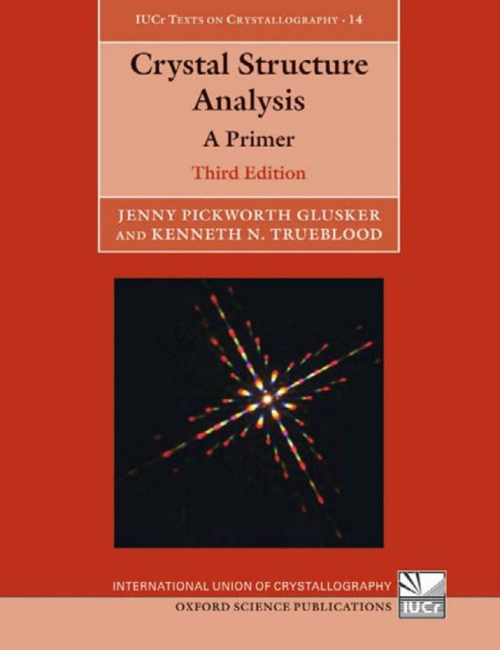
Much of our present knowledge of the architecture of molecules has been obtained from studies of the diffraction of X rays or neutrons by crystals. X rays* are scattered by the electrons of atoms and ions, and the interference between the X rays scattered by the different atoms or ions in a crystal can result in a diffraction pattern. Similarly, neutrons are scattered by the nuclei of atoms. Measurements on a crystal diffraction pattern can lead to information on the arrangement of atoms or ions within the crystal. This is the experimental technique to be described in this book
X-ray diffraction was first used to establish the three-dimensional arrangement of atoms in a crystal by William Lawrence Bragg in 1913 (Bragg, 1913), shortly after Wilhelm Conrad Röntgen had discovered X rays and Max von Laue had shown in 1912 that these X rays could be diffracted by crystals (Röntgen, 1895; Friedrich et al., 1912). Later, in 1927 and 1936 respectively, it was also shown that electrons and neutrons could be diffracted by crystals (Davisson and Germer, 1927; von Halban and Preiswerk, 1936; Mitchell and Powers, 1936). Bragg found from X-ray diffraction studies that, in crystals of sodium chloride, each sodium is surrounded by six equidistant chlorines and each chlorine by six equidistant sodiums. No discrete molecules of NaCl were found and therefore Bragg surmised that the crystal consisted of sodium ions and chloride ions rather than individual (noncharged) atoms (Bragg, 1913); this had been predicted earlier by William Barlow and William Jackson Pope (Barlow and Pope, 1907), but had not, prior to the research of the Braggs, been demonstrated experimentally. A decade and a half later, in 1928, Kathleen Lonsdale used X-ray diffraction methods to show that the benzene ring is a flat regular hexagon in which all carbon–carbon bonds are equal in length, rather than a ring structure that contains alternating single and double bonds (Lonsdale, 1928). Her experimental result, later confirmed by spectroscopic studies (Stoicheff, 1954), was of great significance in chemistry. Since then X-ray and neutron diffraction have served to establish detailed features of the molecular structure of every kind of crystalline chemical species, from the simplest to those containing many thousands of atoms. <...>