
Добрый день, Коллеги. Важное сообщение, просьба принять участие. Музей Ферсмана ищет помощь для реставрационных работ в помещении. Подробности по ссылке
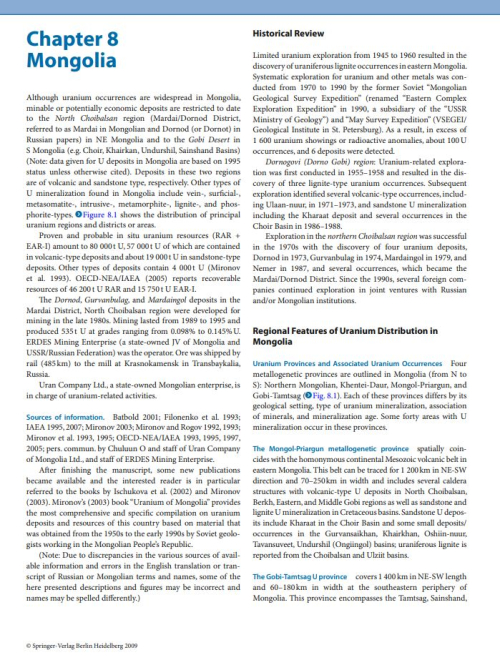
Although uranium occurrences are widespread in Mongolia, minable or potentially economic deposits are restricted to date to the North Choibalsan region (Mardai/Dornod District, referred to as Mardai in Mongolian and Dornod (or Dornot) in Russian papers) in NE Mongolia and to the Gobi Desert in S Mongolia (e.g. Choir, Khairkan, Undurshil, Sainshand Basins) (Note: data given for U deposits in Mongolia are based on 1995 status unless otherwise cited). Deposits in these two regions are of volcanic and sandstone type, respectively. Other types of U mineralization found in Mongolia include vein-, surfi cial-, metasomatite-, intrusive-, metamorphite-, lignite-, and phosphorite-types. >Figure 8.1 shows the distribution of principal uranium regions and districts or areas.
Proven and probable in situ uranium resources (RAR + EAR-I) amount to 80 000 t U, 57 000 t U of which are contained in volcanic-type deposits and about 19 000 t U in sandstone-type deposits. Other types of deposits contain 4 000 t U (Mironov et al. 1993). OECD-NEA/IAEA (2005) reports recoverable resources of 46 200 t U RAR and 15 750 t U EAR-I.Th e Dornod, Gurvanbulag, and Mardaingol deposits in the Mardai District, North Choibalsan region were developed for mining in the late 1980s. Mining lasted from 1989 to 1995 and produced 535 t U at grades ranging from 0.098% to 0.145% U. ERDES Mining Enterprise (a state-owned JV of Mongolia and USSR/Russian Federation) was the operator. Ore was shipped by rail (485 km) to the mill at Krasnokamensk in Transbaykalia, Russia.
Uran Company Ltd., a state-owned Mongolian enterprise, is in charge of uranium-related activities. <...>