
Добрый день, Коллеги. Важное сообщение, просьба принять участие. Музей Ферсмана ищет помощь для реставрационных работ в помещении. Подробности по ссылке
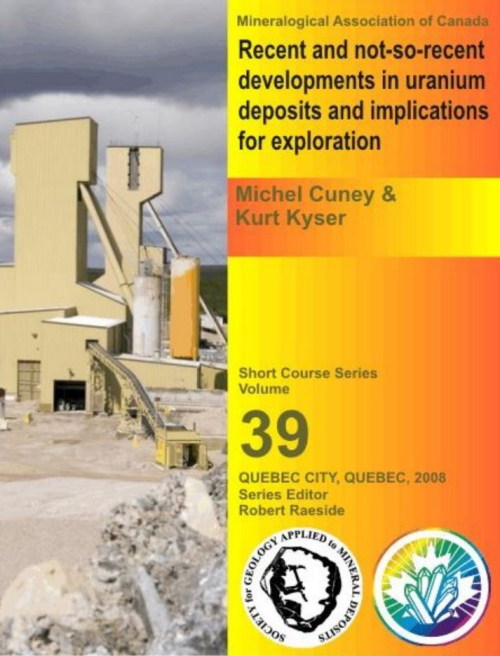
Uranium is one of the most important energyrelated materials, with current use almost entirely for generating electricity and a small proportion for producing medical isotopes. About 17% of the world’s electricity is generated from 440 nuclear reactors spread across 30 countries, and 8% of the total energy consumed globally comes from nuclear power (EIA 2007). Energy generated from U has a minimal “carbon footprint” and substitution of nuclear generated electricity for coal has been proposed to offset the additional emissions expected from the increase in energy anticipated in the future (Pacala & Socolow 2004). To meet the current and projected needs of the uranium industry, discovery of new deposits and development of new technologies for both exploration and processing are critical.
The discovery of uranium is attributed to Klaproth, a German chemist who, in 1789, precipitated a yellow compound by dissolving pitchblende in nitric acid and neutralizing the solution with sodium hydroxide. He heated it with charcoal to obtain a black powder, which was a uranium oxide. He named the newly discovered element after the planet Uranus, which had been discovered eight years earlier by William Herschel. In 1841, Péligot, a French chemist working at the Baccarat crystal factory in Lorraine, isolated the first sample of U metal by heating U tetrachloride with K. Uranium was not seen as being particularly dangerous during much of the 19th century, leading to use of the element in coloring pottery and glass. Radioactivity was discovered by Becquerel in 1896 when he accidentally exposed a photographic plate to U (Becquerel 1896). Realization that U isolated from pitchblende was less radioactive than the pitchblende led to the discovery of Po and Ra shortly thereafter by the Curies (Curie & Curie 1898). Much later, a team led by Enrico Fermi in 1934 observed that bombarding U with neutrons produces the emission of beta rays, and lead to the discovery of fission of U. On December 2, 1942, a team led by Enrico Fermi initiated a controlled nuclear chain reaction. <...>