
Добрый день, Коллеги. Важное сообщение, просьба принять участие. Музей Ферсмана ищет помощь для реставрационных работ в помещении. Подробности по ссылке
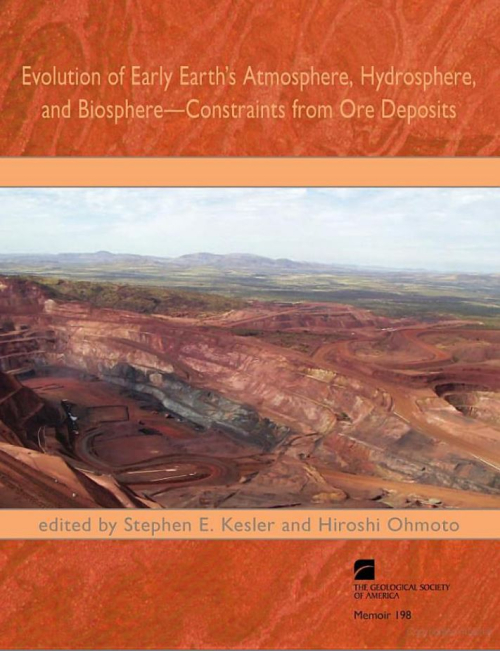
This volume was stimulated by a Pardee Symposium titled “Evolution of the Early Atmosphere, Hydrosphere, and Biosphere: Constraints from Ore Deposits,” which we convened in 2002 at the national meeting of the Geological Society of America. The history of Earth’s early atmosphere, hydrosphere, and biosphere, from Hadean through Archean and into Proterozoic time, is one of the enduring puzzles in the geological sciences. When did the oceans appear, and did they remain liquid throughout Earth’s history? What was the composition of the early atmosphere, and how did it affect climate? How did the atmosphere and ocean compositions change through time, and why? When, where, and how did life emerge on Earth? When did cyanobacteria, sulfate reducers, methanogens, and eukarya appear, and how did they affect their geologic environments? How did changes in the atmosphere, hydrosphere, and biosphere affect the lithosphere, and vice versa?
One of the most prominent aspects of this puzzle is when Earth’s atmosphere became oxic. Controversy today focuses on two possibilities: that the atmosphere has been oxic since early Archean time (ca. 3.8 Ga) or that it gained oxygen between about 2.3 and 2.1 Ga, an event recently termed the Great Oxidation Event (GOE). The availability of free oxygen would have had a strong effect on the (bio)geochemical cycles of elements that exist in more than one oxidation state in nature. Of the major rock-forming elements, only iron does this. In contrast, multiple oxidation states are common in nature for many of the trace elements that are concentrated in some ore deposits, such as manganese, molybdenum, uranium, and vanadium. The atmospheric concentrations of CO2 and CH4 are also of concern as potential greenhouse gases to resolve the faint young sun problem, as the sources and products of biological activities, and as the source of acid rain for weathering the early continents. Finally, the concentrations of various forms of sulfur species in the oceans, especially H2S and SO42–, are of interest because they are linked to the atmospheric pO2 history, the evolution of a variety of sulfur-utilizing microbes (e.g., sulfate-reducing bacteria and sulfi de-oxidizing bacteria), and the origins of a variety of mineral deposits, including banded iron-formations, volcanogenic massive sulfi de, sedimentary exhalative, and Mississippi Valley–type (MVT) deposits. The abundance ratios of many of the elements in ore deposits respond to the oxygen-carbon-sulfur geochemistry of the atmosphere and oceans, making ore deposits particularly good indicators of their geochemical environment.
Historically, the fi rst ore deposit types linked to atmosphere-hydrosphere compositions were uranium paleoplacers and banded iron formations. Later work has expanded the list to include other types of uranium deposits, sedimentary manganese deposits, laterites, and sedimentary exhalative and MVT lead-zinc deposits. Papers in this volume deal with most of these deposit types and include new research results, as well as summaries of the current opinions on how they relate to proposed histories of Earth’s early atmosphere, hydrosphere, and biosphere <...>
Origin of Life
1. The onset and early evolution of life
M. J. Russell and A.J. Hall
2. Early life signatures in sulfur and carbon isotopes from Isua, Barberton, Wabigoon (Steep Rock), and Belingwe Greenstone Belts (3.8 to 2.7 Ga)
N. V Grassineau, P. Abell, P.W.U. Appel, D. Lowry, and E.G. Nisbet
Evolution of the Early Continents
3. Fingerprinting the metal endowment of early continental crust to test for secular changes in global mineralization
C. Thiart and M.J. de Wit
4. Discovery of the oldest oxidized granitoids in the Kaapvaal Craton and its implications for the redox evolution of early Earth
S. Ishihara, H. Ohmoto, C.R. Anhaeusser, A. Imai, and L.J. Robb
5. Secular variations of N-isotopes in terrestrial reservoirs and ore deposits
R. Kerrich, Y. Jia, C. Manikyamba, and S.M. Naqvi
Evolution of Uranium Deposits and Atmospheric Evolution
6. The sedimentary setting of Witwatersrandplacer mineral deposits in an Archean atmosphere
W.E.L. Minter
7. Witwatersrand gold-pyrite-uraninite deposits do not support a reducing Archean atmosphere
J. Law and N. Phillips
8. Evidence from sulfur isotope and trace elements in pyrites for their multiple post-depositionalprocesses in uranium ores at the Stanleigh mine, Elliot Lake, Ontario, Canada
K. E. Yamaguchi and H. Ohmoto
9. Time constraint for the occurrence of uranium deposits and natural nuclear fission reactors in the Paleoproterozoic Franceville Basin (Gabon)
F. Gauthier-Lafaye
Evolution of Seawater and Basinal Sulfur Geochemistry
10. Proterozoic sedimentary exhalative (SEDEX) deposits and links to evolving global ocean chemistry
T.W. Lyons, A.M. Gellatly, P.J. McGoldrick, and L.C. Kah
11. Precambrian Mississippi Valley-type deposits: Relation to changes in composition of the hydrosphere and atmosphere
S.E. Kesler and M.H. Reich
12. Superheavy S isotopes from glacier-associated sediments of the Neoproterozoic of south China: Oceanic anoxia or sulfate limitation?
Liu Tie-bing, J.B. Maynard, and J. Alten
Evolution of Seawater Iron and Oxygen Geochemistry and Banded Iron Formations
13. An evaluation of diagenetic recycling as a source of iron for banded iron formations
R. Raiswell
14. Microbially mediated iron mobilization and deposition in iron formations since the early Precambrian
D.A. Brown
15. Oxygen isotope composition of hematite and genesis of high-grade BIF-hosted iron ores
J. Gutzmer, J. Mukhopadhyay, N.J. Beukes, A. Pack, K. Hayashi, and Z.D. Sharp
16. Rare-earth elements in Precambrian banded iron formations: Secular changes of Ce and Eu anomalies and evolution of atmospheric oxygen
Y. Kato, K.E. Yamaguchi, and H. Ohmoto
17. Chemical and biological evolution of early Earth: Constraints from banded iron formations
H. Ohmoto, Y. Watanabe, K.E. Yamaguchi, H. Naraoka, M. Haruna, T. Kakegawa, K. Hayashi, and Y. Kato