
Добрый день, Коллеги. Важное сообщение, просьба принять участие. Музей Ферсмана ищет помощь для реставрационных работ в помещении. Подробности по ссылке
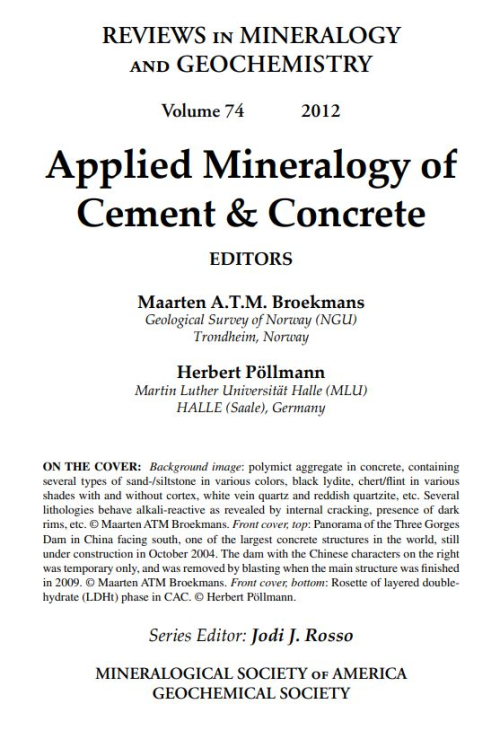
Since its inception in 1974, the “Reviews in Mineralogy” (“–and Geochemistry” from 2000) series has published over seventy volumes covering a diverse range of topics from theoretical to applied, and from very specifi c to generic. The idea for this RiMG volume was initially conceived in 2006, and the revised proposal was approved by the MSA Council in 2009.
‘Building materials’ as a generic term encompasses steel, aluminum, copper and a range of metal alloys, glass and glaze, particulate materials like sand, gravel, or crushed rock, and natural stone of sedimentary, igneous or metamorphic origin. Each of these materials sees a wide range of applications, from structural/bearing via functional to merely ornamental and decorative. The wide range of ‘building materials’ application is achieved through an equally wide range of processing, from use ‘as is’ (e.g., stacking boulders to make a retaining wall), through simple re-dimensioning and fi tting (e.g., splitting and sizing of roofi ng slate) to purifi cation and complex treatment in multi-stage processing (e.g., glass, Portland cement clinker, concreting). The use of building materials, their applications and processing has changed considerably with the development of civilization and technology. Consequently, comprehensive coverage of building materials, applications, processing and history would require multiple volumes.
The present RiMG volume contains a selection of papers on the applied mineralogy of cement and concrete, by far the most popular modern building material by volume, with an annual production exceeding 9 billion cubic meters, and steadily growing. Not even all ‘concrete’ topics can be covered by a single volume, but an interesting assortment was fi nally obtained. The seven chapters deal with mineralogy and chemistry of (alumina) clinker production and hydration (Pöllmann), alternative raw clinkering materials to reduce CO2 <...>