

Добрый день, Коллеги. Важное сообщение, просьба принять участие. Музей Ферсмана ищет помощь для реставрационных работ в помещении. Подробности по ссылке
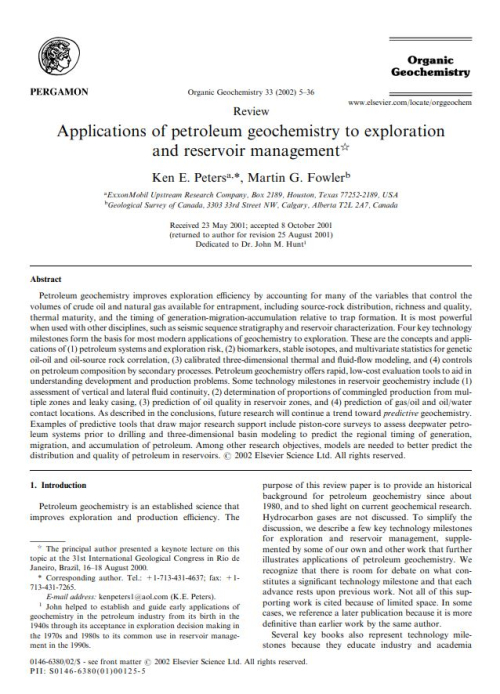
Petroleum geochemistry improves exploration efficiency by accounting for many of the variables that control the volumes of crude oil and natural gas available for entrapment, including source-rock distribution, richness and quality, thermal maturity, and the timing of generation-migration-accumulation relative to trap formation. It is most powerful when used with other disciplines, such as seismic sequence stratigraphy and reservoir characterization. Four key technology milestones form the basis for most modern applications of geochemistry to exploration. These are the concepts and applications of (1) petroleum systems and exploration risk, (2) biomarkers, stable isotopes, and multivariate statistics for genetic oil-oil and oil-source rock correlation, (3) calibrated three-dimensional thermal and fluid-flow modeling, and (4) controls on petroleum composition by secondary processes. Petroleum geochemistry offers rapid, low-cost evaluation tools to aid in understanding development and production problems. Some technology milestones in reservoir geochemistry include (1) assessment of vertical and lateral fluid continuity, (2) determination of proportions of commingled production from multiple zones and leaky casing, (3) prediction of oil quality in reservoir zones, and (4) prediction of gas/oil and oil/water contact locations. As described in the conclusions, future research will continue a trend toward predictive geochemistry. Examples of predictive tools that draw major research support include piston-core surveys to assess deepwater petroleum systems prior to drilling and three-dimensional basin modeling to predict the regional timing of generation, migration, and accumulation of petroleum. Among other research objectives, models are needed to better predict the distribution and quality of petroleum in reservoirs. # 2002 Elsevier Science Ltd. All rights reserved. <...>