
Добрый день, Коллеги. Важное сообщение, просьба принять участие. Музей Ферсмана ищет помощь для реставрационных работ в помещении. Подробности по ссылке
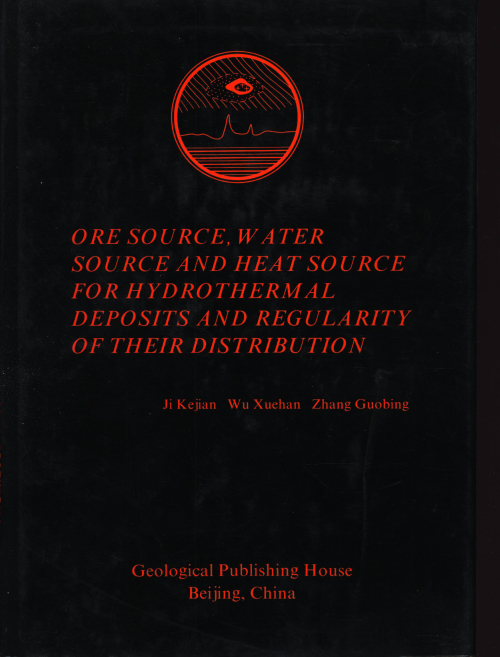
This is a monograph on ore deposits with its unique style, and it is obviously different from other books on this subject in that it separates and deals individually with the three sources for hydrothermal deposits, namely, ore source, water source and heat source. Classical magmatic hydrothermalists combine these three sources into one source, arguing that metallogenic elements and hydrothermal solutions are all products of magmatic crystallization and differentiation, and that heat source refers undoubtedly to magma. Such a theory dominated the field of metallogeny for more than half a century, and it is only in the last twenty years that the multi—source hydrothermal metallogeny has gradually emerged and made some progress; people now realize that magma is by no means the only source for hydrothermal deposits.
The authors of this book consider that the ore—forming heat source for hydrothermal deposits is carried by magma, ore-forming fluids come mainly from downward percolating meteoric water, and ore—forming metals are derived from wall rocks in a broad sense and then concentrate. The authors have got these ideas from large quantities of observations (both in field and under microscope), analyses, tests and simulation experiments instead of from subjective inferences. In the past ten years, they have made field observations and numerous analyses and tests in a number of important ore resources areas of South China, such as the Dexing ore field, middle and lower reaches of the Yangtze River, southeast Hunan and south Jiangxi, and as a result, discovered that there exist geochemical depleted fields of certain metallogenic elements in rocks surrounding these ore deposits and that economic minerals in some ore deposits are conditioned by the composition of wall rocks. These observations show that ore—forming substances come, at least partly, from wall rocks. Oxygen, hydrogen, carbon and lead isotopic ratios and compositions of rocks, minerals and gaseous-liquid inclusions demonstrate that ore-forming fluids are rich in Ca2+ and have much smaller <5lsO values than magmatic water, suggesting the participation of downward percolating meteoric water in the ore—forming process. On such a basis, the authors put forward the triple-source hydrothermal metallogenic model, holding that the downward percolating water is heated by magma and forms circulating current which, in turn, leaches metallogenic elements from rocks and causes them to migrate and concentrate into ore deposits. <...>