
Добрый день, Коллеги. Важное сообщение, просьба принять участие. Музей Ферсмана ищет помощь для реставрационных работ в помещении. Подробности по ссылке
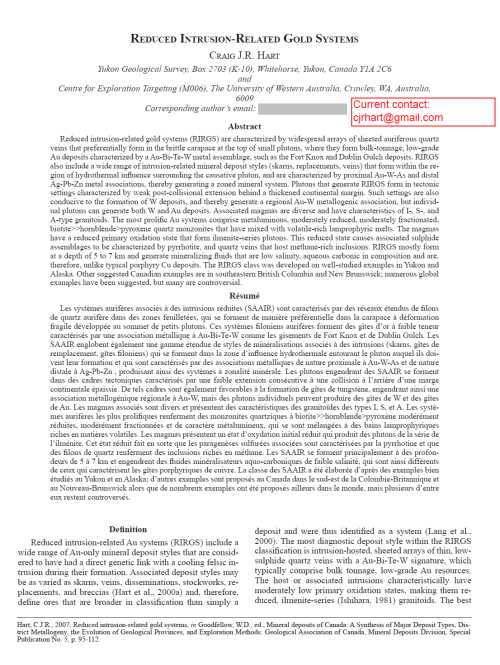
Reduced intrusion-related gold systems (RIRGS) are characterized by widespread arrays of sheeted auriferous quartz veins that preferentially form in the brittle carapace at the top of small plutons, where they form bulk-tonnage, low-grade Au deposits characterized by a Au-Bi-Te-W metal assemblage, such as the Fort Knox and Dublin Gulch deposits. RIRGS also include a wide range of intrusion-related mineral deposit styles (skarns, replacements, veins) that form within the region of hydrothermal infl uence surrounding the causative pluton, and are characterized by proximal Au-W-As and distal Ag-Pb-Zn metal associations, thereby generating a zoned mineral system. Plutons that generate RIRGS form in tectonic settings characterized by weak post-collisional extension behind a thickened continental margin. Such settings are also conducive to the formation of W deposits, and thereby generate a regional Au-W metallogenic association, but individual plutons can generate both W and Au deposits. Associated magmas are diverse and have characteristics of I-, S-, and A-type granitoids. The most prolifi c Au systems comprise metaluminous, moderately reduced, moderately fractionated, biotite>>hornblende>pyroxene quartz monzonites that have mixed with volatile-rich lamprophyric melts. The magmas have a reduced primary oxidation state that form ilmenite-series plutons. This reduced state causes associated sulphide assemblages to be characterized by pyrrhotite, and quartz veins that host methane-rich inclusions. RIRGS mostly form at a depth of 5 to 7 km and generate mineralizing fl uids that are low salinity, aqueous carbonic in composition and are, therefore, unlike typical porphyry Cu deposits. The RIRGS class was developed on well-studied examples in Yukon and Alaska. Other suggested Canadian examples are in southeastern British Columbia and New Brunswick; numerous global examples have been suggested, but many are controversial.