Добрый день, Коллеги. Важное сообщение, просьба принять участие. Музей Ферсмана ищет помощь для реставрационных работ в помещении. Подробности по ссылке
Anyone who takes the trouble to look up all the entries that have been filed under "Calcium Carbonate" in a university library will be surprised - if not overwhelmed - by the enormous amount of literature that is concerned in one way or another with this subject. Most of the corresponding books and journals can be assigned to the realms of chemistry, but they also include technical, geological and mineralogical literature. A continued search will eventually unearth works on the history of the arts and architecture. This is because calcium carbonate minerals, be they in the form of chalk, limestone or marble, symbolize defining moments in the history of our culture - the first prehistoric cave drawings in simple coloured chalk, the gigantic limestone blocks used to build the Egyptian pyramids and the marble statues of Michelangelo and Bernini.
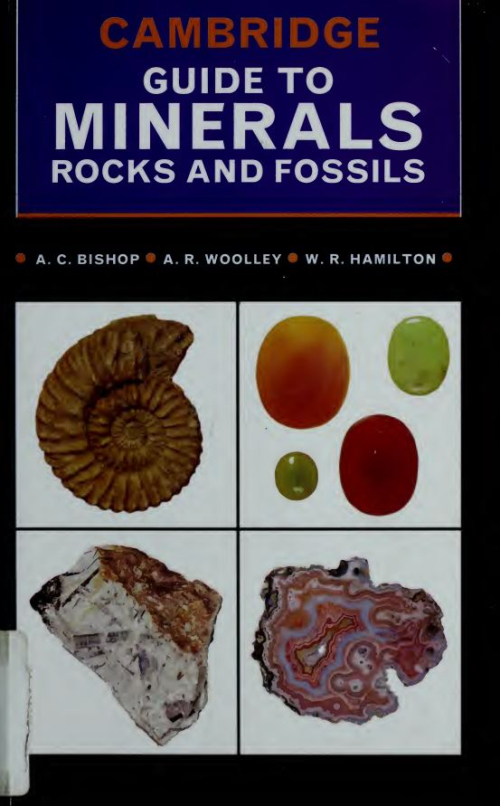
It is over 20 years since this book first appeared and numerous reprints and several foreign language editions are a measure of its success. The colour plates that were specially commissioned for the First Edition have been retained, although presented in a slightly different way, and are supplemented by 17 new plates. There have been significant advances in the geological sciences over the past two decades and the text has been thoroughly revised so as to take account of them. In particular we have tried to ensure that mineral names, chemical formulae and structural data accord to current international practice as recommended by the International Mineralogical Association (IMA).
Die cyansauren Salze pflegt man bekanntlich von der Isocyansäure, d. i. dem Carbimid: =C=NH^ abzuleiten, während für die den rhodanwasserstoffsauren Salzen zugrunde liegende Säure die Constitution: N^C—SH angenommen wird, analog der normalen Cyansäure N^C— OH und der unterchlorigen Säure Cl— OH, von welcher bisher kein Salz in bestimmbaren Krystallen erhalten worden ist.
The monograph series published by the Mineralogical Society has until now been concerned mainly with the application of techniques like X-ray diffraction, thermal analysis, infrared spectroscopy and electron optical methods to the identification and study of clay minerals. Inevitably much information about the chemical constitution was contained within these volumes and was essential to them. However, it seemed that there was also a need for a monograph that contained all this information in one volume and also covered some wider aspects of clay chemistry such as their colloid behaviour and surface chemistry, their reactions with organic substances and to heating, and the chemical conditions necessary for their formation.
Clay, noun. Old English Cladg. A stiff viscous earth. (Blackies Compact Etymological Dictionary. Blackie & Son, London and Glasgow. 1946. War Economy Standard) Clay: The original Indo-European word was 'gloi-" "gli-' from which came "glue' and 'gluten'. In Germanic this became 'klai-; and the Old English 'claeg" became Modern English "clay'. From the same source came "clammy' and the northern England dialect "claggy' all of which describe a similar sticky consistency. (Oxford English Dictionary and Ayto's Dictionary of Word Origins, Bloomsbury, 1999) Clay." from Old Greek yRia, y2oia "'glue" 72ivfl "slime, mucus "" y2oidq "'anything sticky" 'from L-E. base *glei-, *gli- 'to glue, paste stick together. (Klein E. A comprehensive etymological dictionary of the English language. Elsevier, Amsterdam, 1967; Skeat W. An etymological dictionary of the English language.
Oxford University Press, 1961; Mann S.E. An Indo-European comparative dictionary. Buske Verlag, Hamburg, 1987) <...>
A knowledge of clay is important in many spheres of scientific endeavour, particularly in natural sciences such as geology, mineralogy and soil science, but also in more applied areas like environmental and materials science. Over the last two decades research into clay mineralogy has been strongly influenced by the development and application of a number of spectroscopic techniques which are now able to yield information about clay materials at a level of detail that previously would have seemed inconceivable.
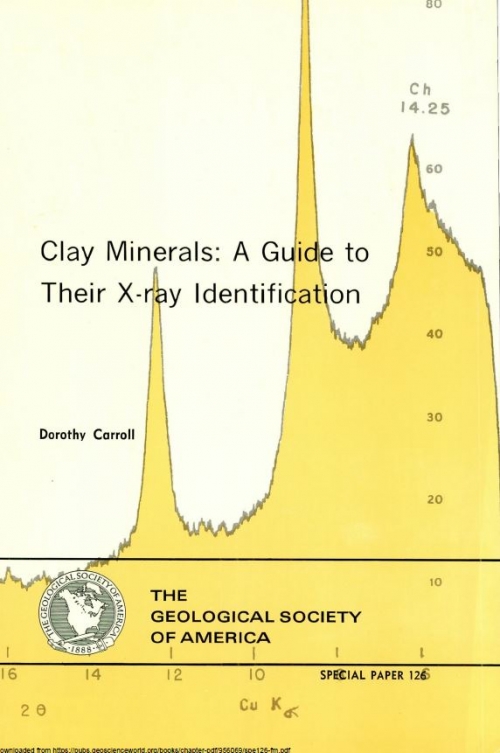
This paper is a guide to the X-ray examination of clay minerals; it incorporates background information concerning the principal crystallographic features of clay minerals, and how this is used in the X-ray identification of these minerals, together with laboratory techniques and the application of X-ray diffractometry to the diagnosis of the clay minerals in natural sedimentary materials. <...>
The clay minerals are small hydrous layer silicates and are part of the phyllosilicate family. As discussed in Chapter 11, many of the hydrous layer silicates in clays, muds, soils, shales, slates, etc. are coarser than clay (< 2 or < 4 pm). Primarily for this reason I have suggested (Weaver, 1980) using the term physil, which has no size connotation, to refer to the low-temperature ( 5 400°C) hydrous layer silicates.