Добрый день, Коллеги. Важное сообщение, просьба принять участие. Музей Ферсмана ищет помощь для реставрационных работ в помещении. Подробности по ссылке
Although this report includes the results of a 6-month reconnaissance investigation of the geology and mineral resources of Paraguay, it is essentially a compilation and interpretation of existing published and unpublished information on the subject. The rocks can be divided into five major classes, depending on age and mode of origin.
Papers on mineral exploration, development, mining, and the social and environmental framework / Документы по разведке, разработке и горнодобывающей промышленности полезных ископаемых, а также социальным и экологическим аспектам
1. Geology and Mining: An Introduction and Overview Dan Wood AO
2. Drivers of Global Mineral Demand: 1900–2050 Martin Lynch
3. The Social Dimensions of Mineral Exploration Sarah Mackenzie, Jo-Anne Everingham, and Pam Bourke
4. Coexistence of Large-Scale Mining with Artisanal and Small-Scale Mining—A Guide for Geologists Elizabeth A. Holley, Oscar Felipe Rodriguez, Stewart D. Redwood, and Nicole M. Smith
5. Aspects of Mineral Exploration Thinking Frederick T. Graybeal
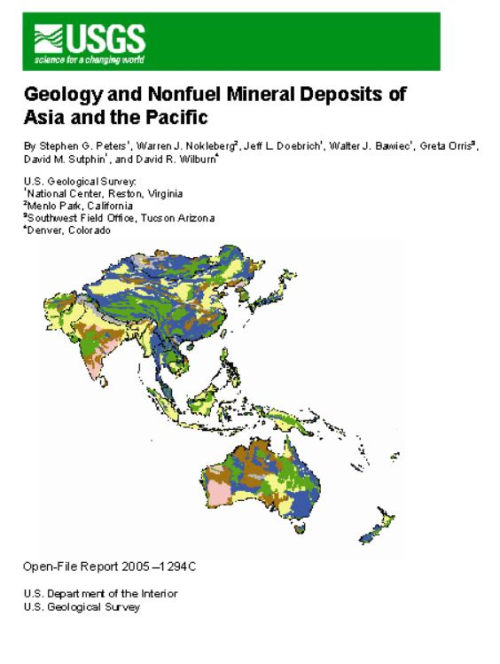
This report on nonfuel mineral deposits and resources of the Asia and the Pacific region is one of a series of geologic regional reports produced by the U.S. Geological Survey to provide up to date summary information of known and undiscovered mineral resources around the globe (Cunningham and others, 2005; Nokleberg and others, 2005; Zientek and others, 2005). These geologic regional reports are designed to be informative with respect to the location and endowment of mineral resources for each region. Boundaries of these regions are those of the USGS Minerals Yearbooks, which monitor production and economic factors affecting the mineral industries of the regions. Additional and historic information related to mineral production statistics also can be found in the Yearbooks. The area described within each of the regional reports is shown on Figure 1 and the Yearbooks are available on line at http://minerals.usgs.gov/minerals/pubs/myb.html. <...>
This report summarizes the geology and nonfuel mineral resources of Greenland, Europe, Russia, and Northern Central Asia and is a preliminary part of a major U.S. Geological Survey study called the Global Mineral Resource Assessment Project. This report is one of a series of regional reports covering the world and provides basic data on the identified resources and geologic setting, together with a brief appraisal of the potential for undiscovered mineral resources. The data in the regional report are derived from published information. An important source of data on production statistics, economic factors that affect the mineral industries, and historical information, is available in U.S. Geological Survey (USGS) publications Minerals Yearbook and the annual Mineral Commodity Summaries (available at http://minerals.usgs.gov/minerals).
A nation’s endowment of nonfuel mineral resources, relative to the world’s endowment, is a fundamental consideration in decisions related to a nation’s economic and environmental well being and security. Knowledge of the worldwide abundance, distribution, and general geologic setting of mineral commodities provides a framework within which a nation can make decisions about economic development of its own resources, and the economic and environmental consequences of those decisions, in a global perspective. The information in this report is part of a U.S. Geological Survey (USGS) endeavor to evaluate the global endowment of both identified and undiscovered nonfuel mineral resources.
This report, which is one of a series of reports summarizing the World’s endowment of nonfuel mineral resources, describes the location and general geologic setting of deposits of major mineral commodities in the United States. The discussion in this report focuses on those commodities produced in the United States that constituted at least 5 percent of global production or global reserve base in 2003 or had at least $100 million production value in 2001. The discussion for each commodity begins with a brief description of the chemical and physical properties of the material and how it is used. The importance of the commodity in the United States relative to the world is also presented. However, most of the discussion emphasizes the geology of mineral commodities – the important mineral deposit types, their geologic setting, and the processes that led to their formation. A compilation of almost 400 major mineral deposits in the United States is included as an appendix. <...>
The Antarctic Ice Sheet has greatly affected global climate, sea level, ocean circulation, and southern hemisphere biota during Cenozoic times. Much of our understanding of the evolution of the ice sheet has been inferred from isotopic studies on distant deep-ocean sediments, because few Cenozoic rocks are exposed on the Antarctic continent. Yet, large differences occur between past ice volumes inferred from isotopic studies and those inferred from low-latitude sea-level variation.
In Australia, the period from 1920 to the present is split by World War II into two sharply contrasting periods with respect to advances in knowledge of the geology of the continent. Between the two world wars geological work was almost entirely restricted to the Geological Surveys and universities of the six states. The official Geological Surveys were more and more confined to routine and ad hoc tasks, such as examination of mines and prospects, siting water bores, and giving assistance to prospectors and the mining industry generally.