Добрый день, Коллеги. Важное сообщение, просьба принять участие. Музей Ферсмана ищет помощь для реставрационных работ в помещении. Подробности по ссылке

Поиск по книгам
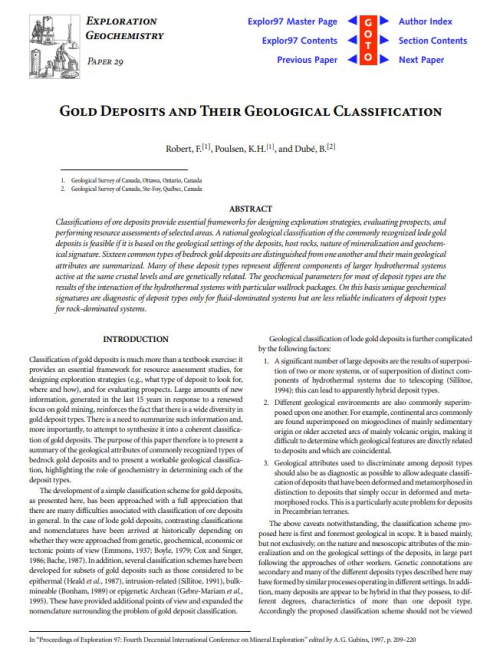
Автор(ы):Dube R., Poulsen K.H., Robert F.
Издание:1997 г., 12 стр.
Язык(и)Английский
Gold deposits and their geological classification / Золоторудные месторождения и их геологическая классификация

Classifications of ore deposits provide essential frameworks for designing exploration strategies, evaluating prospects, and performing resource assessments of selected areas. A rational geological classification of the commonly recognized lode gold deposits is feasible if it is based on the geological settings of the deposits, host rocks, nature of mineralization and geochemical signature.

Редактор(ы):Abdelnasser A., El-Rahman Y.A., Fowler A.-R., Goldfarb R.J., Hamimi Z., Monsef M.A.E., Pradhan B.
Издание:Springer, 2025 г., 633 стр., ISBN: 978-3-031-75971-0
Язык(и)Английский
Gold deposits in Egypt. GAeology, settings, types, genesis and spatiotemporal distribution / Месторождения золота в Египте. Геология, расположение, типы, генезис и пространственно-временное распределение

Brief Note on the Geology and Tectonics of the Egyptian Nubian Shield
Zakaria Hamimi, Yasser Abd El-Rahman, and Harald Fritz Gold Deposit Types and Settings Richard J. Goldfarb
African Gold-Connecting North and South: Comparison Between Gold Deposits and Industry in Egypt and South Africa François Durand
Ancient Gold Mining in Egypt Rosemarie Klemm
Geographical Review of the Ancient Egyptian Turin Papyrus Map (1150 B.C) – World’s First Geologic Map Atef Moatamed A. Mohamed
An Overview for Gold Mineralization in the Egyptian Segment of the Northern Continuation of the East African Orogen Mohamed Abd El Monsef

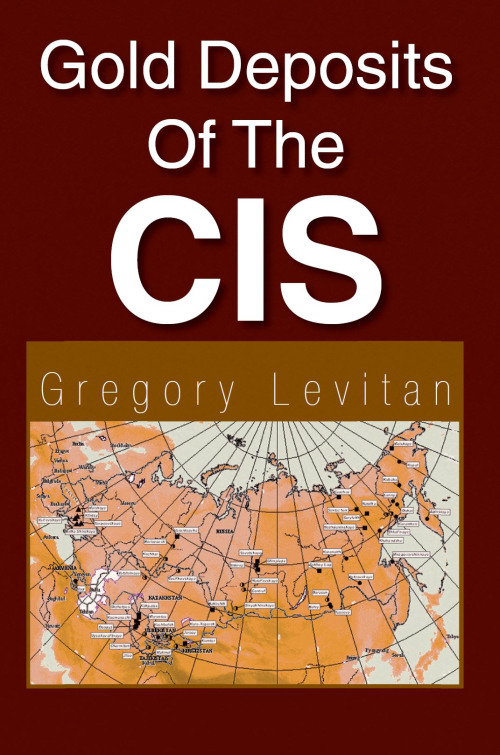
Автор(ы):Левитан Г.М.
Издание:2008 г., 353 стр., ISBN: 978-1-4363-5354-0
Язык(и)Английский
Gold deposits of the CIS (Commonwealth of Independent States) / Золоторудные месторождения СНГ

The Commonwealth of Independent States (CIS), which was formed in December 1991 upon the dissolution of the former Soviet Union (FSU), includes the former republics of Azerbaijan, Armenia, Belarus (Byelorussia), Georgia, Kazakhstan, Kyrgyzstan, Moldova, Russia, Tajikistan, Turkmenistan, Uzbekistan, and Ukraine. The FSU was for many decades, until the end of the 1980s, the second-largest gold producer in the world after South Africa. Peak gold production in the FSU of about 290 t was reached in 1979, with a subsequent decline to about 220-230 t by the early 1990s.

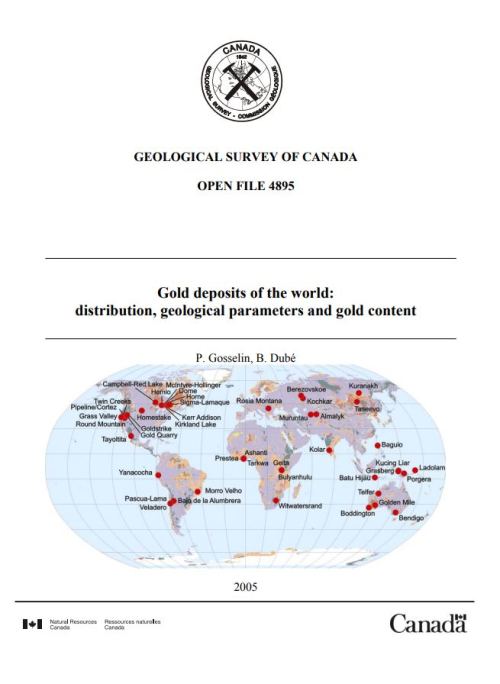
Автор(ы):Dube B., Gosselin P.
Издание:Her Majesty the Queen in Right of Canada, 2005 г., 270 стр.
Язык(и)Английский
Gold deposits of the world: distribution, geological parameters and gold content / Мировые месторождения золота: Распространение, геологические параметры и содержания золота

This Open-File report is complemented by a poster-size geological map of the world, Open-File report 4893: Gold deposits and gold districts of the world, showing locations and sizes of all gold deposits and gold districts spread across the globe. It also displays enlargements of key goldproducing areas (such as the Abitibi Belt and Western Australia) and detailed economic figures current to at least the end of December 2002. 
These products are companions to the Open-File report 4896: Gold deposits of Canada, a database comprising referenced and detailed geological, geographical and economical information on 128 gold deposits, and to the Open-File report 4894: Gold deposits and gold districts of Canada, a poster-size map of Canada showing the location and size of all important gold deposits, as well as enlargements of key gold districts. 


Связанные материалы - База данных месторождений

Выпуск 13
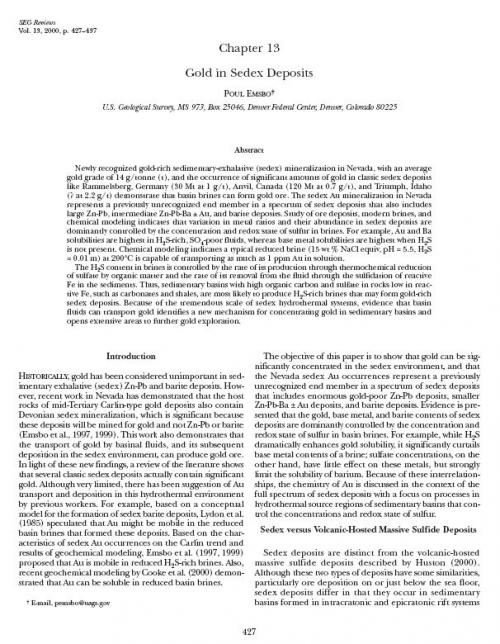
Автор(ы):Emsbo P.
Издание:Economic geology, 2000 г., 12 стр.
Язык(и)Английский
Gold in Sedex deposits

Newly recognized gold-rich sedimentary-exhalative (sedex) mineralization in Nevada, with an average gold grade of 14 g/tonne (t), and the occurrence of significant amounts of gold in classic sedex deposits like Rammelsberg, Germany (30 Mt at 1 g/t), Anvil, Canada (120 Mt at 0.7 g/t), and Triumph, Idaho (? at 2.2 g/t) demonstrate that basin brines can form gold ore. The sedex Au mineralization in Nevada represents a previously unrecognized end member in a spectrum of sedex deposits that also includes large Zn-Pb, intermediate Zn-Pb-Ba ± Au, and barite deposits. Study of ore deposits, modern brines, and chemical modeling indicates that variation in metal ratios and their abundance in sedex deposits are dominantly controlled by the concentration and redox state of sulfur in brines. For example, Au and Ba solubilities are highest in H2S-rich, SO4-poor fluids, whereas base metal solubilities are highest when H2S is not present. Chemical modeling indicates a typical reduced brine (15 wt % NaCl equiv, pH = 5.5, H2S = 0.01 m) at 200°C is capable of transporting as much as 1 ppm Au in solution.

The H2S content in brines is controlled by the rate of its production through thermochemical reduction of sulfate by organic matter and the rate of its removal from the fluid through the sulfidation of reactive Fe in the sediments. Thus, sedimentary basins with high organic carbon and sulfate in rocks low in reactive Fe, such as carbonates and shales, are most likely to produce H2S-rich brines that may form gold-rich sedex deposits. Because of the tremendous scale of sedex hydrothermal systems, evidence that basin fluids can transport gold identifies a new mechanism for concentrating gold in sedimentary basins and opens extensive areas to further gold exploration.


Редактор(ы):Foster R.P.
Издание:Springer, 1993 г., 446 стр., ISBN: 978-0-412-56960-9
Язык(и)Английский
Gold metallogeny and exploration / Металлогения золота и разведка месторождений золота

The distribution of gold in the lithosphere bears critically on models for gold ore deposits. One group of workers advocates derivation of gold from large masses of rock through fluid-rock reactions in the deep crust (Kerrich, 1983; Groves and Phillips, 1987; Colvine et at., 1988) while others stress the importance of relatively restricted petrogenetic groups of rocks termed source rocks that concentrate gold above the norm (Viljoen et al., 1970; Keays, 1984). It is therefore important to know the average gold contents for rock types of the lithosphere, and what concentrations are potentially indicative of mineralization. Tilling et at. (1973) noted that unaltered igneous rocks generally have less than 5 parts per billion (ppb) gold and that 10 ppb is exceeded only rarely. A survey of more recent data presented here confirms that statement. As ore deposits may concentrate gold 104 times the rock background, gold contents of only a few tens of ppb may indicate ore-forming processes.

Редактор(ы):Foster R.P.
Издание:Blackie, 1991 г., 446 стр., ISBN: 978-1-4612-7837-5
Язык(и)Английский
Gold metallogeny and exploration / Металлогения золота и разведка месторождений золота

Within the last decade, the high and continuing demand for gold has prompted a global gold rush on a scale never before seen, not even in the heady days of Ballarat, California and the Yukon. Gold is being sought on every continent and, with very few exceptions, in every country around the world. Such interest and fierce competition has demanded considerable innovation and improvement in exploration techniques paralleled by a rapid expansion of the geological database and consequent genetic modelling for the many different types of gold deposits now recognized.

Редактор(ы):Corral M.D., Earle J.L.
Издание:Nova Science Publishers Inc, New York, 2009 г., 240 стр., ISBN: 78-1-61728-428-1
Язык(и)Английский
Gold mining. Formation and resource estimation, economics and environmental impact / Добыча золота. Формации и оценка ресурсов, экономика и воздействие на окружающую среду

Gold, a chemical element with the symbol Au, is a highly sought-after precious metal, having been used as money, in jewelry, in sculpture, and for ornamentation since the beginning of recorded history. The metal occurs as nuggets or grains in rocks, in veins and in alluvial deposits. Gold mining consists of the processes and techniques employed in the removal of gold from the ground. There are several techniques by which gold may be extracted from the Earth. Since the 1880s, South Africa has been the source for a large proportion of the world’s gold supply, with about 50% of all gold ever produced having come from South Africa. Other major producers are the United States, Australia, China, Russia and Peru. The world's oceans also hold a vast amount of gold, but in very low concentrations. At current consumption rates, the supply of gold is believed to last 45 years. This book will present current research on gold mining including methodologies for discovering new deposits of gold as well as economic and environmental issues. <...>

Издание 2
Редактор(ы):Adams M.D.
Издание:Elsevier, 2016 г., 978 стр., ISBN: 978-0-444-63658-4
Язык(и)Английский
Gold ore processing. Project development and operations / Переработка золотой руды. Разработка проекта и его эксплуатация

From ancient times to the present day, gold has been valued by humans. Egypt was the principal gold-producing country in ancient times. Coptos, the present Quft on the eastern side of the River Nile, was the chief town of the Nomos of Harawi and was once politically important. In the eleventh dynasty (2133e1991 BC) it was overshadowed by Thebes, 50 km to the south, which became the capital of the Middle Kingdom (2133 BC) of ancient Egypt, the present-day Luxor (Figure 1.1).

949