Добрый день, Коллеги. Важное сообщение, просьба принять участие. Музей Ферсмана ищет помощь для реставрационных работ в помещении. Подробности по ссылке
Petroleum is not as easy to find as it used to be. Most of the accessible sedimentary basins in the world have been explored and a large proportion of the more obvious petroleum targets have been drilled. The more risky and costly exploration becomes, the more important it is to develop new discoveries as efficiently as possible and to extract a greater proportion of the petroleum in place from existing fields.
The application of InSAR technology to monitor mining-induced deformations has been successfully applied at the Kiruna mine site for more than seven years. Ground deformations are caused by the use of large-scale sublevel cave mining to extract iron ore from the underground Kiirunavaara mine.
The granitoid-greenstone belts of the Arabian–Nubian Shield are well-endowed with lode gold and massive sulfide ores. Although generally characterized by excellent outcrops and arid desert realm, poor accessibility and lack of finance have been always retardant to detailed geologic mapping of vast areas of the shield. Lack of comprehensive geological information and maps at appropriate scales would definitely hinder serious exploration programs.
The characteristics, peculiarities, the development of the epikarst, and its role in karstifcation are described here. Epikarst varieties are differentiated, the development of these varieties is interpreted, and the factors infuencing the development of varieties are taken into consideration. <...>
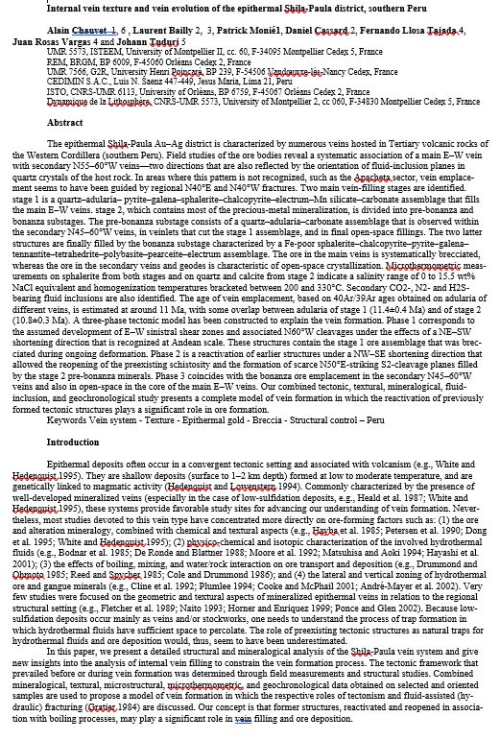
The epithermal Shila-Paula Au–Ag district is characterized by numerous veins hosted in Tertiary volcanic rocks of the Western Cordillera (southern Peru). Field studies of the ore bodies reveal a systematic association of a main E–W vein with secondary N55–60°W veins—two directions that are also reflected by the orientation of fluid-inclusion planes in quartz crystals of the host rock. In areas where this pattern is not recognized, such as the Apacheta sector, vein emplacement seems to have been guided by regional N40°E and N40°W fractures. Two main vein-filling stages are identified. stage 1 is a quartz–adularia– pyrite–galena–sphalerite–chalcopyrite–electrum–Mn silicate–carbonate assemblage that fills the main E–W veins. stage 2, which contains most of the precious-metal mineralization, is divided into pre-bonanza and bonanza substages. The pre-bonanza substage consists of a quartz–adularia–carbonate assemblage that is observed within the secondary N45–60°W veins, in veinlets that cut the stage 1 assemblage, and in final open-space fillings.
Oil and gas-bearing suites are determined in large stratigraphical range of geological structure of the onshore and offshore territory of the Azerbaijan Republic starting from Aalenian subdivision of the Middle Jurassic epoch to the Absheron subdivision of the upper Pliocene. Moreover, middle Pliocene is the basic oil and gas-bearing suite (productive layer) and it prevails according to specific gravity of potential resources and oil and gas-bearing prospectivity.
Review of Kaolin Deposits of Europe Herwig F. Kaolin Deposits of Austria Каолиновые месторождения в Болгарии (Kaolin Deposits of Bulgaria) Kaolin Deposits of Czechoslovakia Kaolin Deposits of Denmark Die Kaolinlagerstatten der Bundesrepublik Deutschland
Seismology is, in the truest sense of the word, a global science, not limited to political boundaries. Thus, it can only be effectively practiced through international cooperation. Seismology is primarily an observational science. Quantitative measurements of seismic ground motion as a function of time require physically well defined, continuously recording instruments. Suitable seismographs of different design principles became available at the end of the 19th century. In the following years, a considerable number of seismograph stations were installed at sites around the globe. At the dawn of this century, some of these stations celebrate their 100th anniversary, as does the International Association of Seismology and Physics of the Earth’s Interior (IASPEI).