Добрый день, Коллеги. Важное сообщение, просьба принять участие. Музей Ферсмана ищет помощь для реставрационных работ в помещении. Подробности по ссылке
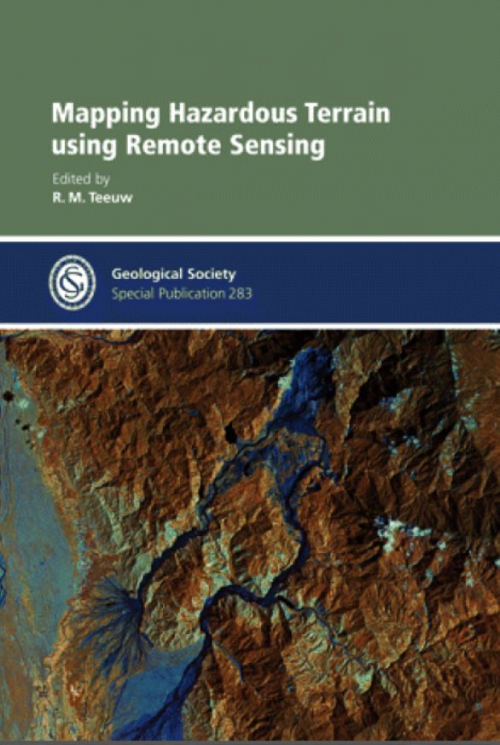
This book has its origins in a conference with the same theme that was run by the Geological Remote Sensing Group (GRSG) in December 2004. The GRSG is a Special Interest Group of the Geological Society of London and the Remote Sensing and Photogrammetric Society. A key objective of the GRSG is to increase the awareness of geoscientists, and the general public, about ways in which remote sensing can be used to map and monitor the Earth’s surface. To that end the GRSG holds at least one conference each year, produces a quarterly newsletter and runs a website (http://www.grsg.org).
When I first started conducting research in Mongolia, I found that I could make a room full of anthropologists jealous by telling them where I worked. To a discipline whose members pride themselves on working in exotic locations, Mongolia is a glamorous research site, for few Western and even fewer American anthropologists had worked there during the Cold War.1 Young anthropologists started to trickle in during the early 1990s: Norwegian, Danish, and French graduate students; Christopher Kaplonski, Peter Marsh, and Katherine Petrie from the United States; and, of course, the University of Cambridge research group (Mongolian and Inner Asian Studies Unit) headed by Caroline Humphrey and now David Sneath. So anthropology, my discipline, was becoming interested in Mongolia.
This book is an introduction to critical cartography and GIS. As such, it is neither a textbook nor a software manual. My purpose is to discuss various aspects of mapping theory and practice, from critical social theory to some of the most interesting new mapping practices such as map hacking and the geospatial web. It is an appreciation of a more critical cartography and GIS.
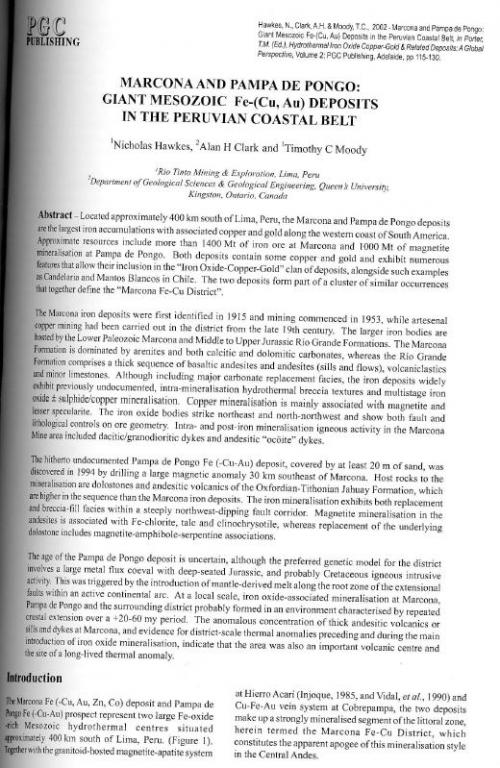
Located approximately 400 km south of Lima, Peru, the Marcona and Pampa de Pongo deposits are the largest iron accumulations with associated copper and gold along the western coast of South America. Approximate resources include more than 1400 Mt of iron ore at Marcona and 1000 Mt of magnetite mineralisation at Pampa de Pongo. Both deposits contain some copper and gold and exhibit numerous features that allow their inclusion in the "Iron Oxide-Copper-Gold" clan of deposits, alongside such examples asCandelaria and Mantos Blancos in Chile. The two deposits form part of a cluster of similar occurrences that together define the "Marcona Fe-Cu District".
Basic data on the opening of backarc basin, South China Sea (abbreviated as SCS hereafter) basin, were obtained through a two-year Japan and China cooperative joint marine geophysical survey in 1993 and 1994. Some new gravity, magnetic and seismic structural data by reflection as well as refraction study of SCS were obtained and added to existing data. A systematic three component magnetic measurement was made for the first time in this basin. These data in addition to those of earlier studies are constraints for depicting a thinning of a continental crust and later followed by a backarc basin opening by ocean floor spreading. Gravimetric and magnetic anomalies, heat flow, and ages of drilled rocks from this area are referred to speculating on the opening scheme of SCS. Origin of disoriented and scattered magnetic anomaly lineations is suggested to be due to intermittent activities along opening ridge systems of SCS. <...>
This planet contains so much water that perhaps it should have been better named Oceania. It is the only known body in the solar system that is surrounded by water filled with unique geologic structures and teeming with a staggering assortment of marine life. Some of the strangest creatures on Earth, whose ancestors go back several hundred million years, live on the deep ocean floor.
Exploration of the oceans using the techniques of the geophysicist has had a profound influence on our understanding of the Earth and its behaviour through time. Observations in the deep ocean have played a key role in establishing modern plate tectonic theory, transforming Earth Science in ways that were quite unexpected when the first geophysicists put to sea. Measurements in shallower waters have revealed how continental margins form, subside and become covered with sedimentary accumulations.
One of the earliest records, if not the earliest, of iron-manganese concretions relates to the form of soil nodules appropriately known as “buckshot gravel” and is given by Liechhardt (1847; quoted in Bryan, 1952) in his book “Overland Expedition from Morton Bay to Port Essington”. “Swarms of whistling ducks occupied large ponds in the creek, but our shot was all used, and the small iron-pebbles which we used as a substitute were not heavy enough to kill even a duck.” Such are the beginnings of science.
The formation and evolution of the Earth and planets depend on transfer of mass and energy. Magma and fluid are integral parts of the transport processes that govern the mass and energy transfer. Mass transport property data are central to describe those processes. Mass transport is accomplished by transfer of fluids and magma and typically takes place at high temperature and pressure. Mass transport typically occurs along temperature and pressure gradients, which means that energy transport also associates with mass transport, although in this book, energy transfer is not explicitly discussed.
Mass Transport in Oxides - An Overview J. B. Goodenough CHARACTERISATION Some Recent Advances in the Characterisation of Silicates M. A. Carpenter Neutron Activation Induced Beta Autoradiography as a Technique for Locating Minor Phases in Thin Section: Emulsion Response Characteristics P. J. Potts High Resolution Powder Neutron Diffraction A. N. Fitch Neutron Scattering Investigation of the Defect Structure о^УоОз. Stabilised Zr02 and its Dynamical Behaviour at High Temperatures R. Osborn, N. H. Andersen, K. Clausen, M. A. Hackett, Ж' Haves, M.T. Hutchings, andJ. E. MacDonald