Добрый день, Коллеги. Важное сообщение, просьба принять участие. Музей Ферсмана ищет помощь для реставрационных работ в помещении. Подробности по ссылке
Behold the power of the microcomputer before your very eyes! This book took less than a year to complete from the initial conversations between Dan Merriam and myself to final typeset copy. This would have been impossible when the first volume of this book was published. All of the papers in this volume, with one exception, arrived on floppy disk but in four different disk formats and many wordprocessing formats. These were all handled elegantly by our typesetter and converted into the appropriate Macintosh file format. Even some of the figures were placed in the book electronically. I see this as a great boon to the world of science because of the much shorter time between inception and dispersal of scientific knowledge. As a result of using microcomputers to typeset this book, the information contained in it is current and fresh. <...>
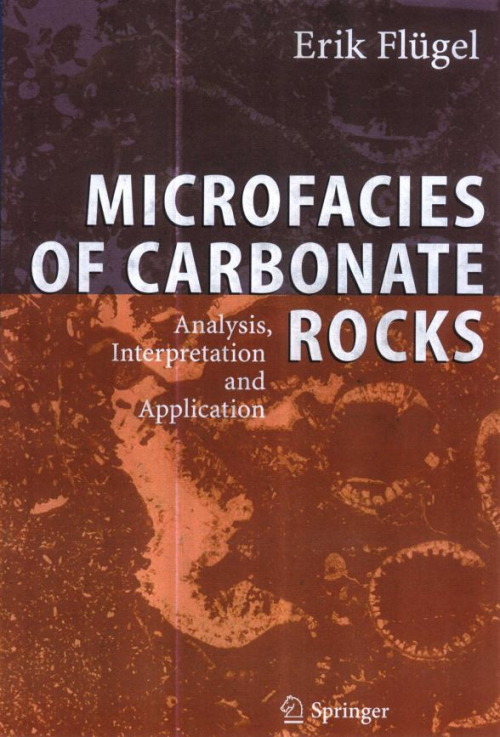
The objective of this book is to provide a synthesis of the methods used in microfacies studies of carbonate rocks and to show how the application of microfacies studies has contributed to new developments in carbonate geology. In contrast with other textbooks on carbonate sedimentology this book focuses on those compositional and textural constituents of carbonates that reflect the depositional and diagenetic history and determine the practical usefulness of carbonate rocks.
The objective of this book is to provide a synthesis of the methods used in microfacies studies of carbonate rocks and to show how the application of microfacies studies has contributed to new developments in carbonate geology. In contrast with other textbooks on carbonate sedimentology this book focuses on those compositional and textural constituents of carbonates that reflect the depositional and diagenetic history and determine the practical usefulness of carbonate rocks.
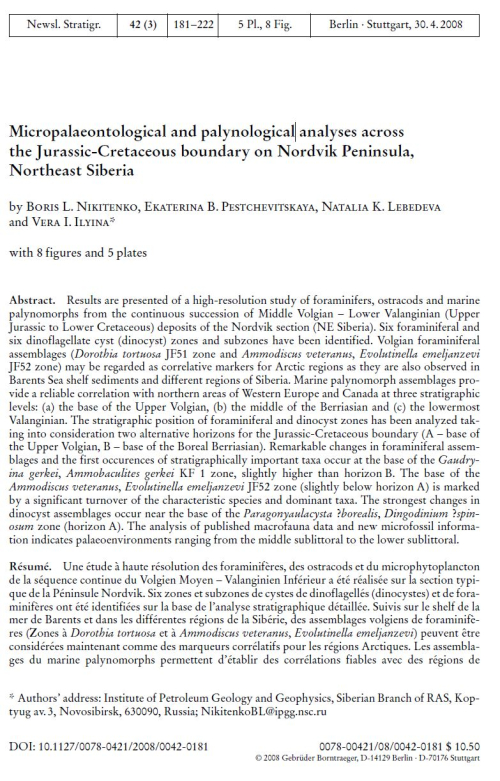
Results are presented of a high-resolution study of foraminifers, ostracods and marine palynomorphs from the continuous succession of Middle Volgian – Lower Valanginian (Upper Jurassic to Lower Cretaceous) deposits of the Nordvik section (NE Siberia). Six foraminiferal and six dinoflagellate cyst (dinocyst) zones and subzones have been identified. Volgian foraminiferal assemblages (Dorothia tortuosa JF51 zone and Ammodiscus veteranus, Evolutinella emeljanzevi JF52 zone) may be regarded as correlative markers for Arctic regions as they are also observed in Barents Sea shelf sediments and different regions of Siberia. Marine palynomorph assemblages provide a reliable correlation with northern areas of Western Europe and Canada at three stratigraphic levels: (a) the base of the Upper Volgian, (b) the middle of the Berriasian and (c) the lowermost Valanginian.
The evolution of calcite microstructures and crystallographic preferred orientations (CPOs) is well understood due to well constrained experimental studies. However, the interpretation of naturally deformed calcite marbles is more difficult because of less constrained strain paths, a multiphase deformation history, and variable P–T conditions. The Penninic units within the Tauern Window (Eastern Alps) have been affected by several deformation events and metamorphic overprint. Generally, three major deformational events can be distinguished. D1 is related to underthrusting of Penninic units beneath the Austroalpine nappe complex, and top-to-the-N nappe stacking within the Penninic continental units. Deformation stage D2 is interpreted as reflecting the subsequent continent collision between the Penninic continental units and the European foreland. D3 is related to the formation of the dome structure of the Tauern Window. This polyphase deformation history can be partly reconstructed by the evolution of calcite microfabrics and CPOs.
Studies on the properties and behaviour of clay soils, conducted in Soil Engineering, have revealed the importance of Soil Structure in the control of the properties and response performance of clays. Early descriptions of clay soil structure, in the 1950s–1960s, using such terms as ‘honeycomb’, ‘cardhouse’, ‘flocculated’, ‘dispersed’ and ‘oriented’ testify to the level of descriptive scrutiny of the micromorphology of clay soils.
The ever increasing amount of data on crystal arrangement in igneous and metamorphic rocks, alloys and ceramics, shows that the microtextures of these materials result from sequences of crystal growth and resorption. Metallurgists have become knowledgeable in the interpretation of textures and can make or modify textures of alloys in order to obtain specifjc responses to traction, distortion, etc. The modifications in texture can be reproduced or changed as often as desired. By analogy, it is probable that the microtextures observed in rocks may result from the same processes that govern similar textures in manufactured products. <...>
Christopher R. German, Jian Lin, and Lindsay M. Parson The Thermal Structure of the Oceani c Crust, Ridge-Spreading and Hydrothermal Circulation: How Well Do We Understand Their Inter-Connections? Christopher R. German and Jian Lin Geophysical Constraints Upo n the Thermal Regime of the Ocea n Crust Martin C Sinha and Rob L. Evans The Rheology and Morpholog y of Oceani c Lithosphere and Mid-Ocea n Ridges R. C. Searle and J. Escartfn
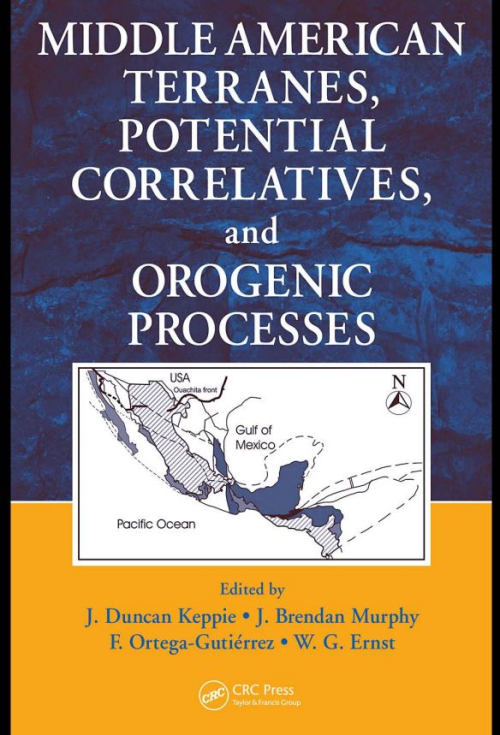
Editors’ Preface —J. Duncan Keppie, J. Brendan Murphy, F. Ortega-Gutierrez, and W. G. Ernst Middle American Terranes Terranes of Mexico Revisited: A 1.3 Billion Year Odyssey —J. Duncan Keppie Oaxaquia Terrane Sedimentary Origin of Calcareous Intrusions in the ~1 Ga Oaxacan Complex, Southern Mexico: Tectonic Implications —J. Dostal, J. D. Keppie, H. Macdonald, and F. Ortega-Gutierrez Geochronology and Geochemistry of the ~917 Ma, Calc-alkaline Etla Granitoid Pluton (Oaxaca, Southern Mexico): Evidence of Post-Grenvillian Subduction along the Northern Margin of Amazonia —C. Ortega-Obregon, J. D. Keppie, L. A. Solari, F. Ortega-Gutierrez, J. Dostal, R. Lopez, A. Ortega-Rivera, and J. W. K. Lee