Добрый день, Коллеги. Важное сообщение, просьба принять участие. Музей Ферсмана ищет помощь для реставрационных работ в помещении. Подробности по ссылке
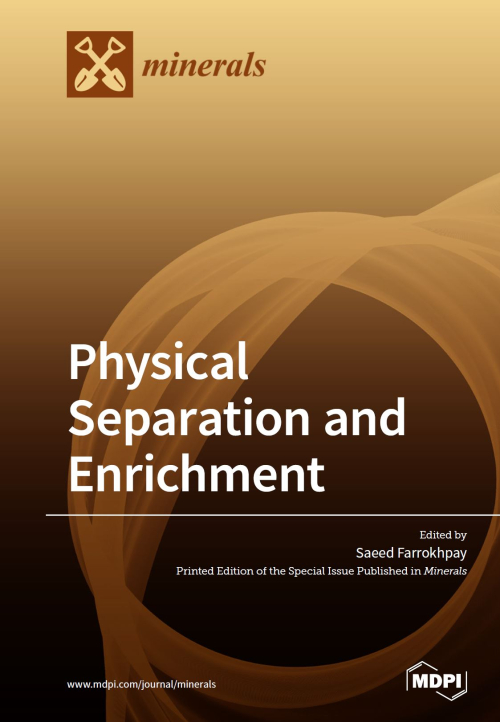
Saeed Farrokhpay Editorial for the Special Issue: “Physical Separation and Enrichment”
Sunil Kumar Tripathy, Y Rama Murthy, Veerendra Singh, Saeed Farrokhpay and Lev O. Filippov Improving the Quality of Ferruginous Chromite Concentrates Via Physical Separation Methods
Jianwu Zeng, Xiong Tong, Fan Yi and Luzheng Chen Selective Capture of Magnetic Wires to Particles in High Gradient Magnetic Separation
Kwanho Kim and Soobok Jeong Separation of Monazite from Placer Deposit by Magnetic Separation
Yuekan Zhang, Peikun Liu, Lanyue Jiang, Xinghua Yang and Junru Yang Numerical Simulation of Flow Field Characteristics and Separation Performance Test of Multi-Product Hydrocyclone
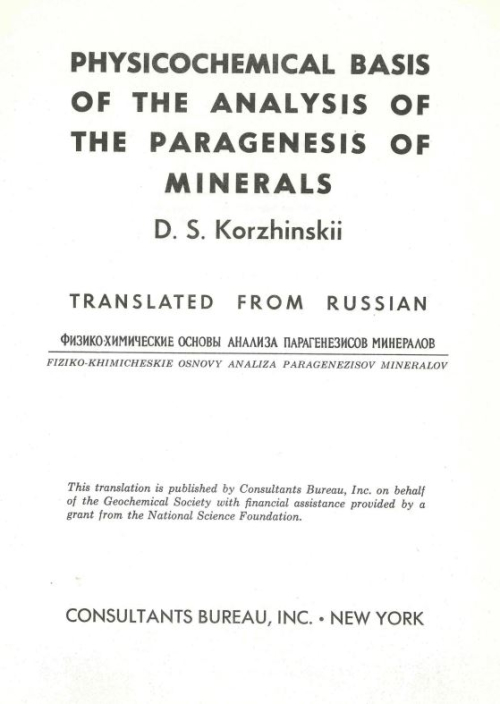
An intimate coexistence of minerals in close contact with one another, observed repeatedly in definite geologic settings, is called their paragenesis. The paragenesis of minerals may result from different causes. Usually by paragenesis is meant an association of minerals formed simultaneously as products of a certain stage of a given process. Such, for instance, is the paragenesis of minerals formed at the same time by a metamor-phic process and existing in close contact with one another. In this book we have in mind precisely this kind of paragenesis of simultaneously formed minerals. Some authors use the term paragenesis to designate an association of noncontemporaneous minerals, provided there is regularity in their occurrence together. Such, for example, is the paragenesis of primary minerals with the products of their decomposition, or the paragenesis of minerals which crystallize in a regular sequence from a cooling magma or a hydrothermal solution, forming overgrowths on one another. The term paragenesis will not be used here in this broader sense. <...>
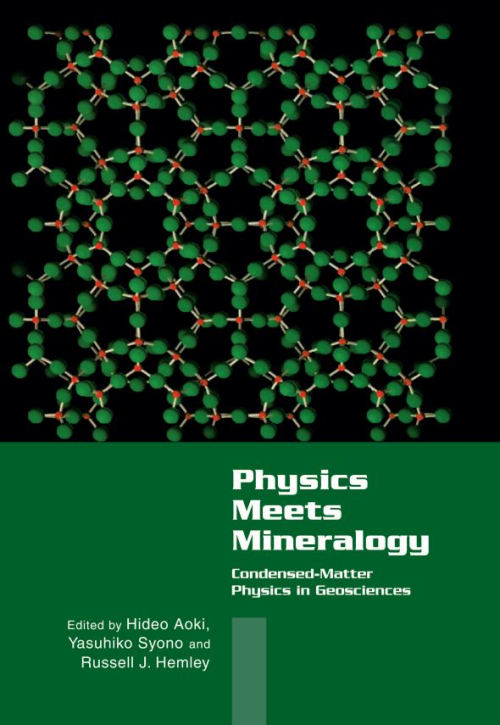
Geology is the study of the Earth in all its aspects except those that are now considered to be separate sciences of the Earth, like geophysics and meteorology. It concerns the materials of which the Earth is made, and the processes that operate on them. Very many of these processes are physical, and their understanding involves an understanding of the underlying physics. The raindrop that falls and makes its contribution to erosion is first created by condensation, falls under the influence of gravity, is held together by surface tension, reaches its terminal velocity as a result of friction long before hitting the Earth, has potential energy during its fall, and kinetic energy that is converted to mechanical energy and work when it strikes the Earth. <...>
It has long been recognized that atomic interactions are key in understanding largescale geological phenomena, which is an approach dating at least as far back as the days of Goldschmidt [1]. Conversely, a study of the materials that comprise the planets can tell us much about fundamental physics and chemistry. This line of approach is subsequently exemplified by Pauling's development of the theory of chemical bonding from the structural studies of minerals [2].
This book provides basic concepts and recent advances of fluid flow and transport in unconventional reservoirs across different scales (from pore to core and to reservoir) for a broad range of audiences from various scientific disciplines, such as geology, geoscience, geochemistry, geophysics, rock mechanics, and petroleum engineering.
Красной нитью этого тома является идея подставления различных методов исследования процессов, происходящих в реальных озёрах. Часть I посвящена подходам и техникам численного моделирования, приложенным к демонстрации отклика озера на ветровое воздействие. Она начинается с представления баротропных и бароклинных течений и распределений температуры воды, формирующихся в озере Цюрих в результате действия различных ветровых сценариев.
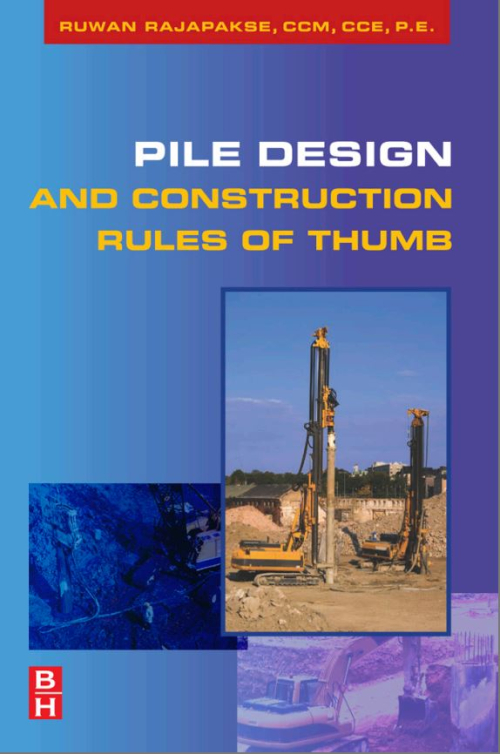
Pile design is mostly about application of engineering concepts rather than use of elaborate mathematical techniques. Most pile design work can be done with simple arithmetic. I have provided necessary equations and concepts in a manner so that the reader would be able to refer to them with ease. All chapters are provided with plethora of design examples. The solutions to design examples are given in a step by step basis with many illustrations.
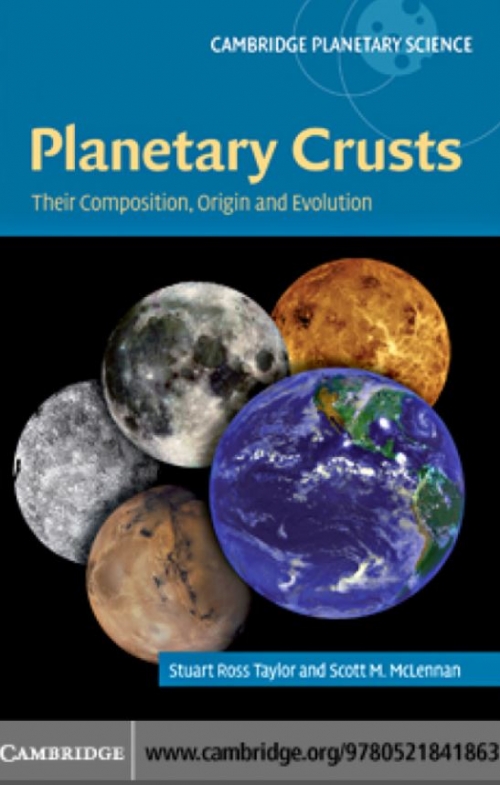
This work is not intended as a textbook, or as a review, but represents an enquiry into the problem of how and why solid planets produce crusts. As this seems to have happened at many different scales throughout the Solar System, we were curious to see whether some general principles might emerge from the detail. The formation of the planets themselves is the outcome of essentially random processes, constrained mainly by the history of the inner nebula and by the cosmochemical abundances of the chemical elements. But perhaps the production of crusts might be a simpler or more uniform process, a notion supported by the frequent appearance of basaltic lavas of assorted types on the surfaces of rocky bodies. <...>
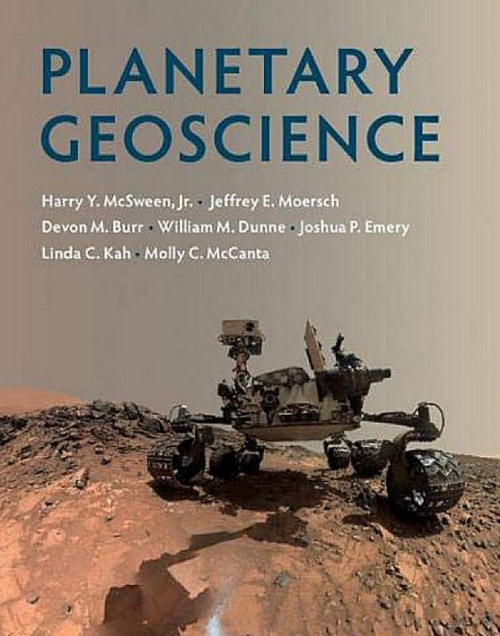
For many years, planetary science has been taught as part of the astronomy curriculum, from a very physics-based perspective, and from the framework of a tour of the Solar System – body by body. Over the past decades, however, spacecraft exploration and related laboratory research on extraterrestrial materials have given us a new understanding of planets and how they are shaped by geologic processes.
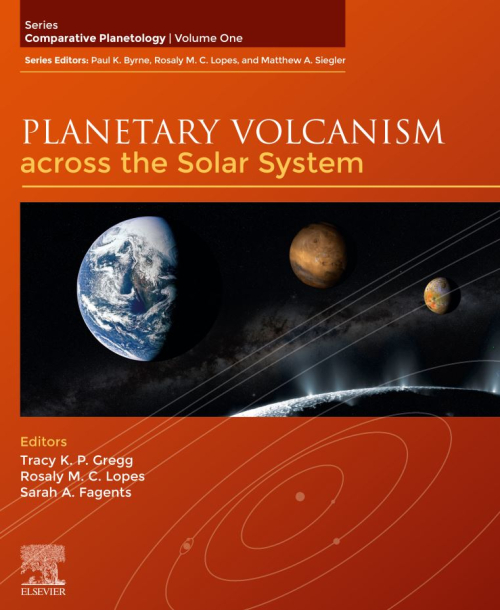
Earth’s infinite geological complexity fascinates us, and centuries of detailed observations and modeling can tempt us to believe that we have a full understanding of Earth’s igneous processes. Our world, however, is only one data point in the Solar System. A model that successfully predicts or explains a volcanic process on Earth, for example, may fail completely when applied to another planetary body. Such comparative planetology is therefore critical, and reveals the weaknesses in our understanding that would otherwise remain hidden: just because a model works on Earth does not mean that it truly explains a given process elsewhere using first principles. <...>