Добрый день, Коллеги. Важное сообщение, просьба принять участие. Музей Ферсмана ищет помощь для реставрационных работ в помещении. Подробности по ссылке

Поиск по книгам
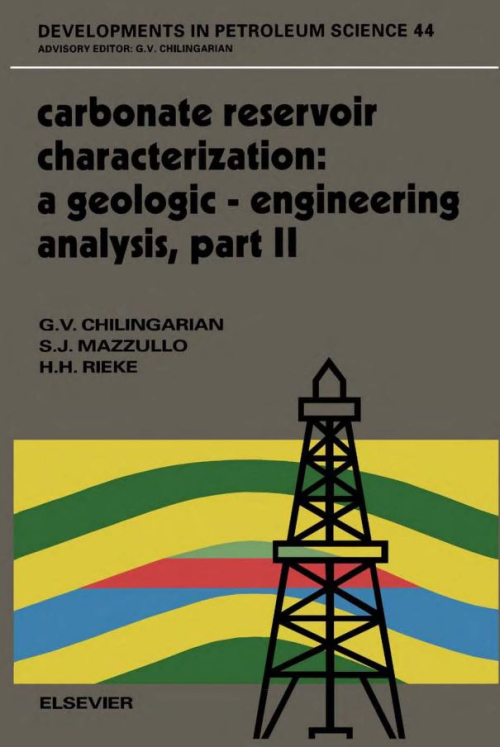
Редактор(ы):Dominguez G.C., Samaniego F.
Издание:Elsevier, 1996 г., 1010 стр., ISBN: 0-444-82103-1
Язык(и)Английский
Carbonate reservoir characterization:  a geologic - engineering analysis, part II / Характеристика карбонатного коллектора: инженерно-геологический анализ, часть II

The approach in Part 2 of this book builds on the various geoscience and engineering methodologies and technologies presented in the first volume. Part 1 presented fundamentals of geologic and engineering concepts for characterizing and evaluating carbonate reservoirs using a wide range of scales. Carbonate rocks are not homogeneous or isotropic in their properties. Hence, porosity, fluid saturation, bed thickness, and carbonate rock types show very little uniformity throughout reservoirs. Permeability, in most cases, also is strongly anisotropic in carbonate reservoirs.

Редактор(ы):Moore C.H., Wade W.J.
Издание:Elsevier, 2013 г., 368 стр., ISBN: 978-0-444-53831-4
Язык(и)Английский
Carbonate reservoirs porosity and diagenesis in a sequence stratigraphic / Пористость карбонатных коллекторов и диагенез в секвенс-стратиграфии

While this book is concerned primarily with porosity evolution and diagenesis in carbonate reservoirs, the reader and the authors must ultimately share a common understanding of the fundamental characteristics of the overall carbonate system. Therefore, the first three chapters are designed to highlight general concepts unique to— and essential for understanding—the carbonate realm.

Автор(ы):Schlager W.
Издание:Society for Sedimentary Geology, 2005 г., 208 стр., ISBN: 978-1-56576-132-2
Язык(и)Английский
Carbonate sedimentology and sequence stratigraphy / Карбонатная седиментология и секвенс-стратиграфия

Sedimentology and stratigraphy are neighbors yet distinctly separate entities within the earth sciences. Put in a nutshell, sedimentology searches for the common traits of sedimentary rocks regardless of age as it reconstructs environments and processes of deposition and erosion from the sediment record. Stratigraphy, by contrast, concentrates on changes with time, on measuring time and correlating coeval events. Sequence stratigraphy straddles the boundary between the two fields. It is a sedimentologic concept as it uses depositional anatomy to reconstruct environments and lateral facies change, and it is part of stratigraphy as it studies the vertical succession of sedimentary rocks and their succession and correlation. <...>

Автор(ы):Gosen B.S., Verplanck P.L.
Издание:2011 г., 8 стр.
Язык(и)Английский
Carbonatite and alkaline intrusion-related rare earth element deposits─A deposit model / Карбонатиты и щелочные интрузии - связь с месторождениями редкоземельных металлов - модель месторождений

The rare earth elements (REEs) are not as rare in nature as their name implies, but economic deposits with these elements are not common and few deposits have been large producers. In the past 25 years, demand for REEs has increased dramatically because of their wide and diverse use in hightechnology applications. Yet, presently the global production and supply of REEs come from only a few sources. China produces more than 95 percent of the world’s supply of REEs.

Редактор(ы):Bell K., Keller J.
Издание:Springer-Verlag, 1995 г., 218 стр., ISBN: 978-3-642-79184-0
Язык(и)Английский
Carbonatite volcanism. Oldoinyo Lengai and the petrogenesis of natrocarbonatites / Карбонатитовый вулканизм. Олдоиньо Ленгаи и петрогенезис натрокарбонатитов

During the last few years, carbonatites have received a considerable amount of attention. Some of this interest was no doubt kindled by the importance of volatiles in the Earth's mantle, particularly CO2 , by the fact that carbonatites can be used to monitor the chemical evolution of the sub-continental upper mantle, and by the fact that carbonatites may be effective metasomatizing agents at both mantle and crustal levels. 

Издание:USGS, 2009 г., 19 стр.
Язык(и)Английский
Carbonatites of the world, explored deposits of Nb and REE—database and grade and tonnage models / Карбонатиты мира, разведанные месторождения Nb и РЗЭ—база данных и модели сортности и тоннажа

This report is based on published tonnage and grade data on 58 Nb– and rare-earthelement (REE)–bearing carbonatite deposits that are mostly well explored and are partially mined or contain resources of these elements. The deposits represent only a part of the known 527 carbonatites around the world (Woolley and Kjarsgaard, 2008), but they are characterized by reliable quantitative data on ore tonnages and grades of niobium and REE.

Издание:Санкт-Петербург, 2015 г., 91 стр., УДК: 551.735 (470.55/57), ISBN: 978-5-4386-0912-4
Язык(и)Английский, Русский
Carboniferous reference sections: potential candidates for the base of the Serpukhovian GSSP  and organic buildups, South Urals / Опорные разрезы карбона: потенциальные кандидаты в GSSP нижней границы серпуховского яруса и органогенные постройки, Ю. Урал

The purpose of the field trip is to show the standard and reference Carboniferous sections of the eastern slope of the South Urals. The area of the excursion is on the border of the Chelyabinsk Region and the Republic of Bashkortostan. The guidebook includes a summary of geology and Carboniferous stratigraphy of the Urals. Eight geological objects of the excursions are described and illustrated. The Verkhnyaya Kardailovka section, a candidate for the base of the Serpukhovian GSSP, is described in detail. A Devonian-Carboniferous section near Verkhneuralsk, the stratotype of the Lower Viséan Ustgrekhovkian Horizon on the Ural River, and Bashkirian organic buildups on the Bolshoi Kizil and Khudolaz rivers are described.

Редактор(ы):Mann P.
Издание:1999 г., 668 стр.
Язык(и)Английский
Caribbean sedimentary basins: Classification and tectonic setting from jurassic to present / Карибский осадочный бассейн: классификация и тектонические условия от юры до нашего времени

The purpose of this introductory chapter is to describe the active tectonic setting of the Caribbean, its major crustal provinces, and to provide a simple classification for sedimentary basins in the Caribbean region. In addition to this background information on Caribbean basins, I provide a series of thirteen quantitative plate reconstructions based on the revised plate model of Mtiller et al. (Chapter 2). These reconstructions serve to place individual basins into a better tectonic framework. <...>

Выпуск 90
Автор(ы):Kuehn C.A., Rose A.W.
Издание:Economic geology, 1995 г., 20 стр.
Язык(и)Английский
Carlin gold deposits, Nevada: origin in a deep zone of mixing between normally pressured and overpressured fluids

Gold mineralization at Carlin is clearly younger than hydrocarbon maturation (pre-Cretaceous) and felsic dike intrusion (Cretaceous), and older than deep oxidation (late Tertiary). Within the episode of gold mineralization, the main gold ore (MGO) stage and late gold ore (LGO) stage are distinguished paragenetically, wi-th a variety of vein and mineralization types in each. MGO stage fluids contained 5 to 10 mole percent COa, appreciable H2S, and 3 ± 1 wt percent NaCl equiv. At least portions of MGO stage mineralization were characterized by two-phase boiling (COa exsolution) at 215° ± 30°C and 800 ± 400 bars. In contrast, LGO stage fluids were gas poor with salinities <1.5 wt percent NaCl equiv and record only nonboiling conditions. MGO stage fluids had 518Oh2o values of 5 to 9 per mil, whereas LGO stage fluids resembled unevolved meteoric water with 518Oh2o values < —3 per mil.

From the MGO stage to the LGO stage, calcite 5180 values shifted from near whole-rock values of 12 ± 3 per mil to around 0 ± 1 per mil as LGO stage fluids flooded the system. Jasperoids also record a large range (9-22%o) in 518Oh2o values. These data indicate the involvement of two very different fluids in ore deposition. Because MGO and LGO stage features are closely associated spatially with each other and with Au, As, Sb, Hg, and other ore elements, both fluids are believed to have both been present during most stages of ore deposition.

At pressures of 80 to 85 percent lithostatic, depths of 3.8 ± 1.9 km are required to accommodate the 800 ± 400 bars of pressure recorded in MGO stage fluid inclusions. Carlin, therefore, is not an epi-thermal or hot spring deposit. Carbon dioxide in gas-rich MGO stage fluids may have originated either directly from buried intrusions or their contact aureoles, or from low-grade regional metamorphism at depth. The water may have been originally meteoric, and Au may be magmatic or derived from leaching of deep metamorphic or sedimentary rocks. Ore deposition appears to have occurred in zones of throttling at a pressure seal between normally pressured and overpressured regimes, where fluids experienced a change from near-lithostatic to hydrostatic conditions. Such pressure seals are common in deep sedimentary basins and may be a key to highly localized gold deposition. Mixing of two fluids and interaction with host rocks along thin permeable bioclastic horizons are believed to have been the major factors in depositing ore.


 

Издание:Economic geology, 2005 г., 34 стр.
Язык(и)Английский
Carlin-type gold deposits in Nevada: critical geologic characteristics and viable models

Carlin-type Au deposits in Nevada have huge Au endowments that have made the state, and the United States, one of the leading Au producers in the world. Forty years of mining and numerous studies have provided a detailed geologic picture of the deposits, yet a comprehensive and widely accepted genetic model remains elusive. The genesis of the deposits has been difficult to determine owing to difficulties in identifying and analyzing the fine-grained, volumetrically minor, and common ore and gangue minerals, and because of postore weathering and oxidation. In addition, other approximately contemporaneous precious metal deposits have overprinted, or are overprinted by, Carlin-type mineralization.

888.15