Добрый день, Коллеги. Важное сообщение, просьба принять участие. Музей Ферсмана ищет помощь для реставрационных работ в помещении. Подробности по ссылке
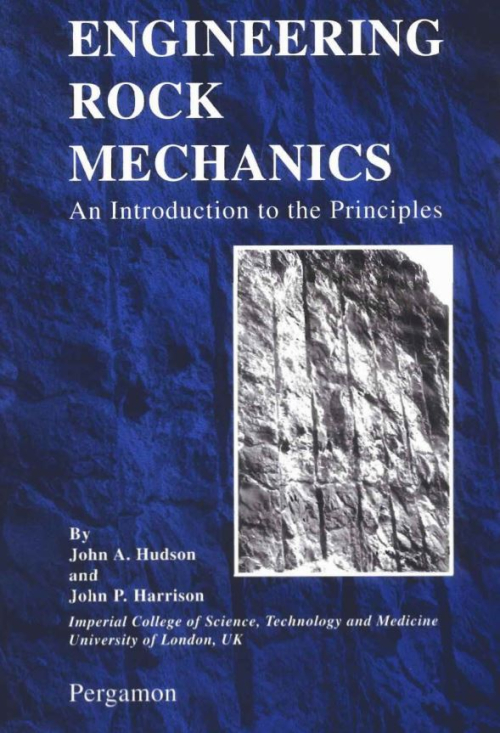
With the title Engineering Rock Mechanics, what is this book about? It is about the discipline, based on mechanics, which is used to design structures built on or in rock masses. These structures, which encompass building foundations, dams, rock slopes, tunnel, caverns, hydroelectric schemes, mines, etc., depend critically on the rock mass properties and the interaction between the rock mass and the engineered structure. As a result, the distinct discipline of engineering rock mechanics has developed. The term ’rock mechanics’ refers to the basic science of mechanics applied to rocks; whilst the term ’rock engineering’ refers to any engineering activity involving rocks. Thus, the term ’engineering rock mechanics’ refers to the use of rock mechanics in rock engineering-within the context of civil, mining and petroleum enpeering. Because rock mechanics can also be used to study structural geology, we emphasize through the title that it is the rock mechanics principles in the engineering context that we are presenting <...>
There are two reasons why it is important to understand and use engineering rock mechanics units correctly: engineering rock mechanics calculations used for rock engineering design should be numerically correct; and to use engineering rock mechanics properly, an understanding of units is necessary. We have used standard symbols and the SI (International System) of units. There are seven base units in the SI system: length, mass, time, electric current, thermodynamic temperature, amount of substance and luminous intensity. These base units are dimensionally independent. <...>
Mineral Potential Analysis (MPA) integrates the mineral systems approach with expert geoscientific knowledge and data science to produce predictive maps that guide exploration efforts to areas with the highest discovery potential. MPA can be applied to a diverse range of commodities, across all exploration scales. Our team boasts extensive expertise in practical mining exploration, data interpretation, and data science.
When NASA first explained its hope that our committee could review its strategy for providing satellite-derived geophysical data sets to the polar science community and provide guidance to make future data sets more useful, the task seemed somewhat ambiguous and daunting. We could not look in depth at every available data set given the time and resources available, nor did it feel particularly useful to comment on what was right or wrong in past decisions. But as the committee met and gathered information, it became clear that our most useful contribution could lie in determining how a better match could be achieved between NASA’s data sets and the needs of NASA’s current strategic guide, the Earth Science Enterprise (ESE) program. By analyzing what information is needed to address the ESE questions from a cryospheric perspective and then mapping those needs against existing resources, we found a way to turn our review into concrete suggestions to guide future activities <...>
Environmental chemistry, Seventh Edition, continues much the same organizational structure, level, and emphasis that have been developed through preceding editions. In addition to providing updated material in the rapidly developing area of environmental chemistry, this edition emphasizes several major concepts that are proving essential to the practice of environmental chemistry at the beginning of the new millennium.
Soils can act as a sink for anthropogenic and naturally released heavy metals. Among these are heavy metal oxides and sulfides, which are emitted e.g. by mining industry and metal smelting. The dissolution and transformation behavior of these heavy metal phases specifies their fate in the soil and determines whether the metals become bioavailable or could contaminate the groundwater. To gain more information about these dissolution reactions in soils, in-situ methods are needed. We present here a method to fix particulate metal phases on an inert support. This method allows us to expose and recover metal phases in the environment under controlled conditions.
The paper presents some contemporary approaches to spatial environmental data analysis. The main topics are concentrated on the decision-oriented problems of environmental spatial data mining and modeling: valorization and representativity of data with the help of exploratory data analysis, spatial predictions, probabilistic and risk mapping, development and application of conditional stochastic simulation models. The innovative part of the paper presents integrated/hybrid model—machine learning (ML) residuals sequential simulations—MLRSS.
Mills, C. F. Geochemical aspects of the aetiology of trace element related diseases Plant, J. A., Baldock, J. W. & Smith, B. The role of geochemistry in environmental and epidemiological studies in developing countries: a review Fordyce, F. M., Masara, D. & Appleton, J. D. Stream sediment, soil and forage chemistry as indicators of cattle mineral status in northeast Zimbabwe Jumba, I. O., Suttle, N. F., Hunter, E. A. & Wandiga, S. O. Effects of botanical composition, soil origin and composition on mineral concentrations in dry season pastures in western Kenya Maskall, J. & Thornton, I. The distribution of trace and major elements in Kenyan soil profiles and implications for wildlife nutrition
One of the main outcomes of the eleven meetings of the Working Party was the recognition of the importance of interdisciplinary studies linking regional geochemistry with plant, animal and human health. The effects of major element deficiencies or excesses on plant health are well known; this is not the case for trace elements. In fact, rapid and reliable analytical methods for determining trace element abundances have only recently become available, and it is to be expected that important new information on trace element levels will be forthcoming.
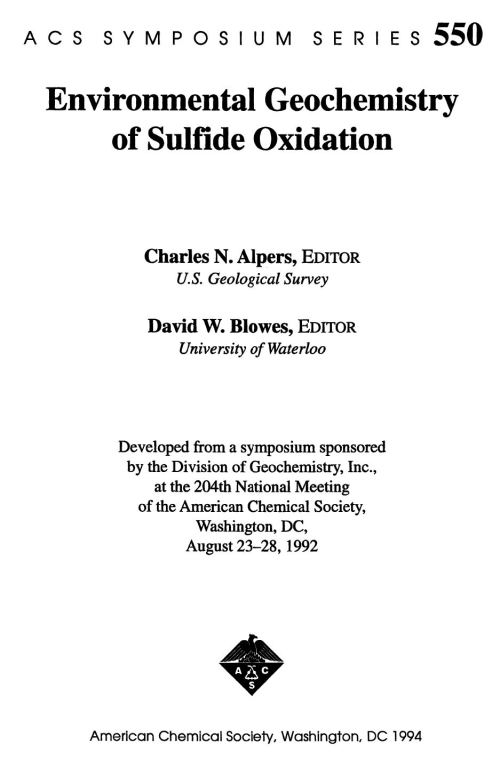
The stury of sulfide-oxidation reactions, the characterization of the products of these reactions, and the prediction of the fate of sulfide-oxidation products in natural environments are increasingly active areas of research. This research is motivated by the locally severe environmental impacts and toxicity associated with the products of sulfide oxidation. Mine wastes are of particular concern because of past and present disposal practices that have resulted in the widespread degradation of surface-water and ground-water quality. Mine wastes have therefore come under increasing regulation.