Добрый день, Коллеги. Важное сообщение, просьба принять участие. Музей Ферсмана ищет помощь для реставрационных работ в помещении. Подробности по ссылке
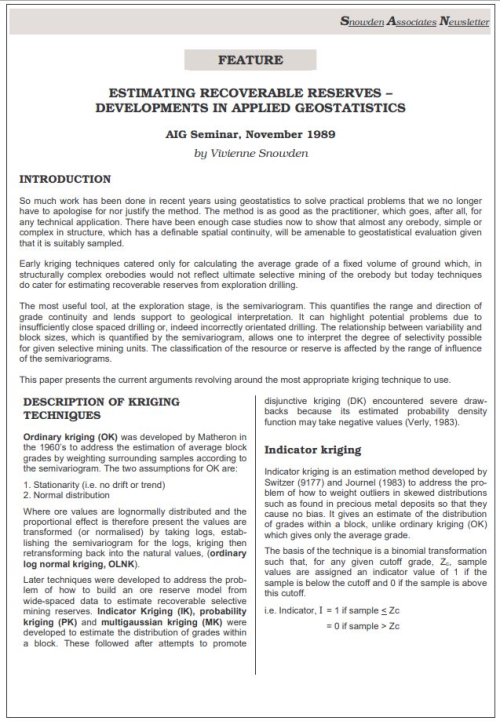
So much work has been done in recent years using geostatistics to solve practical problems that we no longer have to apologise for nor justify the method. The method is as good as the practitioner, which goes, after all, for any technical application. There have been enough case studies now to show that almost any orebody, simple or complex in structure, which has a definable spatial continuity, will be amenable to geostatistical evaluation given that it is suitably sampled.
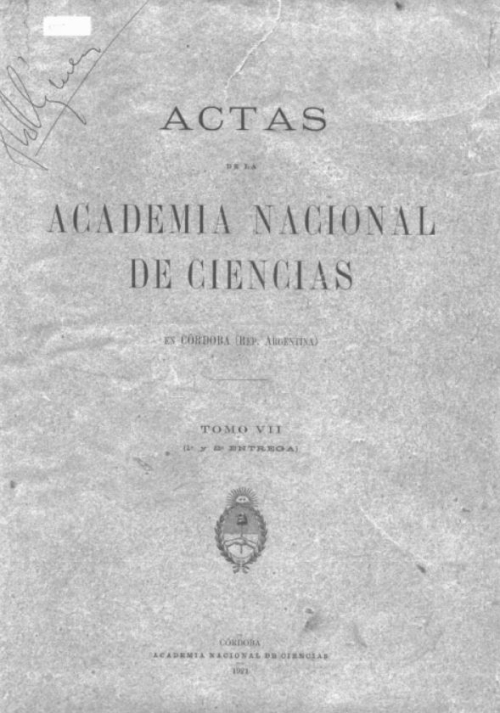
Con la aparición de] Tomo VII de fas /leías de la Academia Nacional de Ciencias empezamos una nueva serie de esta publicación, interrumpida durante varios años por razones age ñas a la voluntad del Instituto y debido principalmente a los reducidos recursos de su presupuesto, que no permitía la confección de obras ilustradas y de mayor extensión.
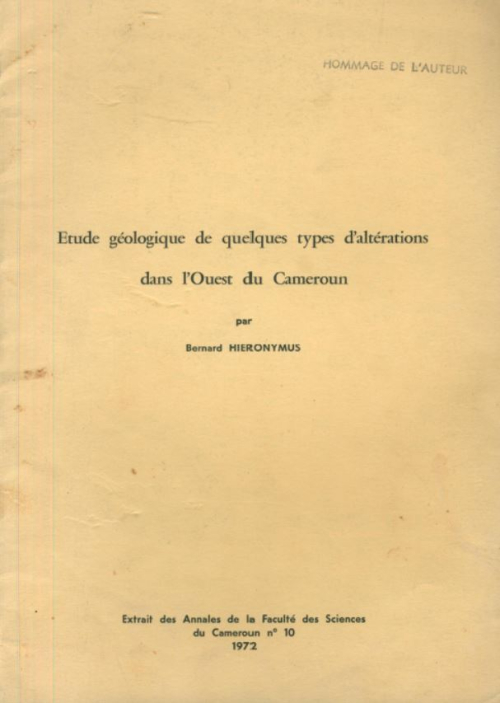
L’auteur décrit différents stades de l’altération latéritique de roches variées, dans des conditions géomorphologiques et climatiques différentes. En particulier, il étudie le processus de formation des gîtes de Fongo-Tongo et de Bangam, ainsi que leur évolution, puis leur démantèlement en relation avec des pulsations orogéniques liées au dynamisme de la « ligne du Cameroun».
Dans un ouvrage publié en 1 922 sur le « Toarcien et l'Aalénien dans le bassin d'Esch » le regretté N. LAUX a comparé la région qu'il étudiait avec celle de Gundershoffen (Alsace), connue surtout par l'ouvrage de LEPSIUS << Beitriige zur Kenntnis der Juraformation im Unter-Elsass >>. Après avoir relevé certaines analogies dans la succession des niveaux, l'auteur ajoute : << Il n'y a que sur le compte des Ammonites en Alsace que l'insécurité reste entière. En 1 875, lorsque l'étude de LEPsrus a paru, les espèces n 'étaient pas encore suffisamment différenciées. Sous ce rapport du moins la ravine de Gundershoffen mériterait d'être remise à l'étude».<...>
Après les savantes études de De Rouville sur cette région, il nous aurait paru téméraire de tenter une révision aussi délicate, si de nombreux faits nouveaux et les découvertes récentes de l’un de nous n’étaient venus éclairer bien des points douteux, en modifier plusieurs qui nous avaient paru mal interprétés, et enfin en révéler d’autres, qui avaient complètement échappé à nos prédécesseurs. <...>
Challenges and Methods of Groundwater Remediation in Karst Neven Kresic Impact of Soil Coverings and Land Cover Types on Groundwater Recharge in Karst Aquifers of Southern Italy D. Cusano, D. Lepore, V. Allocca, and P. De Vita Using Screening Numerical Models to Analyze Groundwater Systems: The Case Study of a Major Karst Spring Supporting a NATURA2000 Site Cristina Di Salvo, Claudio Alimonti, Daniel T. Feinstein, Randall J. Hunt, Pamela Teoli, and Elisabetta Preziosi Updating of Traditional Groundwater Budget and Recharge Assessment by Using the APLIS Method for the Karst Scirca Spring (Central Italy)
FLINT, S., AITKEN, J. & HAMPSON, G. Application of sequence stratigraphy to coal-bearing coastal plain successions: implications for the UK Coal Measures
FULTON, I. M., GUION, P. D. & JONES, N. S. Application of sedimentology to the development and extraction of deep-mined coal
GUION, P. n., FULTON, I. i. & JONES, N. S. Sedimentary facies of the coal-bearing Westphalian A and B north of the Wales-Brabant High
HAMPSON, G. Discrimination of regionally extensive coals in the Upper Carboniferous of the Pennine Basin, UK using high resolution sequence stratigraphic concepts
Much of Europe, from Northern Scandinavia and Iceland to the Southern Iberian Peninsula, has been covered by valley glaciers and extensive ice sheets during long periods of the Pleistocene. Consequently, in both highlands and wide areas of the lowlands (particularly in Sweden, Finland, Northern Russia, and Central Europe) deposits of glacial origin (frontal moraines, different types of tills, lateral moraines, drumlins, and eskers) and other deposits indirectly related to glaciers (fluvioglacial terraces, lacustrine deposits, kames, and outwash plains) can frequently be found.