Добрый день, Коллеги. Важное сообщение, просьба принять участие. Музей Ферсмана ищет помощь для реставрационных работ в помещении. Подробности по ссылке

Поиск по книгам
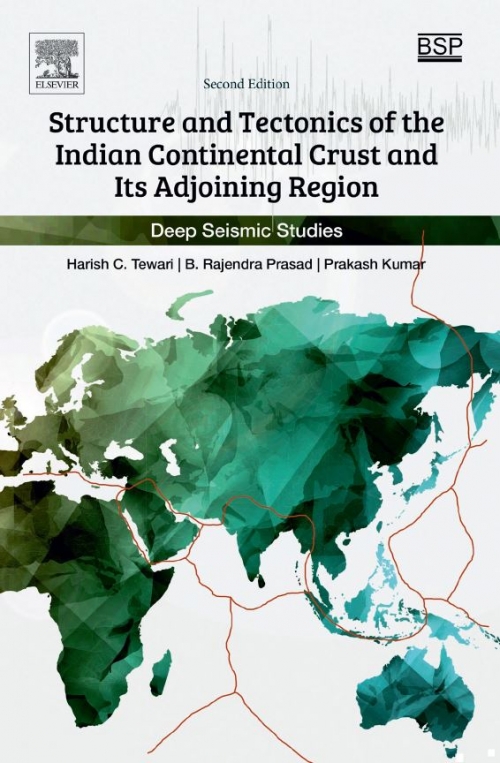
Издание 2
Автор(ы):Kumar P., Prasad B.R., Tewari H.C.
Издание:Elsevier, 2018 г., 262 стр., ISBN: 978-0-12-813685-0
Язык(и)Английский
Structure and tectonics of the Indian continental crust and its adjoining region. Deep seismic studies / Строение и тектоника континентальной коры Индии и прилегающих к ней областей. Результаты глубинного сейсмического зондирования

Five billion years ago the planet Earth was formed as a large conglomerate. The immense amount of heat energy released by massive high-velocity bombardment of meteorites and comets melted the entire planet. Since then, the planet has been cooling off and the process continues even today. During the cooling process, denser materials, such as iron from meteorites, sank into the core of the Earth while lighter material, e.g., silicates, oxygen compounds and water from comets, rose near to the surface.

Автор(ы):Nicolas A.
Издание:Kluwer Academic Publishers, 1989 г., 367 стр., ISBN: 978-94-010-7569-5
Язык(и)Английский
Structures of ophiolites and dynamics of oceanic lithosphere / Структуры офиолитов и динамика океанической литосферы

Ophiolite, Greek for 'the snake stone', appears to have received its first written definition by Brongniart (1813) as a serpentine matrix containing various minerals. Later in 1821 and 1827, Brongniart determined that volcanic and gabbroic rocks were also present, associated with cherts, and he ascribed an igneous origin to the ophiolite. Amstutz (1980) gives an excellent exegesis of these early contributions and traces the further use of the term and concept of ophiolite. This concept had been forged in the western Alps and Apennines where, thanks to talented Italian geologists, in particular A. Sismonda, B. Gastaldi, V. Novarese and S. Franchi, the study on metamorphic ophiolites (the 'pietre verdi') has rapidly progressed. <...>

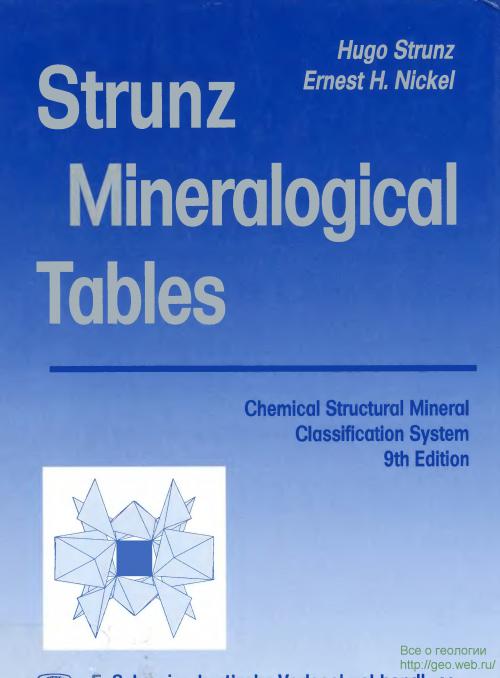
Автор(ы):Nickel E.H., Strunz H.
Издание:E.Schweizerbrat'sche Verlagsbuchhandlung, Stuttgart, 2001 г., 872 стр., ISBN: 3-510-65188-X
Язык(и)Английский
Strunz mineralogical tables. Chemical structural mineral

The chemical-structural mineral classification system developed since the first edition of Mineralogische Tabellen (1941) evolved from the chemical mineral system of Haiiy (1801), which was based on cations, and of Berzelius (1814,1824), based on anions, followed by the chemical-morphological system of Gustav Rose (1838.1852). the periodic system of the chemical elements (cf. Introduction), and finally by the developing knowledge of atomic crystal structures (since Laue, 1912, Bragg, 1913).

The classification system used in the first, and subsequent editions of Mineralogische Tabellen. combines chemical features with structural principles, such as structure types, cation size and coordination numbers; minerals are generally arranged according to increasing cation size. A characteristic scheme of chemical formulae was introduced, as well as internationalized names, such as neso- to tektosilicates. International priority principles have always been acknowledged.

Since the last edition (1978), technological developments, such as improved electron microscopy (since Ernst Ruska, 1931), chemical analysis by microprobe (since Raymond Castaing, 1951). scanning electron microscopy (since Oatley & McMullan, 1952), automatic computer-controlled instrumentation and software for structure determination, have made it possible to carry out the chemical, structural, morphological and physical characterization of tiny particles of new minerals (on the scale of micrograms) within a few days or weeks; computerized structural and morphological drawings can be produced within minutes.

As a result, the number of minerals approved by the Commission on New Minerals & Mineral Names of the IMA (International Mineralogical Association) has grown from about 2500 in 1978 to about 4000 at present, with about 60 to 80 new minerals added each year.

In this edition, the world of minerals is divided by chemical features into ten classes, each of which is subdivided, on chemical-structural principles, into divisions, subdivisions, groups of isotypic and homeotypic minerals, or individual minerals with unique structure types; groups with two or more mineral names comprise minerals with similar structure or composition. The classification system and alphanumeric coding scheme used in this 9,h edition of the Strunz Mineralogical Tables were presented at the 1994 IMA meeting in Pisa. They permit the insertion of thousands of new minerals in the future without changing the basic classification framework.

The authors gratefully acknowledge the contributions to this volume made by a number of mineralogical colleagues, particularly Emil Makovicky for helpful suggestions relating to the sulfide and sulfosalt classification, and Friedrich Liebau for constructive critical reading of the cyclo- and inosilicate portions of the manuscript. We also acknowledge the contribution made by Irmgard Stolle, Berlin, who provided assistance in the preparation of the manuscript.

This contribution to mineralogy is indebted to about seven generations of diligent and active researchers over a period of two hundred years. The authors welcome suggestions for improvements.



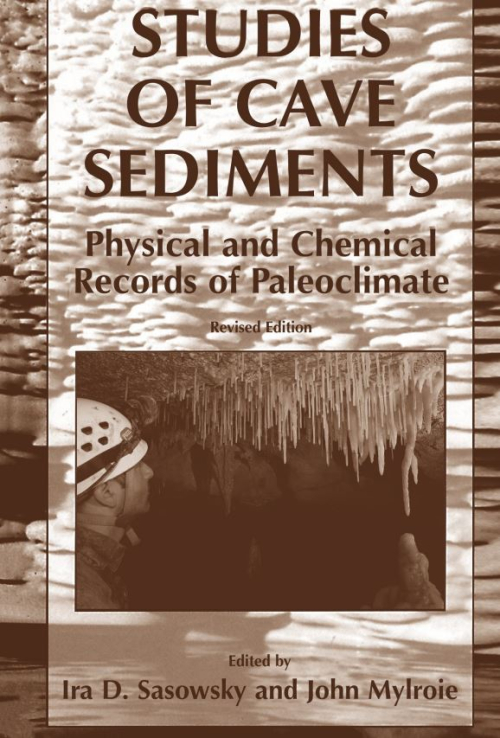
Издание 2
Редактор(ы):Mylroie J., Sasowsky I.D.
Издание:Springer, 2007 г., 331 стр., ISBN: 978-1-4020-5766-3
Язык(и)Английский
Studies of cave sediments. Physical and chemical records of paleoclimate / Изучение пещерного осадконакопления. Физические и химические свидетельства палеоклиматов

Caves occupy incongruous positions in both our culture and our science. The oldest records of modem human culture are the vivid cave paintings from southern France and northern Spain, which are in some cases more than 30,000 years old (Chauvet, et al, 1996). Yet, to call someone a "caveman" is to declare them primitive and ignorant. Caves, being cryptic and mysterious, occupied important roles in many cultures. For example, Greece, a country with abundant karst, had the oracle at Delphi and Hades the god of death working from caves. People are both drawn to and mortified by caves.

Редактор(ы):Смирнов В.И.
Издание:Недра, Москва, 1983 г., 290 стр.
Язык(и)Английский (перевод с русского)
Studies of mineral deposits / Курс рудных месторождений

This book is intended for mining engineers and geologists as well as for undergraduate and postgraduate students engaged in the study of mineral deposits.
Since the general conditions of mineral deposits formation and their genetic classification are considered in a special course, the principal problems of the ore formation theory are not discussed in this book. However, some special problems of :he ore formation theory are reviewed while dealing with the mineral deposits of individual metals.

Редактор(ы):Miccadei E., Piacentini T.
Издание:Intechopen, Риека, 2012 г., 294 стр., ISBN: 978-953-51-0361-5
Язык(и)Английский
Studies on environmental and applied geomorphology / Исследования по экологической и прикладной геоморфологии

This book includes several geomorphological studies up-to-date, incorporating different disciplines and methodologies, always focused on methods, tools and general issues of environmental and applied geomorphology. In designing the book the integration of multiple methodological fields (geomorphological mapping, remote sensing, meteorological and climate analysis, vegetation and biogeomorphological investigations, geographic information systems GIS, land management methods), study areas, countries and continents (Europe, America, Asia, Africa) are considered.

Contents:
Using Discrete Debris Accumulations to Help Interpret Upland Glaciation of the Younger Dryas in the British Isles
Biogeomorphologic Approaches to a Study of Hillslope Processes Using Non-Destructive Methods
Geomorphological Instability Triggered by Heavy Rainfall: Examples in the Abruzzi Region (Central Italy)
Environmental Changes in Lakes Catchments as a Trigger for Rapid Eutrophication - A Prespa Lake Case Study
Intervention of Human Activities on Geomorphological Evolution of Coastal Areas: Cases from Turkey
Spatial and Time Balancing Act: Coastal Geomorphology in View of Integrated Coastal Zone Management (ICZM)
Hydro-Geomorphic Classification and Potential Vegetation Mapping for Upper Mississippi River Bottomland Restoration
Anthropogenic Induced Geomorphological Change Along the Western Arabian Gulf Coast
Comparison of SRTM and ASTER Derived Digital Elevation Models over Two Regions in Ghana - Implications for Hydrological and Environmental Modeling
From Landscape Preservation to Landscape Governance: European Experiences with Sustainable Development of Protected Landscapes

Издание:CAE Mining Corporate Limited, 66 стр.
Studio 3. Data Presentation User Guide / Studio 3. Руководство пользователя по представлению данных

This document aims to provide an explanation of the key features within Studio 3 used for presenting electronic data.
A wide range of tools is available for the presentation of exploration, geological modeling and mine planning data. These tools can be grouped into the following categories:
• Plots Window: create plot sheets, insert plot items and print plots.
• Logs Window: create plot sheets, insert plot items and print log sheets.
• Visualizer Replay Files: save normal, animated or dated Visualizer window replay views.
Instructions and work process examples are used throughout this user guide to highlight various procedures. <...>

Издание:CAE Mining Corporate Limited, 37 стр.
Язык(и)Английский
Studio 3. Dynamic Anisotropy User Guide / Studio 3. Руководство пользователя по динамической анизотропии

This user guide describes the recommended method for using the dynamic anisotropy options in Studio 3. It includes examples and shows the advantages of using the method. <...>

Издание:CAE Mining Corporate Limited, 372 стр.
Язык(и)Английский
Studio 3. Geological Modeling User Guide / Студия 3. Руководство пользователя по геологическому моделированию

The data set used in the Creating Isoshells tutorial contains drillholes that are constrained by upper and lower wireframes. The wireframes are created by running a macro, and are used to define the extents of the isoshells that you create. <...>

Издание:CAE Mining Corporate Limited, 297 стр.
Язык(и)Английский
Studio 3. Grade Estimation User Guide / Студия 3. Руководство пользователя по оценке содержаний

This tutorial introduces you to the key Studio 3 features used for grade estimation. Typically 'grades' are estimated into the cells of a geological block model in order to generate a resource block model, which would then be used as input into the ore reserve optimisation or generation process of a mine planning cycle. Alternatively, 'grades' can estimated using panel (mining block) outlines and results saved to a results table, without creating a block model. <...>

1117.49