Добрый день, Коллеги. Важное сообщение, просьба принять участие. Музей Ферсмана ищет помощь для реставрационных работ в помещении. Подробности по ссылке

Поиск по книгам
Автор(ы):Gunther M.A., Pohl W.L.
Издание:Springer-Verlag, 1990 г., 9 стр.
Язык(и)Английский
The origin of Kibaran (late Mid-Proterozoic) tin, tungsten and gold quartz vein deposits in Central Africa: a fluid inclusions study / Происхождение кибаранских (поздне-среднепротерозойских) оловянных, вольфрамовых и золото-кварцевых жил в Центр. Африке

Composition and evolution of fluids depositing tin and tungsten ores in Kibaran quartz vein deposits allow the modelling of devolatizing evolved granites as their source at depth. Fluids forming gold quartz veins and breccias are different from the first, especially by showing characteristics of a high-pressure environment. All deposits are controlled by compressional deformation whose fading phases affect earlier formed veins. These findings lead to the conclusion that both anatectic melting resulting in intrusion of fertile granites, and the generation of fluids forming gold deposits are the final consequence of deep crustal metamorphism. The latter was caused by crustal thickening immediately preceding the metallogenetic climax. <...>

Издание:Elsevier, 2010 г., 16 стр.
Язык(и)Английский
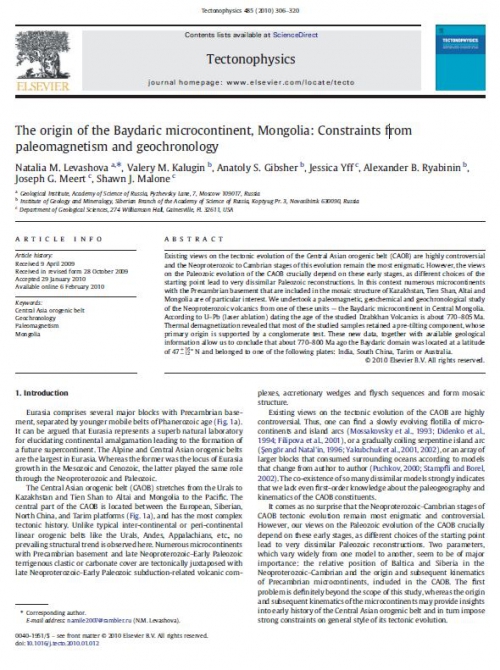
The origin of the Baydaric microcontinent, Mongolia: Constraints from paleomagnetism and geochronology

Existing views on the tectonic evolution of the Central Asian orogenic belt (CAOB) are highly controversial and the Neoproterozoic to Cambrian stages of this evolution remain the most enigmatic. However, the views on the Paleozoic evolution of the CAOB crucially depend on these early stages, as different choices of the starting point lead to very dissimilar Paleozoic reconstructions. In this context numerous microcontinents with the Precambrian basement that are included in the mosaic structure of Kazakhstan, Tien Shan, Altai and Mongolia are of particular interest. We undertook a paleomagnetic, geochemical and geochronological study of the Neoproterozoic volcanics from one of these units — the Baydaric microcontinent in Central Mongolia. According to U–Pb (laser ablation) dating the age of the studied Dzabkhan Volcanics is about 770–805 Ma. Thermal demagnetization revealed that most of the studied samples retained a pre-tilting component, whose primary origin is supported by a conglomerate test. These new data, together with available geological information allow us to conclude that about 770–800 Ma ago the Baydaric domain was located at a latitude of 47 (+16/-12)° N and belonged to one of the following plates: India, South China, Tarim or Australia.

Автор(ы):Sorokhtin N.O.
Издание:Wiley, 2019 г., 517 стр., ISBN: 978-1-119-59344-7
Язык(и)Английский
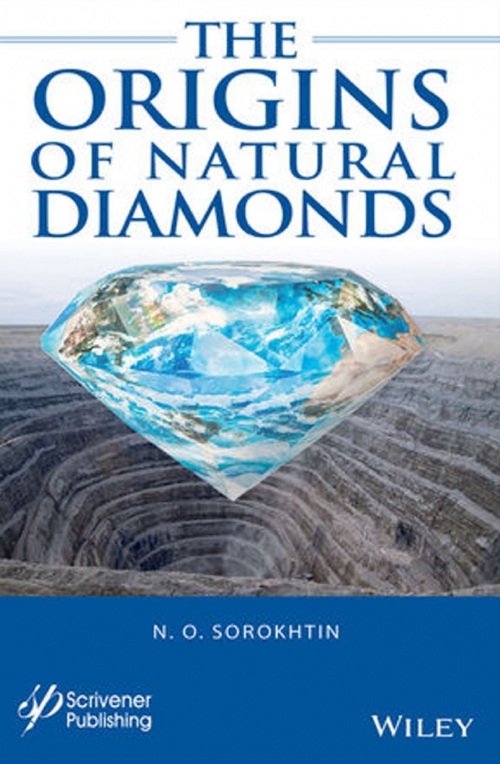
The origins of natural diamonds / Происхождение природных алмазов

Many scientists traditionally believe that the ore (and not only ore) matter of most endogenous economic minerals comes directly from the mantle or through the mantle matter differentiation and invasion of differentiated magmas in the crust together with water fluids rising from Earth’s depth. However, this assumption is right only in part as the entire matter of the continental crust, including ore elements, had been indeed released in the past from the mantle along with the other rock-forming oxides. In substance, however, this assumption is the “path of least resistance” as it allows us to hide our lack of knowledge of the real mechanisms of local crust enrichment with trace elements in a “black box” of the mantle and to substitute one complex problem with another one, no less complex. Indeed, the entire complexity of the classical approach to explaining the formation causes of local ore and other trace element accumulations in Earth’s crust is in that the concentration of most of them in the mantle is disappearingly low, whereas in commercial deposits it is relatively high and reaches sometimes top-cut grade value. For instance, gold and uranium concentration in the present-day mantle is on the order of 10-9; mercury and thorium 10-8; silver, tantalum, tungsten, platinum and lead 10-7; lithium, niobium, molybdenum and tin 10-6, etc., whereas in commercial deposits the concentration of these rare elements may rise to fractions and even whole percentages. <...>

ТематикаГеммология
МеткиАлмазы (211)
Издание:2005 г., 14 стр.
Язык(и)Английский
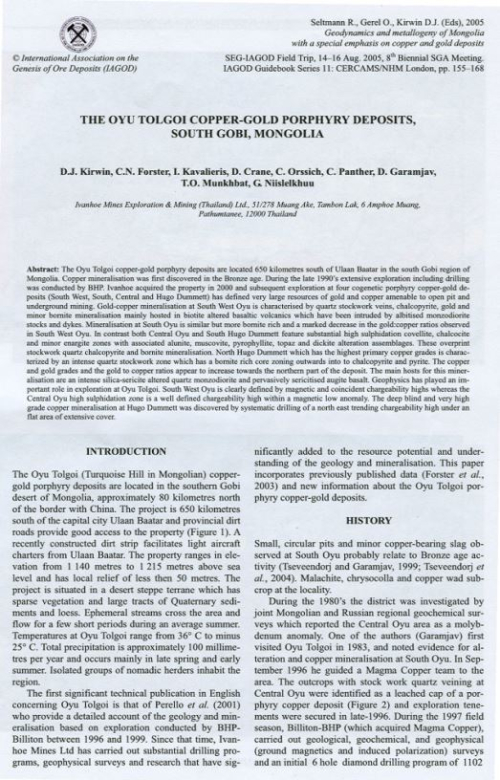
The Oyu Tolgoi copper-gold porphyry deposits, South Gobi, Mongolia / Медно-золотопорфировое месторождение Оюу-Толгой, Южное Гоби, Монголия

The Oyu Tolgoi copper-gold porphyry deposits arc located 6S0 kilometres south of Ulaan Baa tar in the south Gobi region of Mongolia. Copper mineralisation was first discovered in the Bronze age. During the late 1990’s extensive exploration including drilling was conducted by ВНР.

Автор(ы):Correa A., Hopper D.
Издание:PGS Publishing, Linden Park, 2002 г., 13 стр.
Язык(и)Английский
The Panulcillo and Teresa de Colmo copper deposits: two contrasting examples of fe-ox Cu-Au mineralization from the Coastal Cordillera of Chile

The Coastal Cordillera of Chile hosts several world-class FeOx CuAu deposits, including Candelaria, Mantos Blancos, Manto Verde, and El Soldado. Despite this comparatively little has been published on Chilean FeOx CuAu systems. This paper presents observations from two small Chilean FeOx CuAu deposits of Lower Cretaceous age; Panulcilio and Teresa de Colmo.

Panulcilio is a pseudo-stratiform FeOx CuAu / Skarn deposit located within the metamorphic aureole of a monzodioritic intrusive. Chalcopyrite, bornite, pyrite and pyrrhotite occur with calcic amphibole as disseminations and microveinlets in K-feldspar-albite-silica altered meta-andesites, magnetite-albite-scapolite rich mcta-andcsites and in overlying garnet skam.

Выпуск 15
Издание:Economic geology, 2010 г., 28 стр.
Язык(и)Английский
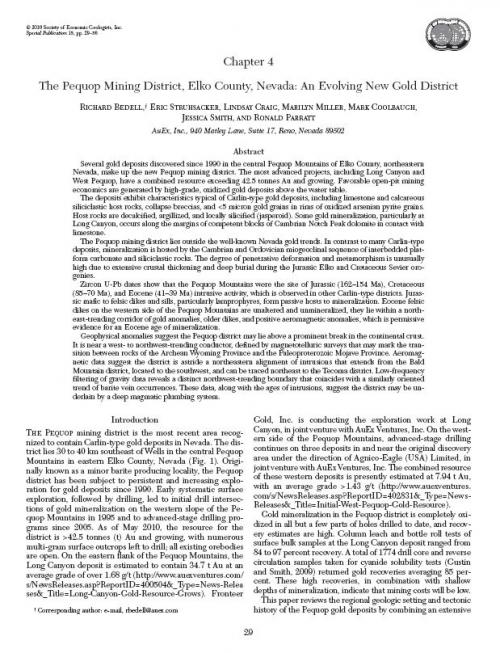
The Pequop Mining District, Elko County, Nevada: an evolving new gold district

Several gold deposits discovered since 1990 in the central Pequop Mountains of Elko County, northeastern Nevada, make up the new Pequop mining district. The most advanced projects, including Long Canyon and West Pequop, have a combined resource exceeding 42.5 tonnes Au and growing. Favorable open-pit mining economics are generated by high-grade, oxidized gold deposits above the water table.

The deposits exhibit characteristics typical of Carlin-type gold deposits, including limestone and calcareous siliciclastic host rocks, collapse breccias, and <5 micron gold grains in rims of oxidized arsenian pyrite grains. Host rocks are decalcified, argillized, and locally silicified (jasperoid). Some gold mineralization, particularly at Long Canyon, occurs along the margins of competent blocks of Cambrian Notch Peak dolomite in contact with limestone.


Издание:PGS Publishing, Linden Park, 2002 г., 9 стр.
Язык(и)Английский
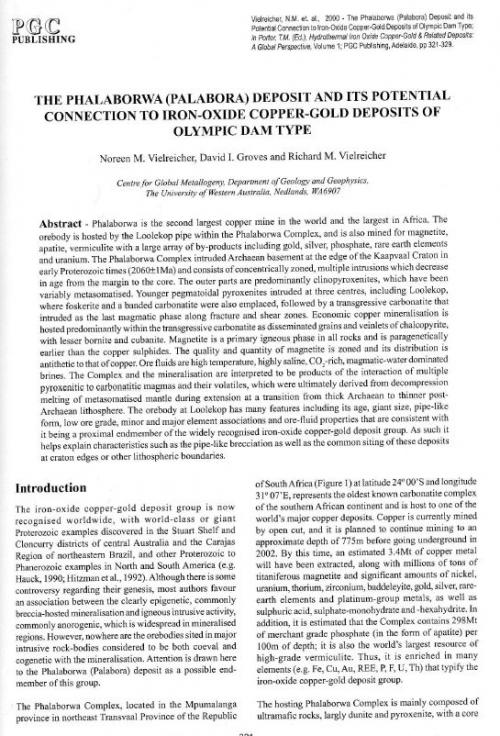
The Phalaborwa (Palabora) deposit and its potential connections to iron-oxide copper-gold depositsof Olympic Dam type / Месторождение Пхалабора (Palabora) и его потенциальная связь с железооксидными медно-золотыми месторождениями типа Олимпик Дам

Phalaborwa is the second largest copper mine in the world and the largest in Africa. The orebody is hosted by the Loolekop pipe within the Phalaborwa Complex, and is also mined for magnetite, apatite, vermiculite with a large array of by-products including gold, silver, phosphate, rare earth elements and uranium. The Phalaborwa Complex intruded Archaean basement at the edge of the Kaapvaal Craton in early Proterozoic times (2060±lMa) and consists of concentrically zoned, multiple intrusions which decrease in age from the margin to the core. The outer parts are predominantly clinopyroxenites, which have been variably metasomatised.

Редактор(ы):Adatte T., Atfy H.E., Hamimi Z., Khozyem H., Nader F.H., Oboh-Ikuenobe F., Zobaa M.K.
Издание:Springer, 2023 г., 747 стр., ISBN: 978-3-030-95636-3
Язык(и)Английский
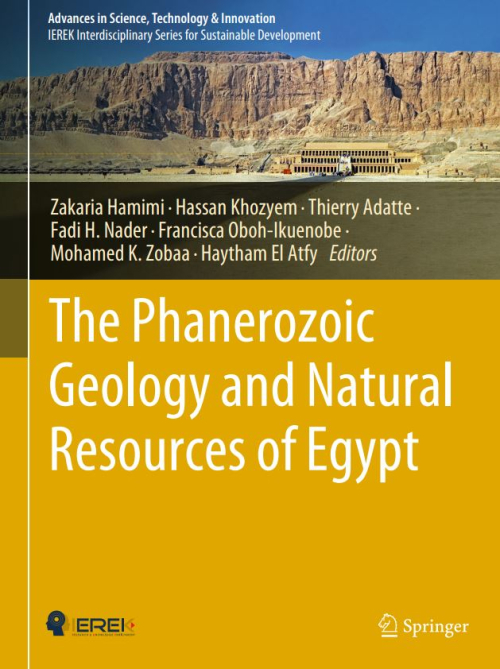
The phanerozoic geology and natural resources of Egypt / Геология фанерозоя и природные ресурсы Египта

Egypt is located in northeastern portion of Africa and extends into the Asian near East. It is susceptible to many local and global tectonic events with sea-level changes during deposition of the Phanerozoic sediments. The Paleozoic history of Egypt showed that the sediments were meagerly comparing with the Mesozoic and Cenozoic. The most important structures which had a great effect on the stratigraphy of Egypt stretched from the northern shores of Egypt to its extreme southern part.

1607.63