Добрый день, Коллеги. Важное сообщение, просьба принять участие. Музей Ферсмана ищет помощь для реставрационных работ в помещении. Подробности по ссылке

Поиск по книгам
Издание:Economic geology, 2016 г., 23 стр.
Язык(и)Английский
Trace element content of pyrite from the Kapai Slate, St. Ives Gold District, Western Australia / Содержание микроэлементов в пирите из сланца Капай, золотой район Сент-Айвз, Западная Австралия

The Kapai Slate is a continuous, pyrite-rich carbonaceous shale horizon within the St. Ives Au district that is spatially related to high-grade Au mineralization. In situ laser ablation-inductively coupled mass spectrometry (LA-ICPMS) trace element analyses, in situ sensitive high resolution ion microprobe, stable isotope (SHRIMPSI) S isotope analyses, and optical microscopy pyrite texture analyses were used to examine the different pyrite types in the Kapai Slate and Au deposits. These data were also used to confirm that the trace element signature of sedimentary pyrite can be preserved in rocks that underwent upper to mid-greenschist facies metamorphism and significant hydrothermal overprint. The data were further utilized to gain a more detailed understanding of the ocean conditions during deposition of the Kapai Slate and determine whether some of the Au and S in the St. Ives district could have been sourced from the Kapai Slate.

Редактор(ы):Naidu R., Prasad M.N.V., Sajwan K.S.
Издание:Taylor & Francis Group, 2006 г., 705 стр., ISBN: 1-56670-685-8
Язык(и)Английский
Trace elements in the environment. Biogeochemistry, biotechnology and bioremediation / Микроэлементы в окружающей среде. Биогеохимия, биотехнология и биоремедиация

Plant and soil form an integrated system. Technogenic contamination of soils with potentially toxic trace elements (PTE) are reflected in the functioning of plants and soil biota. Soil contamination by PTE has several implications for human health, as well as for the biosphere. Trace element “biogeogenic cycling” in the environment is an integral function of the ecosystem (aquatic, terrestrial, and atmospheric). Therefore, the aim of this collective work is to deal with the trace elements in the holistic environment, considering advancements in the state-of the-art analytical techniques, molecular biology, and contemporary biotechnology that enhance our knowledge of the behavior of trace elements in the biogeosphere and organismal levels, i.e., at the cellular and molecular levels. Various chapters of this book provide the background with appropriate examples to understanding the trace elements in the biogeosphere on bioavailability, biogeochemistry, biotechnology, bioremediation, and risk assessment. <...>

Редактор(ы):Aragon P.R., De Leon D.A.
Издание:Nova Science Publishers Inc, 2012 г., 169 стр., ISBN: 978-1-62081-401-7
Язык(и)Английский
Trace elements. Environmental sources, geochemictry and human health / Микроэлементы. Источники загрязнения окружающей среды, геохимия и здоровье человека

Chapter 1 A Study of Airborne Trace Elements in Belgrade Urban Area: Instrumental and Active Biomonitoring Approach M. Aničić, Z. Mijić, M. Kuzmanoski, A. Stojić, M. Tomašević, S. Rajšić and M. Tasić

Chapter 2 Flow Optosensing Applied to the Analysis of Trace Elements Antonio Ruiz-Medina and Eulogio J. Llorent-Martínez

Chapter 3 Trace Metals in Fruit and Vegetable and their Effects on Human Health Stefania Papa, Giovanni Bartoli and Antonietta Fioretto

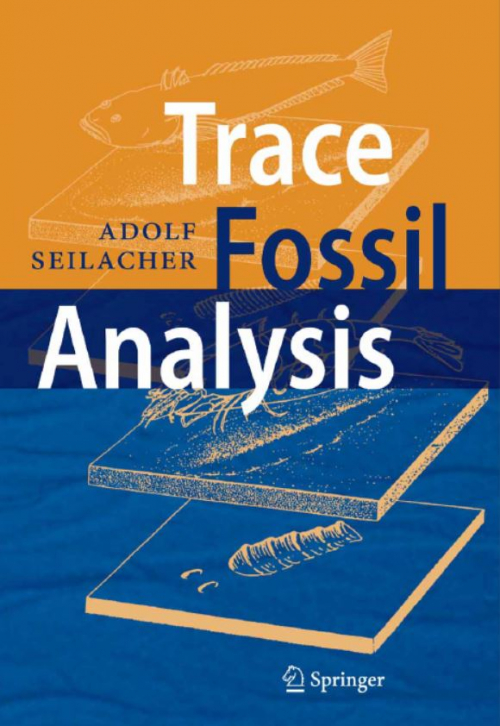
Автор(ы):Seilacher A.
Издание:Springer, 2007 г., 237 стр., ISBN: 978-3-540-47225-4
Язык(и)Английский
Trace fossil analysis / Анализ окаменелостей

This is a course book – meaning that it intends to confer not knowledge, but skill. The need for this skill becomes obvious if we look at the changing role of trace fossils during the last decades. From objects that were treated in standard paleontology textbooks, at best, under “Miscellanea”, together with problematica, coprolites and pseudofossils useless as index fossils, they have become subject of a special field, paleoichnology.

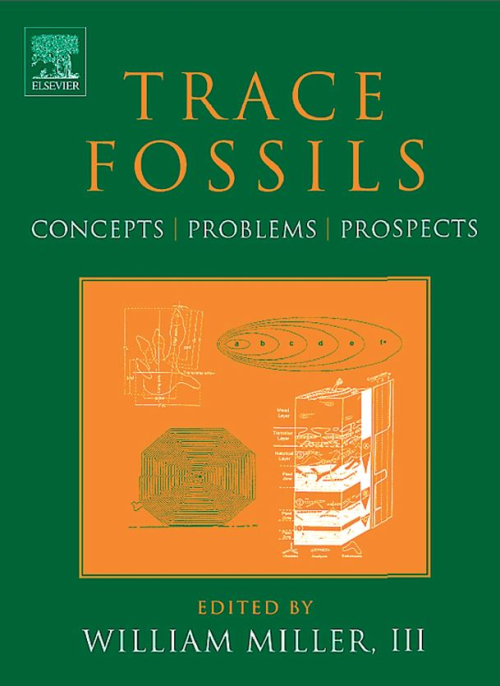
Редактор(ы):Miller W.
Издание:Elsevier, 2007 г., 636 стр.
Язык(и)Английский
Trace fossils. Concepts, problems, prospects / Следы окаменелостей. Концепции, проблемы, перспективы

We have been describing and attempting to interpret trace fossils, more or less effectively, for over a century. One could point to several times in the history of paleontology or sedimentary geology when ichnology, as a separate discipline, appears to take shape for the first time. This is largely a matter of when the various early practitioners were active. I will leave it to the historians of our discipline to nail down all the exact dates, key figures and origins of ideas. A concise historical sketch can be found in the introduction to Ekdale et al. (1984). It is clear from this brief account, and from the longer essay by Osgood (1975) and especially the excellent historical chapters that follow, that the origins of ichnology are varied but that the discipline takes on its modern methodologic and conceptual aspects in the 1950s and 1960s. In anglophone countries, this development is usually associated with a ‘founder’ (Dolf Seilacher, signaled especially by a series of extremely influential articles: e.g., 1953, 1962, 1964, 1967a,b) and a ‘founding document’ (Ha¨ntzschel, 1962, 1975)—at least for invertebrate ichnology. Vertebrate and plant trace fossil researchers would tell the story a bit differently (see the essays that follow). But most of the central concepts and methods start to circulate and become widely applied or discussed at about this time.


Редактор(ы):Cai M., Wang J., Yang G.
Издание:CRC Press, 2015 г., 822 стр., ISBN: 978-1-138-02730-5
Язык(и)Английский
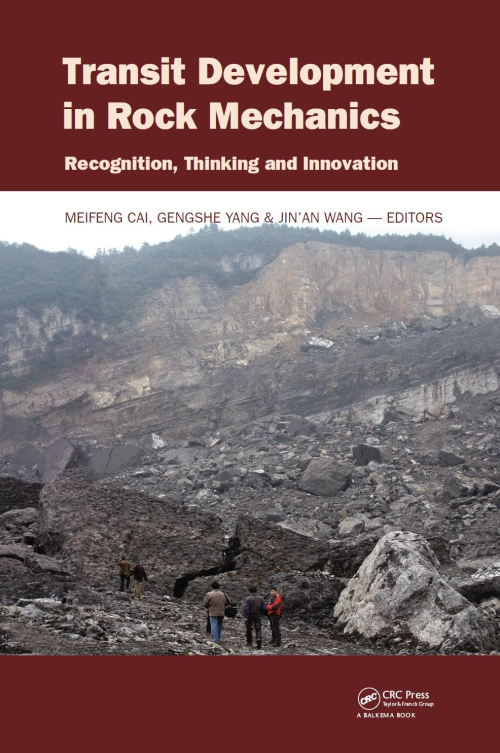
Transit development in rock mechanics. Recognition, thinking and innovation / Транзитное развитие в механике горных пород. Признание, мышление и инновации

This proceedings contain 150 papers accepted for The 3rd ISRM Young Scholars’ Symposium on Rock Mechanics, which was hold in November 8–10th, 2014, Xi’an, China. The Symposium is organized by the Commission on Education of International Society for Rock Mechanics and Xi’an University of Science and Technology, and sponsored by International Society for Rock Mechanics (ISRM) and Chinese Society for Rock Mechanics and Engineering (CSRME).

Автор(ы):McLaren A.C.
Редактор(ы):Liebermann R.C., Putnis A.
Издание:Cambridge University Press, New York, 1991 г., 387 стр., ISBN: 0-521-35098-0
Язык(и)Английский
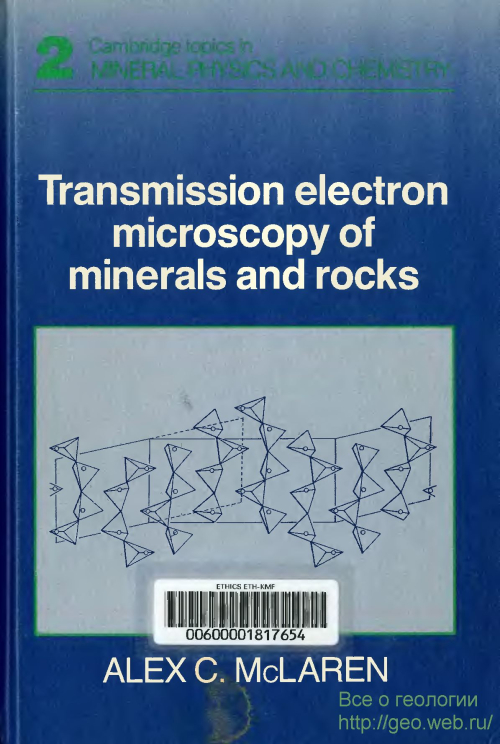
Transmission electron microscopy of minerals and rocks / Просвечивающая электронная микроскопия минералов и горных пород

Of the many techniques that have been applied to the study of crystal defects, probably no single technique has contributed more to our understanding of their nature, properties, and influence on the physical and chemical properties of crystalline materials than transmission electron microscopy (ТЕМ). Although the importance of crystal defects and the use of ТЕМ for their direct observation were recognized by physical metallurgists in the early 1950s, it was at least a decade later that earth scientists responded to many of the new ideas of the defect solid state and to the power of ТЕМ. However, ТЕМ is now used extensively for the direct observation of defect microstructures in minerals and rocks, and there appears to be an increasing number of earth scientists who want to use the technique or to become more familiar with the interpretation of ТЕМ observations. This book is written for such people. However, it makes no attempt to be a practical manual of ТЕМ or a definitive text, but rather an introduction to the basic principles of the technique and of the interpretation of electron micrographs and electron diffraction patterns. As such, I hope the book will also be useful to students of materials science.

Автор(ы):Schmidt S.T.
Издание:Springer, 2023 г., 286 стр., ISBN: 978-3-031-19611-9
Язык(и)Английский
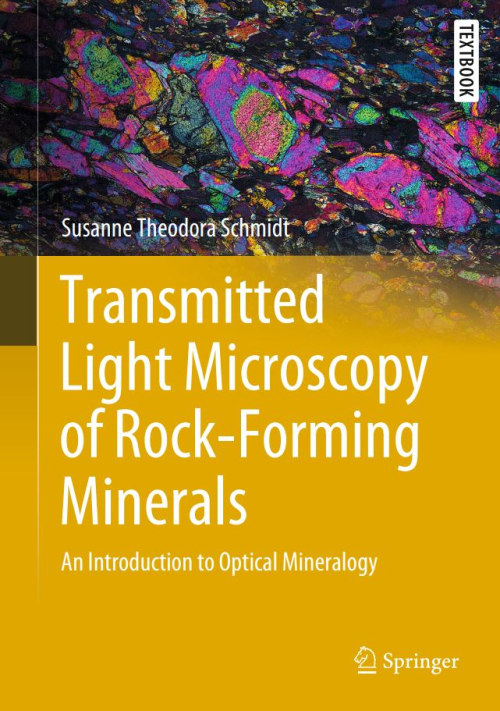
Transmitted light microscopy of rock-forming minerals. An introduction to optical mineralogy / Микроскопия породообразующих минералов в проходящем свете. Введение в оптическую минералогию

I am indebted to many colleagues and former students for valuable suggestions and discussions and for having provided thin sections or images. I thank PD Dr. Afifé El Kohr (University of Fribourg) for reading all chapters and suggesting important improvements in the text and the figures. I thank Dr. Florence Bégué (University of Geneva) for reading and improving remarks on various chapters. Special thanks for commenting on various drafts are due to Prof. Richard Bevins (Natural Museum of Wales), Sam Carmalt (University of Geneva), Dr. William Cannon (US Geological Survey), and Dr. Kenneth M. Towe (Smithonian Institute, Washington).

Издание:5 стр.
Язык(и)Английский
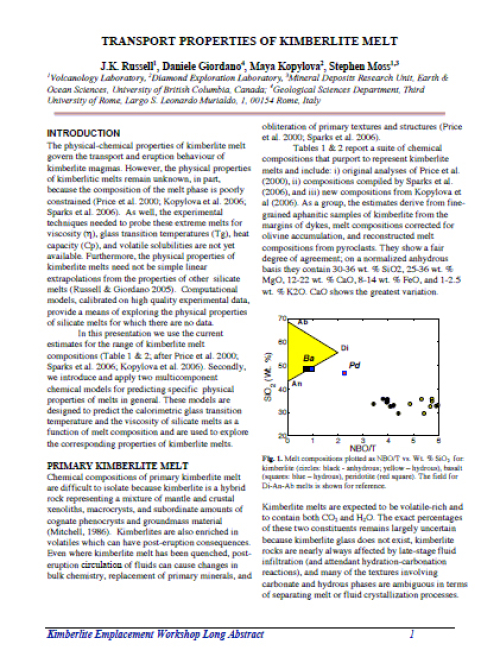
Transport properites of kimberlite melt / Транспортные свойства кимберлитового расплава


The physical-chemical properties of kimberlite melt govern the transport and eruption behaviour of kimberlite magmas. However, the physical properties of kimberlitic melts remain unknown, in part, because the composition of the melt phase is poorly constrained (Price et al. 2000; Kopylova et al. 2006; Sparks et al. 2006). As well, the experimental techniques needed to probe these extreme melts for viscosity (!), glass transition temperatures (Tg), heat capacity (Cp), and volatile solubilities are not yet available. Furthermore, the physical properties of kimberlite melts need not be simple linear extrapolations from the properties of other silicate melts (Russell & Giordano 2005). Computational models, calibrated on high quality experimental data, provide a means of exploring the physical properties of silicate melts for which there are no data.

In this presentation we use the current estimates for the range of kimberlite melt compositions (Table 1 & 2; after Price et al. 2000; Sparks et al. 2006; Kopylova et al. 2006). Secondly, we introduce and apply two multicomponent chemical models for predicting specific physical properties of melts in general. These models are designed to predict the calorimetric glass transition temperature and the viscosity of silicate melts as a function of melt composition and are used to explore the corresponding properties of kimberlite melts.

1253