Добрый день, Коллеги. Важное сообщение, просьба принять участие. Музей Ферсмана ищет помощь для реставрационных работ в помещении. Подробности по ссылке
The uranium minerals that today are at the centre of worldwide attention were unknown until 1780, when Wagsfort found a pitchblende sample in 10hanngeorgenstadt. This discovery passed unnoticed, however, since Wags fort thought that it contained a black species of a zinc mineral-hence the n':lme 'pitchblende' (= pitch-like blende). Seven years later, Klaproth, while examining the mineral, noted that it contained an oxide of an unknown metal, which he called 'uranium' in honour of the planet Uranus, recently discovered by Herschel. Klaproth also believed that he had separated the metal, but, in fact, the attempt failed, and uranium, given its strong affinity with oxygen, was not separated until several years later. In 1833 Arfwedson attempted the separation and, in so doing, reduced the pitchblende. His attempt was not successful and only U02 was obtained. It was Peligot, in 1840, who was finally successful. He managed the reduction of the metal working with metallic potassium. It should be remembered that twelve years earlier Berzelius had isolated thorium.
In 1983 the Nuclear Energy Agency of the Organisation for Economic Cooperation and Development (OECD/NEA) and the IAEA jointly published a book on Uranium Extraction Technology. A primary objective of this report was to document the significant technological developments that took place during the 1970s. The purpose of this present publication is to update and expand the original book.
The Asian continent is the main part of the greatest continental plate—Eurasian plate, on the Earth. The Asian continent covers the tremendous area and has a very long geological history, complex intraplate deformations, a lot of mineral resources and the changeable ecologic environment. Researching the Asian tectonics, which plays a dominant role in the resources and environments, is an interesting subject. With the rapid development of society and economy, it is becoming more and more important, interesting and urgent to re-recognize and understand the relationship between the Asia tectonic evolution and giant ore deposit (including giant or supergiant ore fields and provinces) from the perspective of lithospheric plate tectonics.
Copper is most commonly present in the earth’s crust as coppereironesulfide and copper sulfide minerals, such as chalcopyrite (CuFeS2) and chalcocite (Cu2S). The concentration of these minerals in an ore body is low. Typical copper ores contain from 0.5% Cu (open pit mines, Fig. 1.1) to 1 or 2% Cu (underground mines). Pure copper metal is mostly produced from these ores by concentration, smelting, and refining (Fig. 1.2). Copper also occurs to a lesser extent in oxidized minerals (carbonates, oxides, hydroxy-silicates, sulfates). Copper metal is usually produced from these minerals by leaching, solvent extraction, and electrowinning (Fig. 1.3). These processes are also used to treat chalcocite (Cu2S). A third major source of copper is scrap copper and copper alloys. Production of copper from recycled used objects is 10 or 15% of mine production. In addition, there is considerable re-melting/re-refining of scrap generated during fabrication and manufacture. Total copper production in 2010 (mined and from end-of-use scrap) was ~20 million tonnes. <...>
This book describes extraction of nickel, cobalt and platinum-group metals. The starting point is ore-in-place and the finishing point is high-purity metals and chemicals. We have combined the description of these metals in one book because they very often occur together, are extracted together and have similar properties. The objectives of the book are to:
(a) describe how these metals occur and are extracted; (b) explain why these extraction processes have been chosen; (c) indicate how the processes can be operated most efficiently, with minimal impact on the environment; and, (d) suggest future improvements.
As explained in Preface, this book is a selfcontained member of a broader knowledge system on the world's mineral deposits and their settings I have been developing and experimenting with for more than 40 years. It is a product of global firsthand information gathering in the field and "data mining" from the literature, followed by sorting and organization into interrelated sets searchable and accessible by the rapidly evolving techniques of modern information technology.
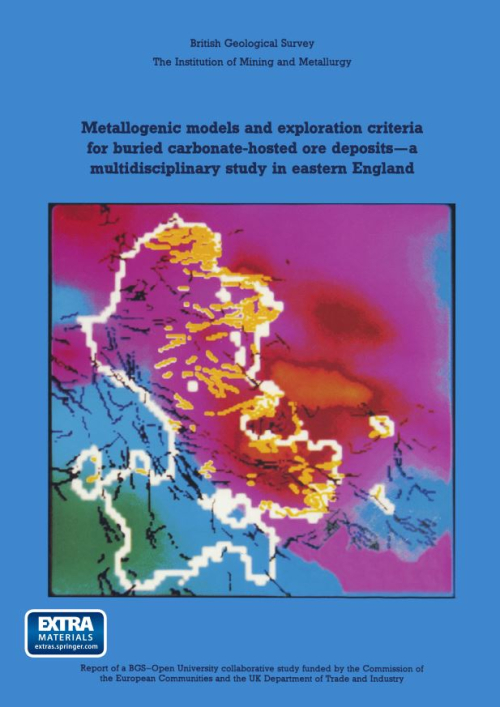
The report that follows presents a first statement of the results of a study sponsored by the European Economic Community and the Department of Trade and Industry as communicated to a meeting of the Institution of Mining and Metallurgy Midlands Section at which the President (Dr A. J. Robinson) and the Section Chairman (Professor N. A. Warner) were present. It was my privilege to attend and to make some concluding remarks; these form the basis of this preface. The Geological Survey, now in its 154th year, has as one of its principal objects the provision of geological maps based on surveying in maximum detail at a scale of 1:10 000. In areas where extractive or other engineering industry is important, the surveys have been revised more than once as new subsurface data became available.
The aim of this book is to summarize the current state of knowledge on the environmental geochemistry and resource potential of metallurgical slags. Hundreds of millions of tonnes of slag, a by-product of pyrometallurgical processing of ferrous and non-ferrous ores or recyclable materials, are generated annually worldwide. These slags are either landfilled, reprocessed, or repurposed.