Добрый день, Коллеги. Важное сообщение, просьба принять участие. Музей Ферсмана ищет помощь для реставрационных работ в помещении. Подробности по ссылке
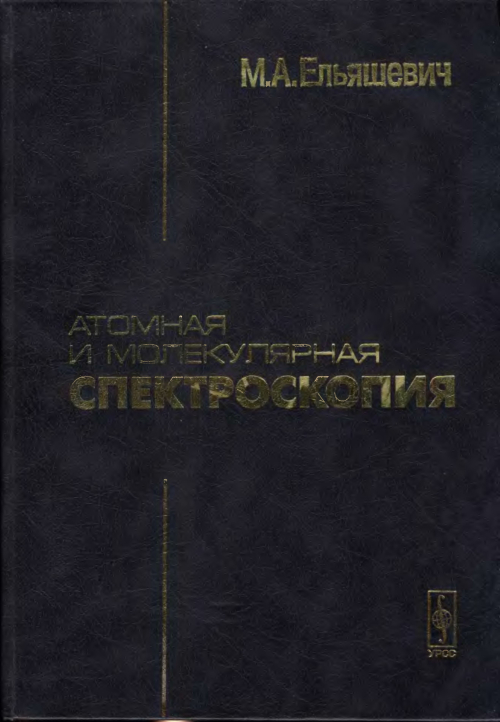
Книга содержит последовательное изложение систематики атомных и молекулярных спектров. В первой части рассматриваются общие вопросы спектроскопии, во второй — вопросы атомной спектроскопии и в третьей — вопросы молекулярной спектроскопии. Книга рассчитана на спектроскопистов и специалистов смежных специальностей — научных работников, инженеров, студентов старших курсов.
When using infrared spectroscopy for the study of minerals, researchers often face a number of specific difficulties. This may be due to various factors, including lack of available substance, small sizes of monomineral grains and aggregates, the presence of structural impurities and mechanical inclusions, instability of some minerals, scattering effects, atmospheric disturbance, background noice, anomalous dispersion, interference, etc. One can distinguish three kinds of sources of errors and artifacts in IR spectroscopy of minerals, which are connected with experimental procedures, data proceeding and data interpretation <...>
Over the past two decades, many curriculum changes have occurred in geology, Earth science, and environmental science programs in universities. Many of these have involved the compression of separate one-semester courses in mineralogy, optical mineralogy, and petrology into a single-semester offering that combines mineralogy and petrology, commonly called Earth Materials.
The title of the short course reads "Natural Zeolites"; however, the subject matter treated in the course and reviewed here deals primarily with those zeolites that occur in sedimentary rocks and which have formed by authigenic or burial diagenetic processes. Unfortunately, only limited coverage has been given to the classical occurrences of zeolites--the megascopic crystals in the vugs and cavities of basalts and other basic igneous rocks. Our only justification is that since the late 1950s, almost all major efforts on zeol ites have been directed towards the "sedimentary" occurrences, and it is these occurrences of zeolites in sedimentary rocks that are still unfamiliar to many geologists and mineralogists. It is our intention that this short course and these notes will playa small role in alleviating this unfamiliarity. <...>
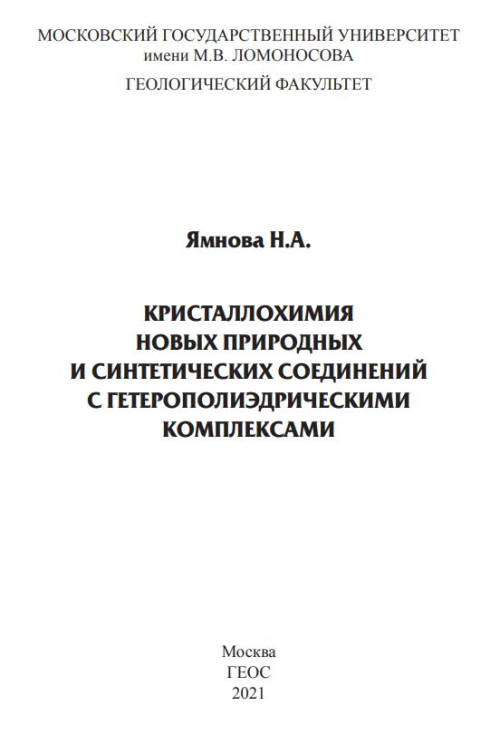
В монографии собраны, обобщены и систематизированы новые данные по структурам природных и синтетических соединений, относящихся к классам силикатов, боратов, карбонатов, карбонатоборатов, сложных оксидов и оксофосфатов. Представлены полученные с участием автора результаты структурных определений 19 синтетических и 32 природных (среди которых открыто 16 новых минеральных видов) соединений.
Sulfur is the fifteenth most abundant element in the continental crust of the Earth (260 ppm), and the sixth most abundant element in seawater (885 ppm). Sulfur (atomic number 16) has the ground-state electronic structure [Ne]3/V, and is the first of the group VIB elements in the periodic table (S, Se, Te, Po). In minerals, sulfur can occur in the formal valence states S S°, S4+, and S6+, corresponding to the sulfide minerals, native sulfur, the sulfite minerals, and the sulfate minerals. In the sulfide minerals, S2~ functions as a simple anion (e.g. CuFeS2, chalcopyrite) and as a compound S2 anion (e.g. FeS2, pyrite). In the sulfosalts, S2~ functions as a component of a complex anion (e.g. ASS3 in tennantite, CU12AS4S13).
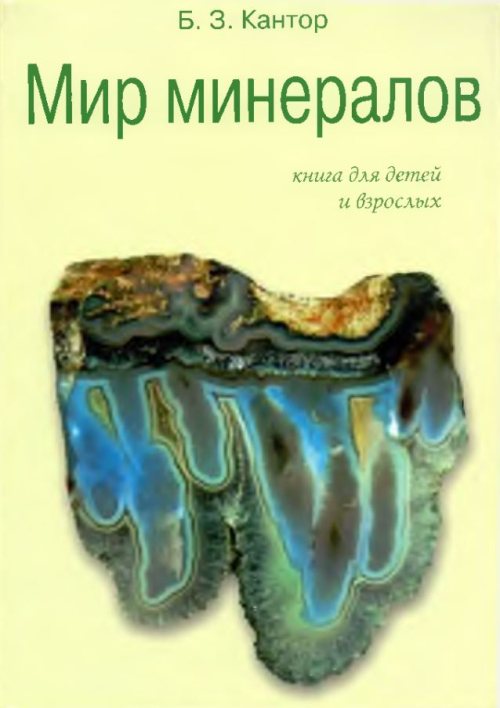
В книге увлекательно и образно рассказывается о минералах - «кирпичиках» твердой оболочки Земли. Несмотря на небольшой объем книга содержит не только важнейшие факты минералогии, но и множество интереснейших сведений из жизни минералов, истории их открытия и их роли в жизни людей. Книга рассчитана «а широкий круг читателей и, особенно, на молодежь.
В монографии изложены результаты минералого-геохимического изучения вольфрамовых, олово-вольфрамовых и молибден-вольфрамовых месторождений Монголии, на примере которых рассматривается ряд общих вопросов рудообра-зования таких, как связь оруденения с различными геохимическими типами гранитов, физико-химические параметры образования рудных ассоциаций, условия и факторы концентрации рудных элементов в гидротермальном процессе. Книга рассчитана на широкий круг геологов, минералогов и геохимиков, занимающихся изучением рудных месторождений
Представлены краткие статьи по материалам докладов Всероссийского ежегодного семинара по экспериментальной минералогии, петрологии и геохимии 2024 года с описанием результатов оригинальных научных исследований, новых методов и идей, ориентированных на практическое решение широкого спектра проблем современной экспериментальной геохимии
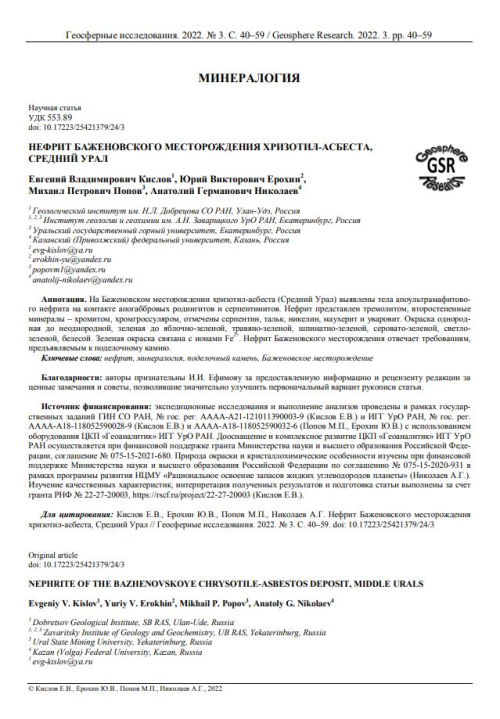
In the Bazhenovskoye chrysotile–asbestos deposit (Middle Urals), nephrite bodies of the serpentinite type were found on the contact of after gabbro rodingites and serpentinites. The color is uniform to non-uniform, green to light green, bluish green, greyish green, and whitish. Spots, streaks, lenticules of bright bluish-green or, on the contrary, light green color are sometimes noted.